While London was in the NICU, I listened to Coldplay’s Ghost Stories religiously. I spent a lot of time meditating on one refrain in a particular song called “Magic.” The lyrics read:
And if you were to ask me
After all that we’ve been through
“Still believe in magic?”
Well yes, I do
Oh yes, I do
Oh yes, I do
Oh yes, I do
Of course I do
Although when I thought about the lyrics, I would replace the word “magic” with the word “prayer.” And I would ask myself over and over again, “Still believe in prayer?” With all my heart I wanted to answer with an earnest, “Yes,” and for a while I did not have an answer.
Why couldn’t I find that earnest “Yes”? I thought about that every day while London was in the hospital and nearly every day since. After all that thinking, I am able to point to a number of reasons.
I have written on here before that not all NICU stories have happy endings. It may come as no surprise, but while we were in the NICU we were witnesses to some sad stories. Within two weeks of London’s birth, the baby in the next pod over died. I remember hearing some of the father’s last words to his daughter and then needing to step behind our curtain because I couldn’t hold back tears.
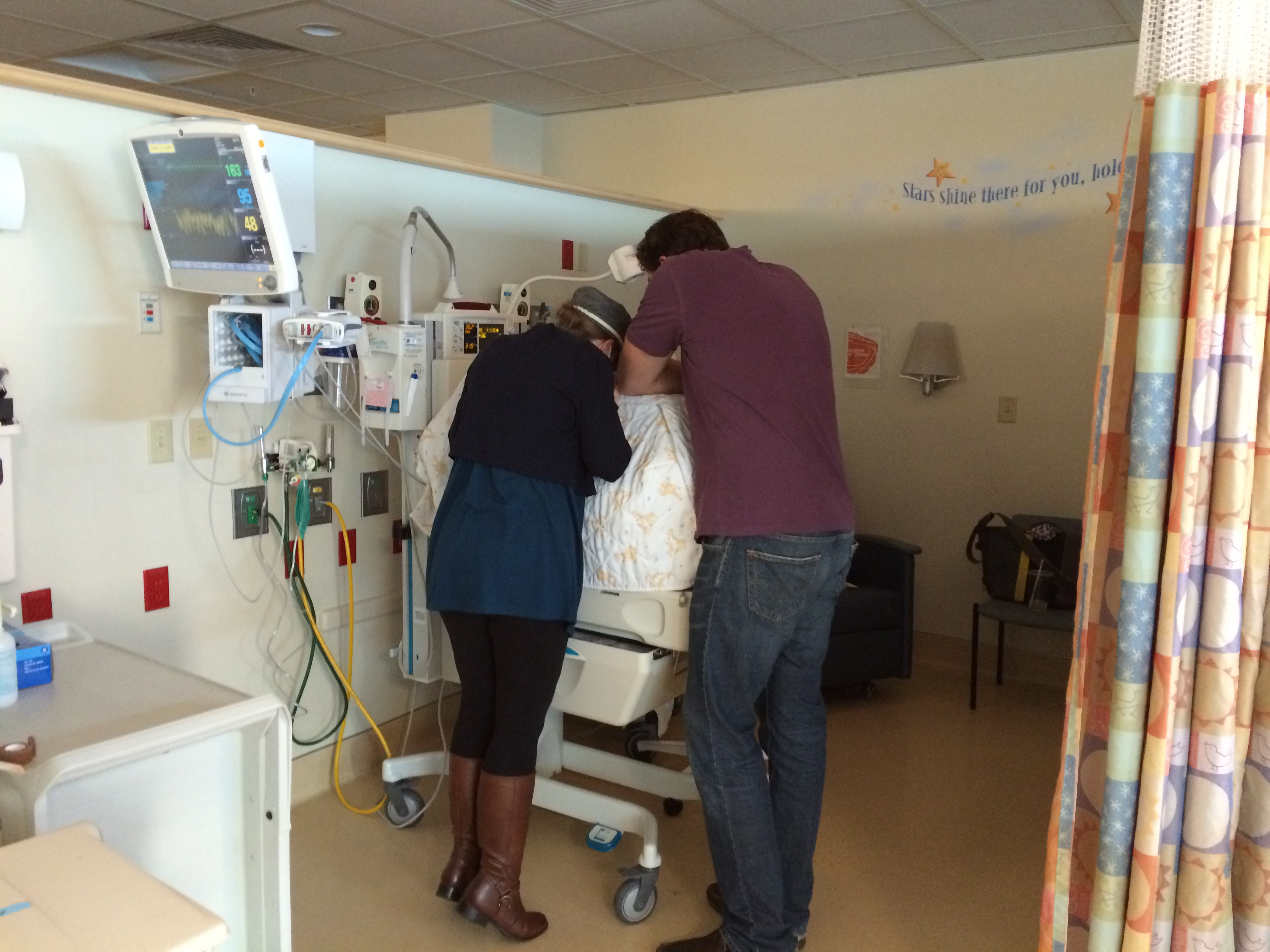
Praying over London. What else?
Throughout London’s NICU experience we had a tremendous number of people praying for her. We were praying for her. And when we would receive good news concerning London’s health, people would be quick to thank Jesus.
I know there were people praying for that baby next-door. But when she died, I don’t know if people were talking about how much they prayed for her. When prayers are answered, people are quick to heap praise on God, but all too often God doesn’t enter the conversation when prayers aren’t answered. There is just a deep sense of loss (in the case mentioned above, loss of a child) and betrayal.
It is the absence of God in conversation following something like a loss of a child, whose survival was clearly being prayed for, that really grates across my soul. And as I let it grate more and more on me, doubt about the fate of my own child crept into my thoughts. Doubt about the ability of prayer to reduce swelling in London’s brain. Doubt about the ability of prayer to make one medication work better than the next. Doubt about the ability of prayer to make London’s lungs flourish.
Yet, I prayed, even though what I had seen in the NICU was doing its best to give me a cynical attitude toward God’s ability to give my daughter a fighting chance. But as I stood next to Kate and watched London seize up, turn blue from head to toe, and watched a team of doctors rush over to her bedside, prayer was the only thing I could hold onto despite clinging to Kate. I desperately prayed over and over, “Don’t let my daughter die.”
Again and again, I was exposed to suffering. Much of the time it was parental suffering, the kind you would expect parents to go through when their baby weighs two pounds. And, at times, it was the raw exposure to parents suffering the death of a newborn, as mentioned above.
In a new way, I was becoming aware of the fragility of my own faith. I had reached the bottom of my soul and I had expected to bounce back and come out better than ever, but I had gone crashing through it, revealing new limits to understanding and faith. This surprised me because I had not lost anyone. Many people endure far worse before they reach the point I reached. However we get there though, we often discover the same thing:
…Suffering gives people a more accurate sense of their own limitations, what they can control and cannot control. When people are thrust down into these deeper zones, they are forced to confront the fact they can’t determine what goes on there.
Lack of control. I had felt it before in my life, but not to this degree so it was easy to say, well, if I don’t have control, and the nurses don’t have control, and the doctors with all their tricks and knowledge don’t have control, then nothing can have control over this.
But doubt is a two-way street. As I doubted in prayer’s ability to heal every last weak and broken thing in my daughter’s body, I also doubted my newfound doubt. I didn’t know for sure that prayer didn’t work. I have prayed all my life for all sorts of things. Some prayers were answered. Some were not. A voice in my head kept saying, why stop now? Because I was afraid, afraid of not having this prayer answered exactly the way I wanted it to be answered. That felt really selfish. It is selfish. But I had prayed this long, I wasn’t going to stop when it came to praying for my daughter’s health.
I guess what tragedy does to you, or, in our case, what a really long stay in the NICU can do to you, is to remind you, just in case you have forgotten, that you are not in control. You never were, despite how good things were going for you. And, you never will be. I felt like this left me with two options. One, surrender to God and put my faith in him because I have discovered how little control (read none) all of us have. Or two, abandon the idea of a God who hears our prayers and can intervene to answer them.
Days, weeks, months, and eventually a year passed, during which God eliminated option two. I had just kept praying. I would often express to God that I really don’t know if you (God) can help with this, because there are many more people in this world that need more help than my daughter does, but somewhere along the way, can you do this one thing for my daughter? Again and again, the answer has been yes. I don’t know why, exactly, my prayers have been answered while the prayers of others had clearly not been. That’s part of the mystery. Part of the faith. I don’t have the answers. But for me, one answer had changed.
It was over a year after London came home from the hospital when I was again listening to Coldplay’s “Magic” and thinking about it all–faith, mysterious, confusing faith, love, my daughter, who I know is a miracle, and my little family–when I finally could sing the end of the song and mean it.
After all that we’ve been through
“Still believe in prayer?”
Well yes, I do
Oh yes, I do
Oh yes, I do
Oh yes, I do
Of course I do
*Block quote about suffering is from David Brooks’ column in the NY Times, “What Suffering Does.”
 ok. That’s what I did and I am ever thankful for it, for if I knew Gilmore’s fate there would be no suspense to carry me through to the last page.
 the FoCo dad