“Do you get to stay home with mommy?”

For over a year now I have been telling people that I stay at home with my daughter. Response to this news falls into two categories.

First response: dismay, followed by an awkward pause in the conversation while IMG_6356recipient of the news digests what I have told them. Their inability to register that there are such people as stay-at-home dads (SAHDs) is obvious on their face and the direction in which the conversation now moves. They typically switch the topic, pointing out London’s cute outfit or smile, etc.

I get this response mostly from older generations. Just the other night after a meal out, I was standing outside of the restaurant holding London. An older woman started talking to us. She was admiring London. The conversation was going well. I love talking with strangers who want to hear about London. Staring at London, the woman asked her, “Do you get to stay home with mommy?”

“No, she gets to stay home with me,” I said it as proudly and happily as possible and looked at her for a reaction. I saw it. A band of confusion moved across her face like a TVs signal being interrupted. God bless her, she tried to recover, but it sure seemed like she had never met a stay-at-home dad before. I also get the feeling that these people assume my role as a SAHD is strictly temporary.

Second response: surprise (but not as much as the people in the first response), excitement, support, and curiosity about meeting a SAHD. Usually these people immediately tell me how awesome it is that I stay at home with my daughter. They tell me that I am doing a great thing. Unlike the first group, people who give me the second response do not assume I dislike this job or am just doing it for a short period of time. Not surprisingly, people in this group are younger and, because of their response, much better to talk to after the SAHD genie is out of the bottle.

Consider this a public service announcement. When you meet a SAHD today, next week, next year, or whenever, give them the second response. You might make their day and make a new friend.

The Next Book For London

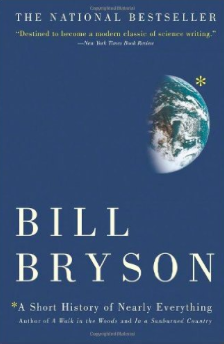
The next book I read to London has impossibly big shoes to fill. What can knock Screen Shot 2015-08-11 at 4.39.35 PM4,100 pages of Harry Potter off the top? Well, it isn’t Bill Bryson’s A Short History of Nearly Everything or ASHONE for short. That’s right, I went full nonfiction science writing for the next book. I needed a change of pace and I am quite sure London won’t notice, except for the expanded vocabulary in Bryson’s work compared to HP.

I love Bill Bryson’s writing. Somehow I had owned ASHONE for ten years and had never read it. London and I cracked open the book a couple of weeks ago, validating my purchase of this book in a Borders (remember them?) in Longmont, Colorado all those years ago. We are only a hundred pages in, but I’ve found that I am not enjoying this as much as his travel writing. There just aren’t as many opportunities in science writing for Bryson to add his signature humor. That said, it’s still an excellent book. Bryson makes the hardest of subjects accessible by writing about them in the common tongue.

One of my favorite passages early on in the book is from chapter two:

…it isn’t possible, in any practical terms, to draw the solar system to scale. Even if you added lots of fold-out pages to your textbooks or used a really long sheet of poster paper, you wouldn’t come close. On a diagram of the solar system to scale, with Earth reduced to about the diameter of a pea, Jupiter would be over a thousand feet away and Pluto would be a mile and a half distant (and about the size of a bacterium, so you wouldn’t be able to see it anyway). On the same scale, Proxima Centauri, our nearest star, would be almost ten thousand miles away. Even if you shrank down everything so that Jupiter was as small as the period at the end of this sentence, and Pluto was no bigger than a molecule, Pluto would still be over thirty-five feet away.

I absolutely love reading about how huge space is. And this is just our solar system.

I always think about God when I think of space, its scale, its never-ending mysteries, because for me, space has always been one of those things in which I see the presence and power of God. Pure awe.

I’m looking forward to the rest of this no-longer-dusty Bryson book.

DVDs $1, Stories Are Free

This house and its occupants are prepping for a garage sale this week. London’s help is extremely limited to nonexistent. She takes a long time examining every little thing we hand her, so she won’t be determining what we are getting rid of and what we are saving. She is most helpful when she decides to take a long morning nap on a Sunday so we can dig through the basement for potential hot ticket items.

We found lots of things to sell yesterday and just as much to throw away or donate. I discovered I had three copies of Goodfellas. (Hey, if there’s one movie to own several copies of it’s that one.) I have a DVD player to sell, but I can’t seem to locate the power cord or the remote. I am finally going to sell my Star Wars Pepsi can collection from one movie, which was both the most anticipated movie of all time and the most disappointing movie of all time, The Phantom Menace. But this can collection? Pristine. Complete. It represents a lot of work. It represents a lot of soda drinking.

For some reason I still had the majority of my class notes from the University of Wyoming. I chucked them all, but kept a few stories to possibly share on here. I threw out two boxes of old New Yorkers, magazines I had been saving because there was at least one tantalizing article in each magazine. I had lofty visions of getting to all of them some day, but having so many magazines and books I want to read around the house can really stress me out. It almost leads to less reading because I see the stacks everywhere and just think, I’ll never make it, why start now?

So, to those stories. I’m going to close this post with one. Please note, these are not my words. It was an assignment in an undergrad writing class for which you had to use a minimum number of sources to build one story or essay using nothing but quotes, a literary collage. And, here it is…

What I recall isn’t pain but a sense of jarring reversal, as of all motion, sound, and light encountering their massive opposites. I felt grass and dirt against my cheek, and sorrow that Dad was shot, and confusion that I couldn’t reach him. (1)

As I saw the last blue line of my native land fade away like a cloud in the horizon, it seemed as if I had closed one volume of the world and its concerns, and had time for meditation before I opened another. (2)

I shut my eyes, the old morte settled its grip, and the next country gathered itself under my feet. (1)

The grey rain-curtain turned all to silver glass and was rolled back, and he beheld white shores and beyond them a far green country under a swift sunrise. (3)

I waded ashore with measureless relief. The bank was an even slope of waving knee-high grasses and I came up into them and turned to look back. It was a wide river, mistakable for a lake or even an ocean unless you’d been wading and knew its current. Somehow I’d crossed it and somehow was unsurprised at having done so. (1)

There came into view a man, or so it seemed. (4) He had a blue coat and a long brown beard; his eyes were blue and bright, and his face was red as a ripe apple, but creased into a hundred wrinkles of laughter. In his hands he carried on a large leaf as on a tray a small pile of white water-lilies. (4)

“This is what we all find when we reach this country. We’ve all been wrong! That’s the great joke. There’s no need to go on pretending one was right! After that we begin living.” (5)

The words uttered by the person without, affected me as somewhat singular, but what chiefly rendered them remarkable was the tone that accompanied them. It was wholly new. I cannot pretend to communicate the impression that was made upon me by these accents or to detect the degree in which force and sweetness were blended in them. They were articulated with a distinctness that was unexampled in my experience. But this was not all. (6)

“We do not want you to become lazy, but to imitate those who through faith and patience inherit what has been promised.” (7)

It (the words) imparted to me an emotion altogether involuntary and uncontrollable. When he uttered the words my heart overflowed with sympathy and my eyes with unbidden tears. (6)

He sat down on a rock and swung his feet in a stream–it was deep and swift; it would take him in a moment. I seized his arm. Please, I said. Soon, he replied, which makes better sense under the rules of that country than ours. Very soon! he added, clasping my hands; then unable to keep from laughing, he pushed off from the rock like a boy going for the first cold swim of spring; and the current got him. (1)

Is there a single person on whom I can press belief? No sir. All I can do is say, Here’s how it went. Here’s what I saw. I’ve been there and am going back. Make of it what you will. (1)


Sources:

(1) Enger, Leif. Peace Like a River. Atlantic Monthly: New York, 2001.

(2) Irving, Washington. The Legend of Sleepy Hollow and Other Stories. Penguin: New York, 1978.

(3) Tolkien, J.R.R. Return of the King. Houghton Mifflin: Boston, 1955.

(4) Tolkien, J.R.R. The Fellowship of the Ring. Houghton Mifflin: Boston, 1954.

(5) Lewis, C.S. The Great Divorce. Harper: San Francisco, 1946.

(6) Brown, Charles Brockden. Wieland. Oxford: New York, 1994.

(7) Hebrews 6:12. Bible.


Blogging Away Resistance

You may have noticed that for a while in the late spring and early summer I was writing a lot on here. Every weekday I would sit down and write something. I was going strong. I was practicing my craft and sharing whatever came to mind. Traffic to the blog steadily increased too.

And then nothing.

Two-week and three-week blocks would pass without me writing anything at all. And when I wrote, the posts weren’t so much related to raising London at all. There were a few book reviews and a little something about Jon Stewart’s last show.

Some of this absence is explained by some summer and spring trips. We are once again free to move about the country with no complications other than those standard hiccups that come with a baby (even though she wears 3T clothing, she’s still technically a baby).

The rest of the absence can be attributed to me thinking it is healthy to take a break from writing every so often and then just a dearth of ideas. The writing break I’ve always been a fan of. It is healthy, but this break has been unhealthily long due to this creeping feeling that I am just contributing to the noise, that is, the saturation of our world by parenting blogs.

I have been having an internal debate about what is worthy of writing about. There is a part of me that wants to write as much as I can on here. And there is also this part that just does not want to spew forth words just for the sake of it. There is a part of me that realizes the stupidity in having a blog about fatherhood. There are thousands of them out there. And there have been billions of fathers before I became a father. What do I have to contribute to fatherhood that has not already been contributed? Is there anything original for me to unearth, create, or ideate?

Well, for a while now the part of me that answers no to that question has been winning the debate. And I think that is the resistance Steven Pressfield writes about in his amazing work, The War of Art.

Coming up with words to share on this blog is moderately difficult for me. But giving into resistance and batting away those words while admonishing myself for ever thinking they were worth putting out there is very, very easy to do. This is the “War of Art,” and it is so unbelievably hard to be in when you think of yourself as a creative, whether you are drawing, writing, painting, sculpting, photographing, or whatever it is that you create.

I have not written these words anywhere else. Sitting down with my computer now and explaining my absence was as much for me as it was for the followers of this blog. I hope it means I return to regular blogging, but even as I write this I fear the next time the fuel gauge reads empty. That thought alone is almost enough to put a halt to the journey right this minute, but I am not there yet.

Pressfield writes that resistance will bury you. Okay, maybe I was a little buried there for a while, but for now, for now I am above ground.

#JonVoyage

On Thursday, Jon Stewart will host The Daily Show for one last time.

I started watching Stewart long before I agreed with him on anything. I watched because the show was funny. I watched because Stewart’s show can actually be informative. I watched because his Bush impersonation was both horrible, but also so accurate, like Bush if he was in South Park. I watched because some of what Stewart or his correspondents were joking about challenged my beliefs.

And I watched because of the interviews. As much as Stewart denies it in discussion after discussion, his show is sort of a news show at times, not necessarily because it is striving to be, but because all the rest of the “news” shows on TV do a poor job for the most part. One of the best examples of Stewart posing questions that everyone else on TV is afraid to ask was his relatively recent interview with Judith Miller, Pulitzer Prize winning journalist, formerly with the New York Times. If you’re not aware, Miller played a pivotal role in reporting on the Bush administration’s justification for going to war in Iraq. The interview was one of the most awkward moments I have ever watched on the Daily Show, but it was also one of the best. Click here to watch it in full. Below is a CNN mashup of the interview, not nearly as good as the uncut version, but you get a feel for the atmosphere and Stewart’s persistent questioning and Miller’s persistent shirking of any responsibility.

No one on TV interviews like this. Not one person on the big three networks, nor on any of the cable news channels. This, among other reasons, of course, is why anyone who watches TV loses something great this week.

#JonVoyage

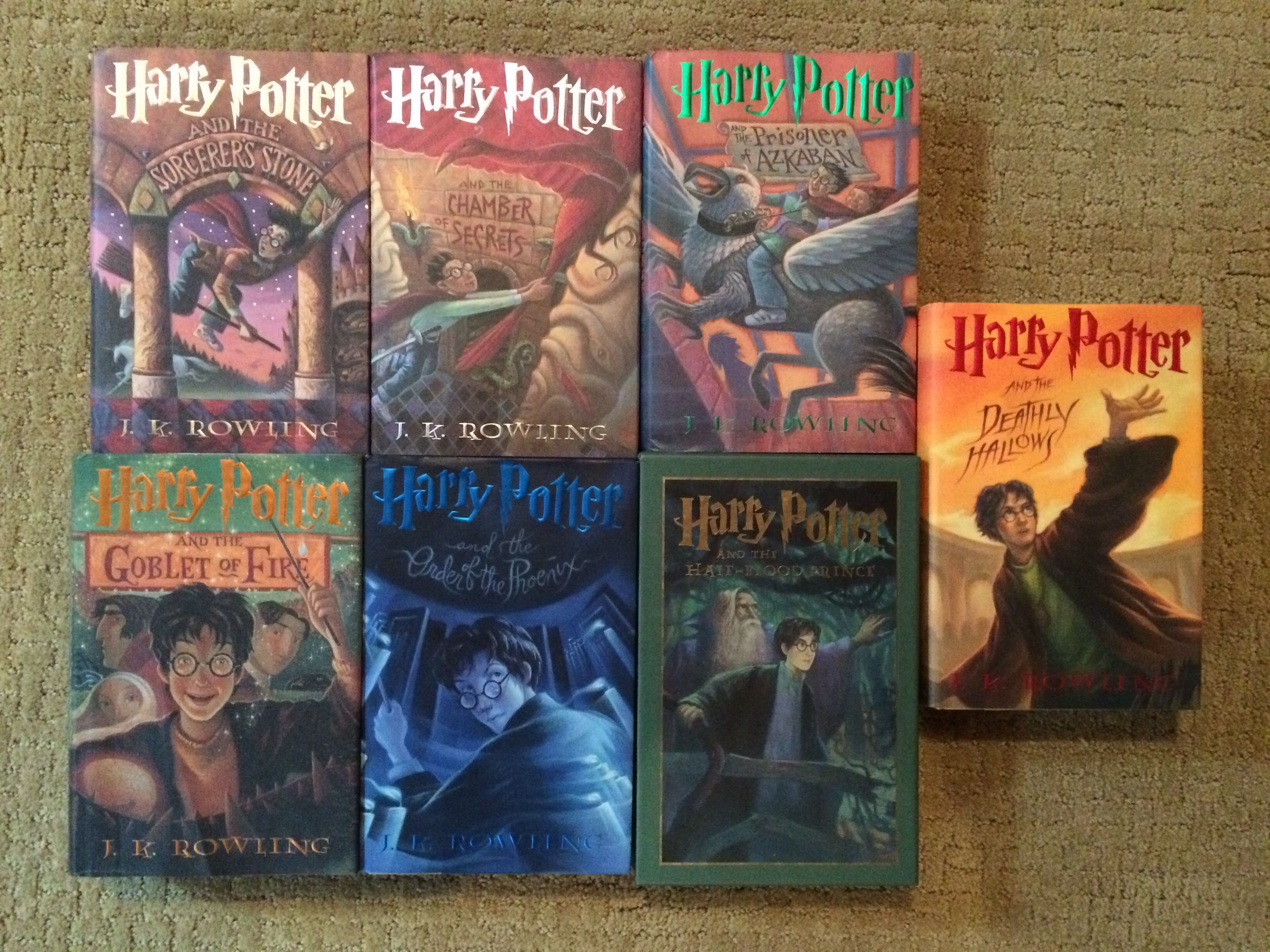
4,100 Pages of Harry Potter

On July 16th, I read the last page of the Harry Potter books to London. It had taken me one year, two months, and four days to read that page and the previous 4,099 to her. Before May 12, 2014, I had never made an earnest attempt at even reading the first book. I had made more of an attempt at watching the movies, but had only made it through the first two and started and failed to finish the third movie on several occasions.

By the time I got to page 759 of Harry Potter and the Deathly Hallows, I felt I was finishing more than a book, but a saga of both literature and life. The obvious saga, that of Harry Potter’s journey from Four Privet Drive to the climactic duel with Lord Voldemort, and the less obvious saga, of London’s journey from her 102nd day in the NICU (the day I started the first book) to her fourteenth month at home, and her seventeenth month of life.

HP Books

Beautiful artwork on all the covers of these increasingly heavy books.

When I cracked open Harry Potter and the Sorcerer’s Stone it was an act of therapy. I did not know if I would finish all the books. I did not know if I would be able to read all of them to London. However, as time went by, it became clearer and clearer to me that I would finish the books, that London would hear every page of these books, and that just because we got out of the NICU did not mean the reading of the books ceased to be therapeutic.

In the beginning, it was easy to find time to read Harry Potter to London. I would place her on a pillow in my lap and could read for as long as I like really, assuming she was oxygenating well and in a comfortable position. When she left the NICU, I read several times a day to her, while she was on the floor making cooing noises, while she was falling asleep, and while she was taking a feeding from her NG tube. Later on, I only read to her as she fell asleep for naps. And a little later on from that, she stopped falling asleep if I was by her side reading Harry Potter. This coincided with her ability to pull to a standing position, so she would stand inside her crib and reach out for the pages of the book and get frustrated that she couldn’t grab them.

Eventually, I had to start reading Harry Potter to her when she was in the living room playing with toys. By this last stage, I knew that my voice comforted her. I could read a whole chapter and sometimes two while she played. I may have pushed the limit on July 16, when I read the last sixty pages to her in one sitting as she drained all the fun out of one toy to the next until she was clearly wondering why I had been reading to her for so long without any breaks.

On more than one occasion during the last several days of reading Harry Potter I choked up because it would dawn on me that I am almost done with the books, or I would remember in a flash how far London has come over these 4,100 pages, so incredibly far as you may know.

I take great joy in knowing that I will be able to read these books once again to London when she is older and able to follow the plot. Perhaps I won’t read every word aloud to her. She might take over. That is fine with me. I know I will always be reading with London.

*Special thanks to my wife’s family who let me borrow all of their pristine, hard cover, first edition Harry Potter books.

12 Classics in 2015: The Stranger

I enjoyed picking up another slim volume, knowing I would finish this next book in two or three sittings. The Stranger, by Albert Camus, is a study of the absurd arc of all lives. It focuses on one man, Meursault, who kills a man on the beach in the first part of the book. Meursault’s trial constitutes the second part of the book.

Meursault, to me, felt very little emotion other than his lust for Maria, his girlfriend and, possibly, future wife. And although I saw some justification of him shooting the man on the beach, Meursault seemed to hold none of the same justification. He seemed only to defend his atheistic beliefs, and nothing else. He is a sad figure, not because I am a believer and he is an atheist, but because he seems utterly defeated by the absurdity of life. He refuses to use religion or the legal system to comfort or free himself because he recognizes the futility in prolonging the truth: that we will be born, we will die, and then no longer matter. All of us.

Meursault is a Debbie Downer, but Camus channels his philosophy quite well through Meursault’s actions and words. Interestingly, Meursault becomes happiest when he gives up all hope of a life, long or short, and accepts that any path he goes down ends the same.

I certainly don’t see eye to eye with Camus on this. I recognize that life can indeed be absurd and it will yell at us again and again, “resistance is futile,” but resisting is one of the hardest and most rewarding parts of life. It amplifies everything, the valleys, the peaks, the springs, and the winters of our lives. I believe it makes for a richer life, which looks better to me than Meursault’s fate of a jail cell and decapitation.

12 Classics in 2015: The Jungle

The Jungle is widely known as the book that turned the public’s gaze upon the meat industry. Months after the novel’s publication, the Food and Drug Act went into effect. The public was disturbed to find out that their chances of eating rotten and diseased food were quite good, as the condition of the slaughterhouses was revolting and what oversight existed at the time was a farce.

This was a positive reaction from the public, but Upton Sinclair did not mean to turn the people’s fervor toward the meat industry alone. Sinclair’s primary protestations regarded the labor conditions and complete lack of workers’ rights. Indeed, that is what struck me about the book. Sure, the descriptions of the making of sausage with scraps of meat and innards from the floor and the drains, and the tubercular cows passing right by the “screener”, are disturbing. But the human suffering detailed in the book is far more painful to endure. It lasts from shortly after the first chapter to the very last (357th) page.

The book’s main character is Jurgis Rudkus. You get the impression that the lion’s share of his life is lived out on these pages. What life Jurgis does have plays out like a train wreck. You see everything coming before he does. Blow after blow Jurgis is dealt with no means to protect himself or to save his family from abject poverty. My heart ached for Jurgis and every member of his family and for all those wasting away in Packingtown, the meat-packing area of Chicago.

I am thankful that workers’ rights are a thing now. No one spoke of them in The Jungle until the very last pages of the book, which is a screed in support of Socialism, one of Sinclair’s great causes.

The struggle of the working class is still very real. More than once I thought of fast-food workers, who are campaigning for greater pay because of the poverty they are forced into by trying to support a family on the current minimum wage, and I recognized that they are a group of people who would be at the heart of The Jungle if it were written today. Sinclair would be pleased to know that these workers don’t have to work 7-5:30 Monday thru Saturday just to keep their job, but many still work those hours because one job is not enough. A second is needed to scrape by.

The Jungle is a serious book with an intensely dark and sad narrative, but also a book with a surprising appeal to the reader to read just one more page. I found it enticing, even though with every new page Jurgis encountered his next setback or you could make out the train wreck on the horizon a little better. Out of the six classic books I have read this year, The Jungle has surprised me the most with its novel subject matter and its desperate plea for help from the immigrant masses who are still growing, tending, picking, and packing our food.

Parents on the NICU and their PTSD

Over a month ago, I read and posted about an article in the New York Times about 22 weeks gestational age being the new definition of viability (for some doctors). In the sidebar I noticed another article under “related.” Its title: For Parents on NICU, Trauma May Last. As soon as I was done reading about the viability of 22 weekers I clicked over and read about PTSD in NICU parents, which I had blogged about once already.

I have not read a more accurate article about parents dealing with the NICU. The first parent’s story is more stressful and scary than ours was. For example, I never got to the point where I was sleeping with my shoes on, but on more than one occasion I expected the hospital to call with horrible news. And I was and can still be easy to anger as a direct result from our NICU experience. I mentioned that back in October as well.

This NY Times article was first published in 2009, citing a new (for then) study about PTSD in NICU parents:

A new study from Stanford University School of Medicine, published in the journal Psychosomatics, followed 18 such parents, both men and women. After four months, three had diagnoses of P.T.S.D. and seven were considered at high risk for the disorder.

In another study, researchers from Duke University interviewed parents six months after their baby’s due date and scored them on three post-traumatic stress symptoms: avoidance, hyperarousal, and flashbacks or nightmares. Of the 30 parents, 29 had two or three of the symptoms, and 16 had all three.

One of the NICU parents quoted in the article hits the nail on the head:

“The NICU was very much like a war zone, with the alarms, the noises, and death and sickness,” Ms. Roscoe said. “You don’t know who’s going to die and who will go home healthy.”

I haven’t said it better myself. As a parent, even after months in the NICU, I would find myself wondering if we were ever going to make it out whole, meaning all three of us. Perhaps the most revealing statistic shared in the article is this:

The Stanford study found that although none of the fathers experienced acute stress symptoms while their child was in the NICU, they actually had higher rates of post-traumatic stress than the mothers when they were followed up later. “At four months, 33 percent of fathers and 9 percent of mothers had P.T.S.D.,” Dr. Shaw said.

It’s easy to picture stoic fathers in the NICU, but what most of them are really doing is repressing so much intense fear and anguish that once the drawn-out trauma of their child’s NICU stay is over they burst. I was stoic from time to time, but I certainly was not afraid to show emotion during London’s stay in the hospital. Crying in front of nurses was not something I was above. This helped.

One NICU survivor shares this in the NYT article:

In her book, Ms. Forman wrote: “From the moment my twins were born, I saw potential for tragedy wherever I turned. It would be years before I stopped thinking that way.”

This is probably what I struggle with the most now. It’s beyond worrying, it’s an all-consuming conviction that something horrible is going to happen. Prior to my trip to DC, I had a really hard time shaking the feeling that I wasn’t going to see my family again, I wasn’t going to make it back from DC, or maybe I was never going to make it there in the first place. Before the NICU, I was not wired to think this way, but now a part of me is. The other part is fighting for balance. Like Ms. Forman, maybe it will be years before hope and the safety I knew become my heading once again.

That Wasn’t So Bad

FullSizeRender-5

A view of Roxborough Park as we flew over Littleton yesterday.

We just got back from our first plane trip with London. Going into the weekend getaway in California, I was not that nervous about London’s behavior on the plane. I was mostly concerned with the technicalities of traveling with a stroller and our decision to lug her Radian RXT booster seat with us (this seat weighs 40 lbs, maybe more). I spent more time looking up travel tips last weekend than writing any blogs, hence the complete lack of posts for a week or so.

Flying truly has become more of a hassle in the post-9/11 days. Then you throw a baby in the mix and my head hurts. One tip that we followed, that probably most parents follow, is to arrive at the airport earlier than you would if you were flying sans baby. This is a great decision if you stress out over having to rush through everything at the airport like I do. I actually enjoy being able to be as slow as I want once I arrive at the airport. I feel less stressed and I am way more prepared if anything goes wrong, like if baby has a blowout, or if I forget to lock the stroller wheels in place and she goes rolling off toward security by herself.

I would rather be over prepared for something like flying with a baby. And I think I was, because it seemed almost easier. If it weren’t for having to sit on the plane with a baby in your lap, flying with a baby would be easier than flying without one, based on our sole experience. At both airports we checked bags at the curb, immediately freeing ourselves of some tremendous weight and time waiting in line. At security, we were selected for the fast line, and at DIA for the TSA Precheck line. We didn’t have to stand in the stupid X-ray machine either. Maybe we looked absolutely clueless the entire time because we just seemed to be given preferential treatment wherever we walked. Little did everyone know that I spent a week studying for this like it was a final.

The part about traveling with a baby that is a drag is the actual plane ride itself. Even if your baby is very well behaved, like mine, you can’t really relax while holding him or her. One thing I love about flying is turning my phone off, being disconnected from the world for a few hours, and really getting into a book or reading a magazine from cover to cover. That won’t be an option for quite a few years, but I’ll get it back. In the meantime, I feel like a slightly more accomplished parent now that I have run the TSA gauntlet with London in tow and have not lost her or slowed any other traveler down due to a lack of preparedness.

That First Goodbye

As I mentioned a couple weeks ago on this blog, I had a trip to DC coming up. It was a birthday gift from Kate. Well, it was an awesome trip and I will share about some of it soon, but I want to write about the day I left for DC.

FullSizeRender-4

A quick snap of London after saying goodbye at the airport.

I had been thinking for over a month about what it would be like to say goodbye to London at the airport. Since she was born almost sixteen months ago, I had never been more than an hour’s drive away from her. I had spent one night away from her, but that taking place in the same city. So, when we got to the airport I was saying goodbye to more than just London.

Since her instant, premature arrival, I have been tied to London like nothing before in my life. She took the breath out of me when I stood up and looked at her being pulled from her mom in the OR. Since then she has had it. I wished time and time again over those first ten months of oxygen support I could have given her more of my breath. Instead, I gave what I could, my constant attention, worry, and commitment to making her as happy as possible with meticulous mental note taking of her every need. For, 469 days, London had been within reach. Was I in control for one of them? No, but at least I was there. I knew I was saying goodbye to that streak, the first, long season of fatherhood.

When I arrived at the airport with my mom and London, I had to face the end of an era, so to speak. I had prepared myself and worried about it as much as possible. I still cried though. I leaned in to kiss her perfectly soft cheeks and could not leave without taking another picture of her. In that picture, she appears to be a little confused, possibly from my tears, but as beautiful as ever. I looked at it more than once while I was in DC. And more than once, I thought of our next hello.

12 Classics in 2015: The Old Man and the Sea

Reading 12 classics in 2015 would be a lot easier if you could knock out each one of them during a flight, like I did this short book on the way home from DC. In order to read some of the longer books I have selected for this task, such as Moby Dick, Midnight’s Children, and The Executioner’s Song, I needed to select some very short works.

_BKP1117

2013. Cayucos, CA.

The Old Man and the Sea is a delightfully simple plot that I will not rehash here. A warning though, it being such a short book most of the plot will be revealed by merely writing a few paragraphs about it.

While I read this book I thought about chasing goals, the way we chase them, and the people we leave in our wake while we chase those goals. Once the old man, Santiago, commits to catching the giant marlin he has hooked, there is no turning back. However, along the way, on nearly every other page, the old man thinks of the young boy, his apprentice Manolin, who had fished with him in the past and regrets his decision to not take the young boy out with him this day.

Pride and the necessity to make a living pushes the old man out to sea, the catch seeming impossible for hours and then days, but finally the marlin weakens and starts circling the boat. At this point, the old man’s energy and hand strength is somewhat revived. He pulls the marlin in against all odds and lines up the eighteen feet of marlin next to his boat. What a prize! Bask now in the glory of your catch because it will be rotted, decayed, or poisoned by the time you expect to reap the bounty.

Indeed, by the time the old man gets to shore, he has eighteen feet of skeletal remains alongside his boat and the old man himself is nearly dead. Would the ending have been different if the young boy had been allowed to fish with the old man on this journey? I think we are led to think that way. The victory for the old man is that he made it home at all and he can now take Manolin out fishing once again. Together, perhaps, they will catch a big marlin, but the biggest catch of all was lost. Be it pride, stubbornness, or just a foolhardy decision to go for the big prize, the old man did it. Better to try and fail than to not try at all. For if the old man had cut his line after the marlin towed him out to sea for a day, the decision would have eaten at him for the rest of his life.

I revere Hemingway’s writing. It’s the stuff I will aspire to for as long as I write. I will never get there, but it is fun to imagine. I will also never get to the point where I will shoot myself in the head with a shotgun. Exquisite writing and shotgun-assisted suicide I leave to you, Ernest.

One Year Ago Today, We Left the NICU

IMG_4165

London’s first night home. I already look horrible.

Today is the one-year anniversary of London’s big move from the NICU to her new home. Reflecting on that day a year later, I think I made the right choice by not overthinking what a big change it was going to be for London and for us.

I knew it would be an exhausting transition, but my thinking was that I would roll with the punches, get knocked down a few times (which I did), adapt my style (easy, give up sleep), and then hang on for dear life and at some point in the future I would come out a practiced and knowledgable parent (still looking to the future on that one, at least in some regards). To me, going through that process seemed easier than trying to be ahead of the curve. Plus, that would take time to read and figure out what I was doing wrong. After 109 days in the NICU and then starting parenthood all over again when London came home, we did not have time for that.

Learning London’s cues taught me nearly everything I needed to know about taking care of her this last year. A few cues are exclusive to taking care of a preemie, like knowing when to stop the bottle feed and move forward with the tube feed, or knowing when 1/8th liter flow was not enough or if it was just right. I relied on London’s pediatrician, her nurses, her physical therapist, her occupational therapist, and both sets of grandparents to fill in the gaps in my knowledge.

FullSizeRender-3

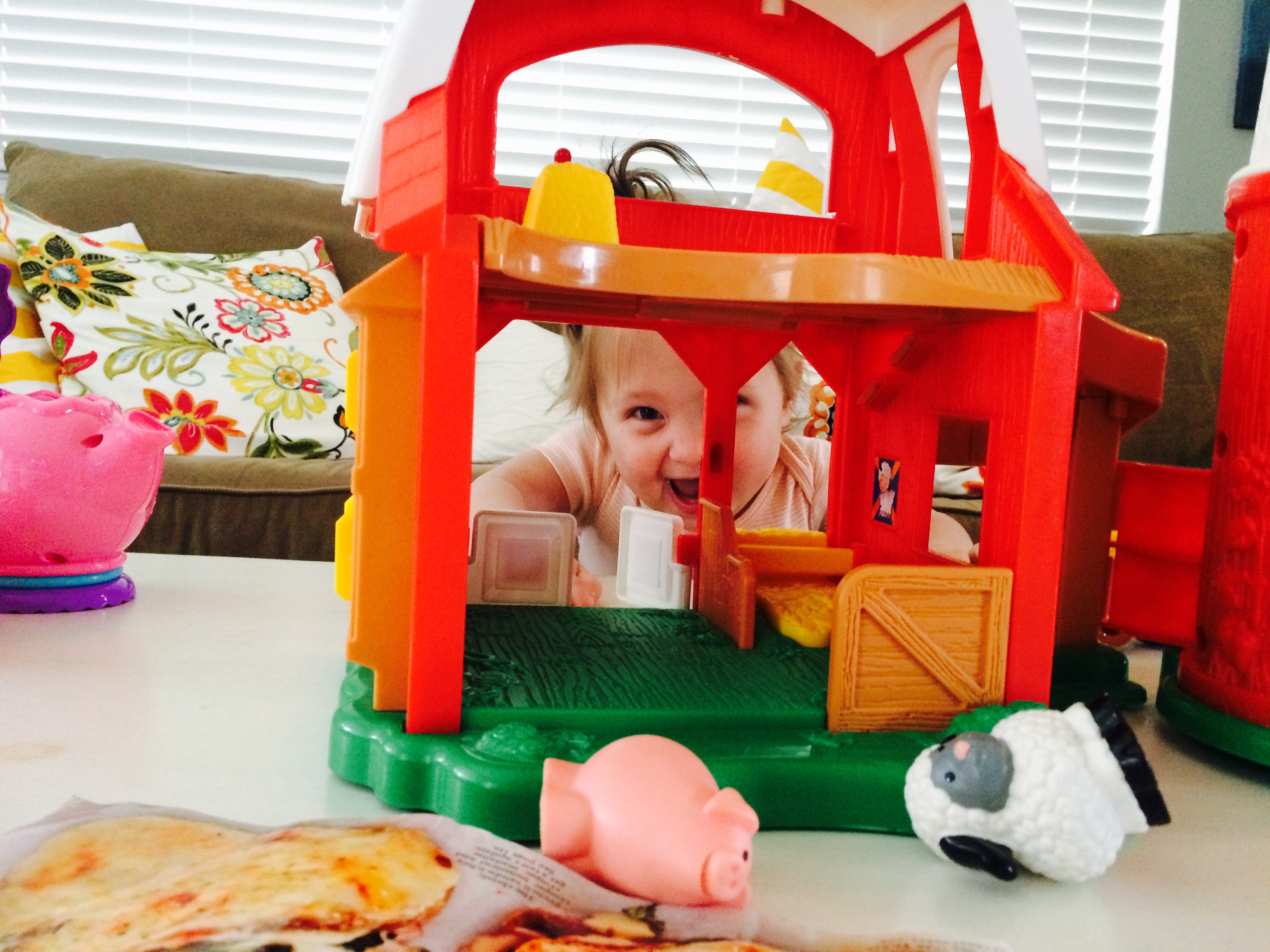
Today. Playing with her Little People farm.

A year later, London is far easier to take care of than she was with all the accessories she came home with. And, I am far more rested than those first days and weeks she was home. I am still tired most of the time, but I have coffee for that.

London’s first year home bears the mark of many a preemie: daily doctor’s appointments at first, then weekly, and then gradually monthly, with some major scares along the way. I hope and pray her second year at home will be smoother than that, that it will bear more marks of hope and promise than it will remnants of her harrowing beginning.

I’m a Cheerios Vacuum

When London will not eat one thing I give her, Cheerios save us. They are like little life preservers floating about on the table top, saving her because they give her sustenance, saving me because she is actually eating something. 

I’ll hand London some Cheerios wherever we are. She drops half of them on a good day and 75% of them on all other days. 

I can’t let them go to waste. I will eat them off the carpet, the kitchen floor, from the couch cushions, from the bottom of her activity saucer, and from inside her onesie. 

There are two places I won’t eat Cheerios from. One, the bathroom floor. This has only happened once as I have never fed London Cheerios in the bathroom, but I mush have carried one in there on my clothing. I found it today. 

And two, from inside her diaper. Found one of those yesterday. 

And you can forget about the five-second rule. I am confident I have eaten Cheerios that were several days old, maybe a week. It’s easy to tell when you get one of those. They have entirely lost their crunch. 

My Cheerios consumption is up 1000% over last year. I suspect that as London grows older it will steadily decline from the current stage, which, I would guess, is at peak Cheerios flow. 

12 Classics in 2015: Midnight’s Children

For my fourth act, I read Salman Rushdie’s Midnight’s Children51yqNUCZu6L

When you study literature Rushdie’s works come up a lot in discussion. And yet, I made it through an English undergraduate program without ever being assigned one novel or short story by Salman Rushdie. In my graduate studies in International Relations, his name came up quite a bit too because of my focus on the Middle East. But no Rushdie reading assignment there either. Of course, when a professor would ever mention Rushdie in my undergraduate or graduate courses my classmates would nod their heads. I would too. We all knew who he was. But had we read his stuff? Maybe my peers had. I had not. So, I picked up Midnight’s Children, admired the cover, and dove in. It was March 30th.

And now it is May 12th. What exactly happened between the aforementioned dates, pardon me, between the covers of the book, I am not entirely sure. But I am not too worried about that because a major theme of the book is the unreliability of Saleem’s narrative. He reminds you again and again that this may not be the way things happened exactly, but it is how he is remembering them at this precise moment. Padma (Saleem’s future wife) reminds Saleem of his story’s inaccuracies as well whenever he has screwed up the date of a significant event, such as Gandhi’s assassination.

Saleem’s story starts long before his birth, with the telling of how his grandfather met his wife, but the story really picks up when Saleem is born at exactly midnight on August 15, 1947, the day India became an independent country. All the babies born in India during its first hour of existence end up acquiring special powers. One of them can time travel. Another is a powerful witch. Saleem, being born at the precise moment India was born, is the most powerful. He can read people’s minds. And he can feel the presence of all those born that fateful night, the young ones known as Midnight’s Children. He can read minds from afar and explore the memories of anyone he wishes.

Eventually, Saleem loses that gift, but acquires another, the ability to smell nearly everything, from love to the exact scent of every human he has ever come into contact with. Over 533 pages, his story unfolds like that of Forrest Gump. Saleem is intimately involved with his country’s dealings for much of the book. Finally, he catches up to his 31-year-old self who is telling the story, only to close the novel (spoiler alert) with the prediction of his own death on the day he turns 32.

Saleem’s journey is epic. There is no point in sharing the entirety of it here or ever, really. I would feel different, I think, if I had loved the book. But this book, which might be the heaviest lifting I will do throughout this New Year’s resolution of mine, was one of the most confusing books I have ever read. Perhaps, the most confusing book that I have ever finished. For most of the book, I consulted chapter summaries on Spark Notes. Of course, I read the chapter first and only then would I read Spark Notes. It was a rough start, having no idea what really happened after I finished the very first chapter. In my defense, it was late afternoon, I was sitting outside in the sun, and London was napping. But I had my coffee? It didn’t matter. In fact, coffee can’t really help you through this book. But Spark Notes did, so I actually felt a connection to the story from time to time.

The thing about Midnight’s Children is that it is damn respectable for the quality of the writing. The style is unbelievable. Rushdie’s vocabulary is astonishing and there are sentences that flow so well I read them a few times for the sheer delight in their finely-tuned form. The book won the Booker prize in 1981. And then, for the 40th anniversary of the Booker prize, it was voted Best of the Booker, the best novel to have won that prize in 40 years. That is one huge honor, which certainly played a role in my selection of this particular work of Rushdie’s. I have got to read such an acclaimed book.

I did. It did not live up to what I would expect for the Best of the Booker award, but the book will certainly stick with me for a while. And now, when a professor mentions Rushdie’s name I can nod my head without feeling like such a dolt.

DC Bound

BKP_8216

The last time I was in DC, I didn’t know how to operate any sort of camera, so I share this picture from London in 2012, the last time I was there.

A couple of months ago Kate secretly arranged for me to have a vacation.

I am actually going to travel out of the state. On. A. Plane.

I am heading to DC on Thursday for a four-night stay. My mom is helping out a ton by driving from New Mexico (again) to hang out with London while Kate is working.

When Kate first told me I was excited, but at once sort of terrified of leaving London and being away from her for four days. I have spent only one night away from London before and, even then, I was in the same city.

I am sure when I am dropped off at the airport I will have a little slice of adulthood immediately come back to me, the no-strings-attached freedom to move about as I please without a diaper bag, stroller, and a pretty big one-year-old baby. It will just be me. That will feel weird for a time.

As excited as I am for the vacation, I find myself already looking forward to coming back to Colorado and being reunited with my family. I have never felt that way before. It is one of those new feelings, that I can only ascribe to the love I have for my budding family.

Coffee Obsessed? You should read this.

_BKP4310

The bloom in the Chemex.

I do not like the thought of going through a day without coffee. I love drinking it, but I have also become infatuated with making it. Weighing out the coffee beans, grinding them, weighing out the water, and slowly pouring water in a circular motion from the inside out have all made for a ritual I have come to love over the last year.

Learning to make coffee and learning to enjoy it has been a very long process. I did my compulsory stint at Starbucks, but I did not enjoy coffee then. Years later, I only drank the stuff as an energy boost and took very little delight in its flavor. I consumed more and more of the stuff through grad school. After graduation, the consumption declined, but it did not stop. When my wife and I bought our first house, I finally had some room to let my coffee wings spread out some and I took to cold brewing, modifying a method my father-in-law was using. In December, after I received my first Chemex and coffee grinder I transitioned to following this recipe from Counter Culture Coffee for Japanese style iced coffee and I have not looked back.

_BKP4368

Actual ice cubes are a nice touch.

I have learned a lot about coffee in the last year, but then last week I picked up an issue of the New Yorker from 2011 and read a fascinating article. I learned that I still have a lot to learn about coffee. For example, for best results when the cherry is picked from the tree, it is twisted off, not plucked. (I’ll remember that next time I am picking cherries in El Salvador.) And, we are in what is called the third wave of coffee consumption. Furthermore, the coffee snobs of the third wave lament the ancient ways of making coffee, which originated in Ethiopia. Only now, in this era, is coffee growing and brewing coming close to the true potential of the fruit.

The article is “Sacred Grounds” and it was wonderfully written by Kelefa Sanneh. I highly recommend reading it, even if you are not obsessed. Maybe you will be once you finish.

The Story of London’s Birth

IMG_0109

This picture…because it’s Cinco de Mayo!

A few months ago I wrote a post linking back to the story of London’s birth, the first posts on this blog. It had been a while since I had mentioned them and wanted to make sure people were aware of them, especially since they were now buried in the archives.

I have finally done something I should have done months ago. I have posted links to London’s birth story in the About the Author tab of this blog. I encourage you to read those posts if you have not.

In the meantime, happy Cinco de Mayo! I made a margarita last night following this recipe. It was delicious, but to make more tonight I had to raid the limes at the grocery store today. You will need a lot of limes. Enjoy!

Turning One Again

May 4th. May the Fourth Be With You. It’s Star Wars day.

And it’s also one year from London’s due date. It’s her one-year birthday (developmentally). It is a significant milestone, but I think May 19th will be more of a celebratory day because that will be the one-year anniversary of London’s homecoming.

This time last year we were going through a stressful stage of London’s NICU stay. We were hoping to have her home by now, but we were hitting really big snags regarding London’s energy. The journal entry from May 4, 2014 reads:

IMG_2319

May 4, 2014.

Eileen and Megan (nurses) are very uncertain about why you are so tired all the time. Will ask questions with docs tomorrow. For now, starting 24 hours of all tube feeds.

I remember crying after being told of London’s lack of progress and of a new battery of tests to be performed on her in the coming days. My chair was backed up against the window in London’s pod and I numbly stared out into the rest of the NICU as Megan explained what the next steps were going to be. Kate held London. I let the tears drop out of my eyes without blinking. I was in a dark, sad place, and so surprised that we were still in the NICU with no set discharge date.

So much can change in a year. As today’s afternoon thunderstorm rolls across Denver, I am reminded of the first couple of weeks London was home. There were storms every afternoon, including several tornado warnings. London would fall asleep in the middle of the living room while hailstones hit the windows. I’d try to fall asleep wherever I could too, but couldn’t pull it off quite like London. Kate and I lost massive amounts of sleep all over again for the same baby, but we eventually found our groove. And London did too. She’s right where she should be for a one-year old.

Happy Birthday again, London!

London’s First Cry

London was on a ventilator for the first three weeks of her life. This meant that we didn’t hear a peep from her all that time. We could see from time to time that she was crying, but there was no noise to accompany the cry. It looked so odd, different than any other baby cry I have ever seen. Finally, when London promptly freed herself of the ventilator we could hear her cry. This time it was unlike any baby cry I had ever heard. Intubation can damage the vocal cords of preemies. The damage, in London’s case, was only temporary, but for a while her cry sounded like this. I described it to someone as sounding like a goat. It’s heart-wrenching to hear, then and now, because I just want to pick her up, cuddle, and rock her, but back then that was never an option. And now that it is, London doesn’t cry. Decent trade off.