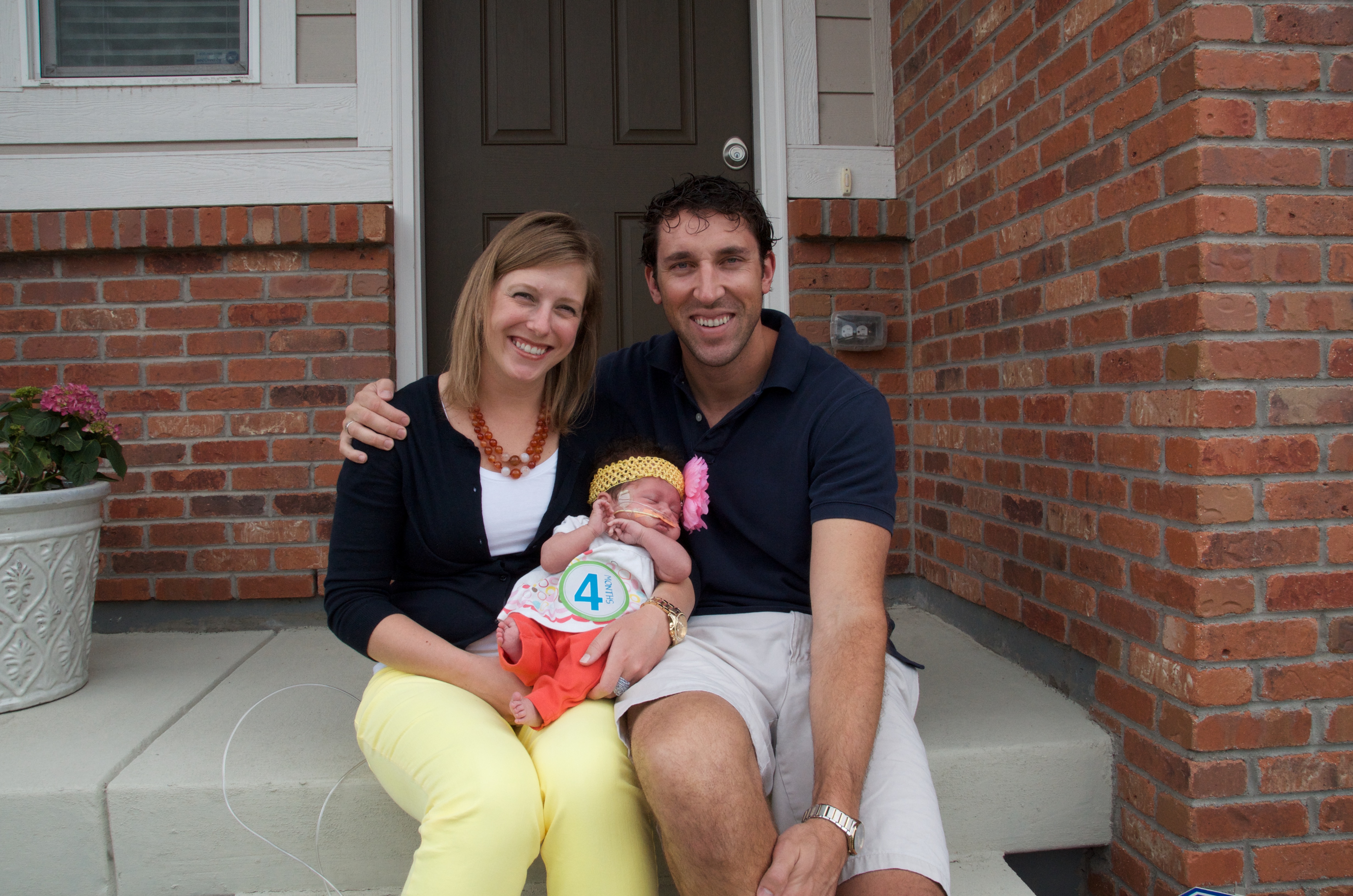
Welcome to the Pump House: Adventures in Fatherhood and Breast Milk Management

A version of this post appeared on my blog years ago when London wasn’t even a year old. But I just tweaked it a bit, slimmed it down , and added here and there. I think it’s better now. Here it is…

Never in my wildest dreams, as I prepared for fatherhood, did I think I was going to spend so much time with lactation nurses, reviewing the intricacies of hand expressing (including motions), analyzing breast milk volumes, discussing engorgement, and just how much breast milk one could fit in a chest freezer.

A few hours prior to my meeting with lactation consultants, thinking there were three more months to learn these things, I didn’t even know lactation nurses existed. I knew that some babies were born prematurely, but I didn’t know my wife’s breast milk would still come in just as early as our daughter wanted out at 26 weeks gestation.

So it was that our 109-day stay in the neonatal intensive care unit (NICU) started with a crash course in breast milk. Within those first days of life for my daughter (London), my wife (Kate) and I spoke at great length with not just one lactation nurse, but several of them about breast milk and breasts, starting with a nurse asking my wife if she was going to pump breastmilk. Partly due to the trauma of the last 24 hours, and partly due to my complete lack of knowledge about breastfeeding, I had not thought a bit about breast milk or pumping. Kate was of a similar mindset at that particular moment, but we were both satisfied to know that there was a good chance Kate’s milk would come in. The early drops of colostrum, the nutrient-dense milk first released by the mammary glands, often come in shortly after the placenta detaches from the uterine wall, no matter the gestational age.

A couple of hours later a lactation nurse wheeled into our room something that looked like a medieval torture device. They were calling it the Symphony. They hooked Kate up to it and it hummed and sucked for 18 minutes. At the end of that first session, we could just barely make out two milliliters of colostrum. A few hours later Kate produced 2.6ml and then later that night 3.8ml. The next day, January 31, marked Kate’s first 24 hours of pumping. She produced 32.6ml that day, or 1.1 ounce. The lactation team handed us a log with the direction that we were to write down when Kate pumped, for how long, and the total volume.

We then received a DVD to watch, which would apparently help Kate get more milk by hand expressing and provide tips to alleviate the pain of engorgement. We were to watch it and return it to the NICU team afterwards. That same day, we popped the DVD into my laptop to watch some before going to bed. One minute into this educational video, the biggest breast and nipple either of us had seen appeared on screen. Kate laughed so hard she began to worry she might injure herself being only two days clear of a C-section. Everything hurt. If we continued watching, we put Kate’s health at risk. I slammed the laptop shut. Tears ran down our cheeks from laughing so hard.

Who knows who is responsible for making this particular lactation video, but may I make one small suggestion on behalf of my wife and all women who have recently had C-sections? Great. Do not make the first breasts on the video also be the largest breasts known to mankind. They should not be comically large, needing 3-4 hands to get them under control. In fact, this video is a danger to new mothers everywhere, they might literally bust open their gut laughing from it, like we almost did.

Thus, it fell on me to watch the lactation video alone, gleaning from it any helpful tips and then sharing them with Kate. She was impressed. It wasn’t like Kate’s breast milk volumes needed any help. Not long after London was born, I was spending part of everyday rearranging containers of breast milk in the chest freezer in the basement—the chest freezer we needed to buy solely to store breast milk. Kate and I would joke that I knew more about hand expressing breast milk than she did so I should print up some business cards and walk around the NICU offering my services to anyone who needed them. Hand Expressions by Bryce. Simple and to the point.

By day of life 57 for our little girl, Kate was producing 1,863ml a day, or 63oz of breast milk. To put that in perspective, London was fed a total of 800ml on day 57, the most she had ever consumed in one day. In fact, it took London a long time to drink as much milk in one day as Kate got from one 20-minute pump. A point was reached where no amount of rearranging the breast milk in the freezer would make room for more. I picked up a second chest freezer at Costco and Kate started to fill that, too.

For the months London was in the NICU we rented a Symphony pump, which at the time retailed for $1500-2500, and kept it in our bedroom. We started to call it the pump house. When at home, Kate disappeared every three to four hours to spend some quality time with the Symphony. As all moms know that schedule wreaks havoc on sleep and work responsibilities, but Kate did an excellent job. I did what I could by waking with her every time throughout the night, assisting in bottling of the milk, labeling and recording volumes, washing pump parts, and then delivering milk to the freezers in the basement. So, at our house, at least two times a night, Netflix and chill was swapped out for Netflix and pump.

As Kate tapered off the pump, we were just filling up the second chest freezer and the lactation nurses understood why Kate was putting an end to pumping. She had developed a reputation in the NICU as a super producer. At London’s discharge, on May 19th, 109 days after she was born, the NICU staff wrote messages to us. One of our favorites from the lactation team wrote, “Your mom was a rock star with pumping. She could have fed three babies in the NICU!”

Next week, London will be six-months-old and I can thaw breast milk from three months back. And right now it’s lunch time for the little girl, to the chest freezer I go.

Surviving at 22 Weeks

“Do you want us to save your baby?”

_BKP2261

London at one-day old.

That’s a question you may have to answer if your baby is born earlier than 24 weeks, the current gestational age of viability. In fact, you may not get that question at all. Quite a few NICUs do not have the means to even attempt to save a 22 weeker. And, from the sound of an article I read in the NY Times yesterday, some doctors will not try to save a 22 weeker if they aren’t breathing on their own. And the chances of such a preemie breathing on their own, if the mother didn’t receive corticosteroids, is extremely slim, if it’s possible at all.

Yet, there are some 22 weekers who have made it, as detailed in a recent study, from The New England Journal of Medicine, mentioned in the aforementioned article.

The study, one of the largest and most systematic examinations of care for very premature infants, found that hospitals with sophisticated neonatal units varied widely in their approach to 22-week-olds, ranging from a few that offer no active medical treatment to a handful that assertively treat most cases with measures like ventilation, intubation and surfactant to improve the functioning of babies’ lungs.

The study involved very premature babies, those born at 22-27 weeks. Among the 22 weekers, there were 78 cases:

18 survived, and by the time they were young toddlers, seven of those did not have moderate or severe impairments. Six had serious problems such as blindnessdeafness or severe cerebral palsy.

7 out of 78. So at 22 weeks, there’s less than a 10% chance of surviving without any severe, lasting impairments. Survival rate at 23 weeks was about 33%.

The article detailed the varying strategies used by hospitals around the country. Some hospitals are very ambitious and with the parental approval, go after all 22 weekers. But, understandably, some hospitals stick to the 24 week line as the viability tipping point. A doctor describes his hospital’s strategy this way:

At his hospital, “we go after the 24-weekers,” he said. “If it’s 23, we will talk to the family and explain to them that for us it’s an unknown pathway. At 22 weeks, in my opinion, the outcomes are so dismal that I don’t recommend any interventions.”

At 22 and 23 weeks, I am glad that parents are asked the question I opened this blog post with. After having experienced the emergency delivery of my daughter at 26 weeks and then the following 109 days in the NICU, I would hesitate to answer yes in a 22 week or 23 week situation. My gut tells me at 22 weeks, I would say no. At 23, I’d have to think about it a lot more. It would depend on whether or not my wife received steroids. There was no time for steroids in London’s case, and that set her back significantly even at 26 weeks, nearly a month older than the earliest babies in this study.

It was a fascinating article to read. Here is the link again. I am amazed that 22 weekers can survive, but blindness, deafness, and severe CP are not minor complications. And those are the 22 weekers who make it out of the hospital.


Turning One Again

May 4th. May the Fourth Be With You. It’s Star Wars day.

And it’s also one year from London’s due date. It’s her one-year birthday (developmentally). It is a significant milestone, but I think May 19th will be more of a celebratory day because that will be the one-year anniversary of London’s homecoming.

This time last year we were going through a stressful stage of London’s NICU stay. We were hoping to have her home by now, but we were hitting really big snags regarding London’s energy. The journal entry from May 4, 2014 reads:

IMG_2319

May 4, 2014.

Eileen and Megan (nurses) are very uncertain about why you are so tired all the time. Will ask questions with docs tomorrow. For now, starting 24 hours of all tube feeds.

I remember crying after being told of London’s lack of progress and of a new battery of tests to be performed on her in the coming days. My chair was backed up against the window in London’s pod and I numbly stared out into the rest of the NICU as Megan explained what the next steps were going to be. Kate held London. I let the tears drop out of my eyes without blinking. I was in a dark, sad place, and so surprised that we were still in the NICU with no set discharge date.

So much can change in a year. As today’s afternoon thunderstorm rolls across Denver, I am reminded of the first couple of weeks London was home. There were storms every afternoon, including several tornado warnings. London would fall asleep in the middle of the living room while hailstones hit the windows. I’d try to fall asleep wherever I could too, but couldn’t pull it off quite like London. Kate and I lost massive amounts of sleep all over again for the same baby, but we eventually found our groove. And London did too. She’s right where she should be for a one-year old.

Happy Birthday again, London!

The Apple Watch, A Screen Too Many

Screen Shot 2015-04-30 at 3.16.06 PM

…And I’m not buying it…

The Apple Watch is not for me. I know, I know, a lot of people said the same thing about the iPad. Who needs one of those? But the two are not the same. When I want some actual peace and quiet, I enjoy storing my computer away, setting aside the iPad, and taking my phone out of my pocket and leaving it somewhere out of reach. I don’t want to take my watch off every time I want some peace.

It matters to me that the watch, like the computer, iPad, and iPhone, is another temptation to go down the rabbit hole of the internet, whether that is compulsively checking emails or entering the time suck known as Facebook. The internet and the screens on which we access the internet are only good in moderation. I feel a noticeable difference in mood when I shed myself of access to the world wide web. I relax a little more than I can if every one of those devices is pinging me with notifications and breaking news.

For me, truly cutting away from all that technology means I have to physically remove it from anywhere within reach. It’s an out of sight out of mind thing. If I keep my phone on me when I would rather be writing or reading then I will inevitably take a lap around the internet on it, making me less productive and having a negative effect on my mood. The watch would just be another temptation to do all that. I have a hard time envisioning someone with the Apple Watch regularly checking the time and doing nothing else with the gadget.

Now that I am a dad, ridding myself of screens has become much more important. I still catch myself looking at my phone a little too much and not at London. It breaks my heart when I think of giving more attention to my stupid gadgets than to the beautiful baby I spend every day with. Having a mini computer on my wrist is the last thing she wants and I agree.

I just can’t imagine having an Apple Watch and not increasing the amount of time I look at screens, which I think is more than enough already. And it makes me feel ill when I see toddlers walking around connected to their iPad already. The absence of a screen on my wrist will be another attempt to shield London as much as possible from lesser forms of communication than what we were made for.

Graduating to a Bottle

Last week I uploaded a video of Kate and I feeding London 1 ml of milk from a very tiny syringe. Though it was a long, long time until London could move on up to a bottle and I took many videos between that syringe and the first bottle, I wanted to skip to a video of an early bottle feeding.

In this video nurse Eileen is giving London a bottle. It was during a time of London’s NICU stay in which she was particularly stubborn about wanting to drink at all. Sometimes she was a champ, drinking her whole feed, but at other times she drank 5 ml and looked at us like, what? I’m done. Just gavage the rest and get on with it.

I think I had been trying to feed London and handed her off to Eileen, hoping London would cooperate a little more. She does in the video at least, but I can’t remember if she finished that particular bottle. Most of the time she did not. Thus, when it was time for London’s NICU discharge she came home with an NG tube.

One thing you see here in the video of London is the pacing that we had to do for quite a long time before London had the energy and the skill to take a constant flow from the bottle without choking and also learning how to breath properly during feeding. We would give London some flow from the bottle, for three seconds about, and then tilt the bottle back and let her catch her breath and finish swallowing the milk. It seems simple enough, but you also had to keep her body tilted to the side as well. And after that, you had better familiarize yourself with London’s cues…or else a nurse might give you heck from the other side of the pod, “And dad’s just choking the baby over there.”

When my sister visited London she was eager to give her a bottle. I felt bad, but I just had to say no. I went on to explain that it wasn’t like giving a full-term baby a bottle, at least not yet. After watching me feed London, my sister acknowledged that it looked difficult. I’m glad she did. At that point, I was only willing to hand London to someone other than Kate or a nurse if all they were going to do was sit with her.

I remember the day I discovered that I did not have to pace London’s bottle anymore. We were waiting for a ROP exam, and she was a little moody so I brought out a bottle and I tilted it up so the milk started flowing and I did not tilt it back down again until the bottle was empty. I was astonished and looked from the bottle to London’s happy, chubby face and back to the bottle. I knew we had reached a milestone in London’s feeding progress. But back down to earth we came, for the ROP exam was next.

I Hear Old People

It was one of those freak, 65-degree days in January and I had ventured downtown with London. We were at REI and I had just sat down at a patio table at the Starbucks there, overlooking Confluence Park and the South Platte River and Cherry Creek.

Our table was in the sun and London stayed in her stroller, which was positioned just right for her to eye every person walking by her on their way to get a coffee. Babies love people watching and London was clearly into it.

IMG_4863

The scene of the crime.

I pulled out my phone and casually checked my email and did a quick scan of Instagram. It was about two to three minutes of screen time before I heard an old woman speaking. She was seated with her husband, I assume, at a table directly across from our table, with the path for patio customers between us. I had started to eavesdrop because I heard her say to her husband, “Don’t you wonder about kids these days and what their vocabulary will be like as they start school?”

I couldn’t hear what her husband said in response. I continued listening, positioned in a way that I was facing London, now giving her a bottle, but I had my sunglasses on so my eyes were fixed on this lady and she could not tell.

What she said next made me freeze. “Well, that dad over there has said all of three words to his daughter since sitting down. He’s been playing with his phone and not talking to her at all.”

In that moment, I’m pretty sure I wanted to huck my iced coffee at her face. But she went on, bemoaning the sad state of parenting because of parents like me who look at their phone in the presence of their baby. I continued my stare, amazed that she could not see my eyes through my sunglasses and astonished that she would choose to say such things at all about someone sitting right across from her.

The old couple’s conversation eventually shifted to a different topic.  Where I sat I did not need the hot, January sun to keep me warm anymore. My blood was boiling. For the next ten minutes I sat there thinking about what I would say to this woman, if anything at all, and how would I deliver the message? And every word I spoke to London I second-guessed, am I saying this to London just because of what that old lady said?

Was this a moment to hold my tongue and be the bigger person? Or did this justify letting this old hag know just how much her assessment of modern-day parenting was incorrect? I admit, normally, I would have let this lady walk by without saying a word, but I had never had my parenting called into question like this. I am no perfect parent, but speaking and reading to London is where I excel. I decided I had to defend this.

The couple had stood up, gathered their biking gear, and were making their exit, forced to walk right by me. My eyes did not leave that old lady as soon as she starting moving. This time she noticed my stare and as she was right by my table I said, “I heard every word you said about my daughter and I. I really didn’t appreciate it and wanted to let you know that you are wrong. I have read thousands of pages to my daughter and I think she’ll have a fine vocabulary.”

Old lady, immediately apologetic and surprised, “Oh, I’m so sorry.”

No response from me. London stared at her and made some noises. “I can tell she’s trying to talk,” the old lady said.

“Yep,” I said, a little on the curt side, but hey, I think it’s pretty clear that I didn’t strike up this conversation to be friends with you so move along.

She felt like adding one more thing, “Well, it wasn’t like I was broadcasting it.” I did not acknowledge that and she got the hint and moved on. All the while her husband was a little behind her and I am pretty sure he missed the whole exchange. I gave him a wave and said, “Enjoy your ride.”

“Thank you,” he said, and walked on, completely unaware of what went down.

It was so liberating to let that woman know just how wrong and mean her comments had been. I watched her at a distance now, as she was getting onto her bicycle. There was a part of me that was hoping she would feel like an ass for the rest of the morning.

I think what that old lady said to her husband that day is so characteristic of some older or elderly people. It’s this feeling they sometimes get (or always have) that everything used to be better and now everything is going to shit, including parenting. As many people grow older the list of things they dislike and bemoan grows longer and longer. Eventually it is so long that most of the sentences coming out of their mouths are complaints. The worst of these are the most negative people to be around. This is a trait I loathe and one that I hope does not follow me into my golden years.

As a younger person it can be discouraging and exhausting to be around people who think everything is going to hell. I know it is very hard to be positive sometimes. And it is hard to hope. But try. Promise me that. And I’ll promise to read to my daughter today.

A 1 ml Bottle

A long way from a full feeding, but a good start.

There were about two months of training from the day (February 27, 2014) I took this video of London until she could take a crack at an actual bottle. What an amazing step for her this was. A 1 ml syringe holds quite a bit more milk than that cotton swab we used to put in her mouth. We were thrilled in this moment.

I have posted very few videos on this blog so far, but I have so many I would eventually like to share and perhaps write about. Plus, on days I don’t have a chunk of time to write at length about raising London, sharing a video is a great option.

The Complicated Age of Preemies

_BKP2827

Home at last. London’s 4-month and 1-month birthday.

“How old is she?” The simplest of questions for parents of full-term babies to answer, but not so for parents of preemies because there are two answers for this one question.

At some point, a baby arrives so early that their actual age is going to be different from their developmental age. For example, my daughter, London, was born at 26 weeks gestational age, three months early. Her birthday is January 30, 2014. Her developmental birthday is May 4, 2014. This means London’s adjusted age is 11.5 months, even though she’s been with us for 14.5 months.

So how do I answer the question, “How old is she?” Well, sometimes I lie. If the person asking is asking because they are wondering why London is not walking and or talking because she’s the size of some two-year-olds, I lie and give them the adjusted age. By doing so, I direct the conversation toward the obvious and usually hear something like this: “My God, what a big baby.” I would much rather talk about how big my baby girl is than tell the person the truth and then have the conversation inevitably slide toward how London is, developmentally speaking, three months behind.

That said, I think most of the time I tell the truth and answer, “Almost 15 months,” because most people, whether they dwell on my answer or not, just aren’t going to say anything else. But I know, because I’ve seen it in their eyes, that when I say London’s real age some people look a little confused. I don’t know what they are thinking exactly, but it’s something along the lines of:

“Shouldn’t she look older?”

“She should be crawling by now.”

“She should be walking by now.”

“She should be talking more by now.”

IMG_2714

At seven and four-months old.

When I feel this reaction in people I know I could take the time and explain London’s two ages, but somehow just saying, “She was born three months early,” sounds cheap because I’m taking this huge, scary part of our lives and trivializing it in six words. Plus, the majority of people will not be able to comprehend what those six words truly mean. Getting stranger after stranger to comprehend that over and over again can be exhausting. I know, because I would make a casual effort to explain London’s prematurity to nearly everyone that asked. This was right after she came home from the NICU. Still on oxygen. Still rocking cheek patches. NG tube still snaking across her face. Understandably, those people who asked how old she was back then knew they were probably going to get something more than, “3 months.” But after a while, parents of preemies tire of going into the explanation thing. So, like parents of full-term babies we get back to basics with a simple, short answer, “Fourteen and a half months.”

Or am I going to say, “Eleven and a half months,” this time?

Oh hell, maybe I’ll just split the difference.

“Thirteen months.”

36 Weeker ≠ 26 Weeker

One does not want to brag about how long their baby was in the NICU, although many do (see this earlier post on NICU bragging).

However, not all who mention how long their baby was in the NICU for are bragging about the experience. I would say a decent number of parents are simply stating that information up front as a desperate attempt to find someone else out there who has gone through exactly what they have gone through. I can relate to their desire because parents who have had a 26-weeker are not going to have much in common with parents of a 36-weeker.

What Kate and I know about prematurity is based on our own experience of having a 26-weeker. So, if you can, imagine our reaction when we read something like this, “My baby was born at 36 weeks. It was so horrible. We had to stay in the NICU for two weeks.” Parents of a 26-weeker are just going to laugh at that. In a similar fashion, so different our experience could be from a 24-weeker that parents of such a preemie might rightly scoff at our daughter’s 109 days in the NICU. I would not hold that against them because 24-weekers are at a higher risk of having longterm side effects from their prematurity than 26-weekers.

The earlier your child is born, the more you will hear stories from parents of preemies that will sound “easy” or “absurd.” The more they are going to sound like the person is NICU bragging, when, in fact, they might not be at all. Perhaps they just want to share their story. 32-weekers are fairly rare, right? Yes.

As you might be able to tell from reading the earlier post about NICU bragging, my views on this phenomenon have slightly evolved. For parents of preemies, a good rule of thumb is this:

Next time you are talking to someone who has also had a preemie, do not assume that their child’s time in the NICU was harder, easier, shorter, or longer than your child’s stay there. There are ways to find parents who have gone through the same experience as you have, but starting off with woe is me, is likely going to isolate you rather than find you the support you desire.

Free Of It

I was filling up a growler at the Bull and Bush when I received word that London no longer needed oxygen support. Tears immediately filled my eyes as I stared at the text message from Kate that delivered the news. I tried to compose myself as I signed the bill and took my growler, noticing a woman next to me at the bar. The woman’s prolonged stares told me that she knew I was trying hard not to cry.

Back in my car, I was able to share the news with my parents who were visiting us for Thanksgiving. After that I wept. I was overcome with pride in my daughter’s strength and attitude. It was the happiest cry I can remember having.

Here, on this blog, I have tried to convey to you what this journey has been like for our little family. However, there are some emotions that are so hard for me to put into words that I know I cannot give you the depth of feeling I felt at this news or that news, nor should I really expect to be able to do that because my feelings as London’s dad are obviously not going to be the same for you. Nevertheless, I wanted to try.

If you have read this blog from the start, you know just how far London has come since birth. I have reminded you enough. But her finally shedding oxygen support was a landmark event in her story, unlike any that she or heFullSizeRender-2r parents have lived through.

From January 30, 2014, we have treated London like a normal baby, sort of convincing ourselves that this is how all lives start. This is a coping mechanism and I suspect parents of babies and children with physical or mental setbacks have often treated their child as completely normal. This has served us well and I am sure it has served countless other parents well.

Now, I can only speak for myself, but no matter how much I thought of London as normal, I knew of her unique health risks and the challenges she had faced, so I never forgot that this was all quite far from normal. For all of her life up until last Tuesday, London had external, let’s call them accent pieces, on her face that clued everyone else into her prematurity or special needs. As a parent of a preemie, you get used to this, but from that first moment when you see your baby in that Isolette with tubes coming out of her mouth, nose, and belly, you yearn for the day when she can rid herself of it all, when she can be free of it.

Just shy of her ten-month birthday, that day arrived and I will remember for the rest of my life where I was when it did.

Have A Preemie, It’s Such A Deal

I am here to be honest with you. Having a preemie is such a deal both in cost and effort. Think of all the deals you have come across in your life. Think of the deals you expect to encounter in the future. Let your imagination run wild. I really doubt the deal you have in mind will come even close to being as good a deal as I am about to share with you.

1. Delivery is really fast. You don’t even have time to anticipate it. One night, you’ll be at home watching TV (in our case, I was trying to watch the latest episode of True Detective on HBO), and you will be truly concerned about everyday tasks, leaning over to your spouse and saying, “Oh gosh, we still have to clean the kitchen.” Then the pain will come. You’ll make a smart decision to go to the hospital to get some drugs or something and be sent home. So, still, having a baby won’t even be on your radar. But then the water breaks and well, you know something is going to happen. You’re not quite sure what. And then a few hours later you have a kid. Very little pain. Lots of drugs. A lot of very nice people working to help you deliver this baby as quickly and as painlessly as possible. And it is. The scar will heal up very nicely.

2. No third trimester. “Wow, killer deal!” You might say. Well, you are spot on. From what I hear, that third trimester is just a pain in the ass, or more like the lower back. Fatigue? Ha, you won’t even get to the worst of it. Frequent urination? You’re safe. A two pound baby does not make you urinate more. Heartburn? Okay, you might still get this if you have a preemie, but it’s not what you think. It’s just because you had tacos with the hot salsa on them, not because you are growing a human being. Swelling? Nope. You’ll be able to wear your wedding ring right up to delivery. Weight gain? Are you freaking kidding me? As soon as you develop the slightest baby bump you’ll be hours away from delivery, saved from the expand-a-pants, saved from the waddle, the stretch marks, and the need to have a whole different wardrobe for that third trimester.

3. Best babysitting in the world. As soon as your baby arrives, NICU nurses, will be with your baby 24/7 until the baby leaves the NICU. The earlier the baby, the more days you’ll get this amazing babysitting at a relatively low cost. You can still go out for dinner. You can go home to sleep. In addition to the nurses there are many other professionals checking in on your baby, making sure she is comfortable and developing as expected. You might be a little stressed about leaving your baby in the NICU at first, but, oddly, you get used to it. You still need to enjoy your free time before you have a baby at home. You weren’t expecting to have a baby this soon. You had three more months. Take them. The NICU team has you covered.

4. The lighter your baby the better. Truly, if you have a really small baby, you just qualified for all sorts of assistance regardless of your income. You will learn about supplemental security income. You’ll get a check from the Feds once a month that has to be used on baby things. Easy enough. And then for some reason you’ll get a little bonus check when your baby leaves the hospital. Sort of like the Feds just saying, “Hey, congratulations! And thanks for paying all your taxes all those years. This is how we roll. We actually do some good stuff with the money you give us. Here’s some back.” Then, if you’re lucky enough to live in Colorado, your little, teeny, tiny baby qualifies for at home physical therapy and occupational therapy visits. Three times a month, they come to you, assess your baby, tell you what the baby needs to do better, tell you where the baby might be a little ahead, and, this is all at no extra cost to you. This time it is like the state saying, “Thanks for paying your taxes. You struck gold with this little girl and now we are going to pay people to help you with her development.”

5. People give in emergencies. The more traumatic the experience, the more people you will hear from, the more flowers you will receive, the more food will show up at your doorstep, the more aid in your mailbox, the more touching notes you will receive from people you’ve met once or have never met before, the more baby clothes you will receive, and the more diaper cakes you’ll be gifted. People will feel for you. They’ll fork over some really excellent gifts and meals. Truly, what a steal.

6. Having a preemie could very well be cheaper than having a full-term baby. When you have a preemie, she needs a place to stay. These places are called neonatal intensive care units or NICUs. A night at our NICU costs as much as the Peninsula Suite at the Peninsula, Chicago, or almost $9,000 a night. Multiplied by 109. No one is going to stick you with that bill. Trust me. In fact, when your bill arrives you could end up paying less than 1% of your total stay. I mean, if you have very solid insurance, you might just pay .007% of your total hospital bill. Double-O-Seven.

7. After hours visiting at the hospital. You know, typically when you show up at our hospital after 8 you have to sign in and say who you are going to visit. They give you a sticker that you immediately throw in the trash. What a waste. It’s a real hassle. You don’t want to stop and talk with anyone, you’re going to see your baby for crying out loud. Worry not. You’ll live at the hospital. After you’re stopped once or twice, you’ll just look over at the security desk when you next enter the hospital after hours and you’ll get in with the head nod you always see guys giving each other.

8. You get to write about it and people will read. And maybe, after you’ve gone through all this and cried a thousand times for your child’s life and watched her vital signs plummet to numbers that you just associate with death, you’ll be able to find some humor in the whole experience and put a spin on it like I just did.

More Baby Time

IMG_2925

DOL 2: Eyes still fused shut.

How long is a baby considered a baby? Yeah, I just googled that because it feels like London has already been a baby for so long. The Google consensus is that a baby is a baby from one-month old to less than two years. Prior to a month, a baby is a newborn, although I never referred to London as a newborn when she was less than a month. She was a baby. Still is. And, I guess, she will be for quite some time still.

I suppose it feels like she has been a baby for so long because we watched her last three months of in-utero development outside of the uterus. By three-months, most babies are doing something new each week, maybe even rolling over. London was still doing something new each week, but at three-months she was still struggling with eating. Watching that development outside of the uterus is special. Not many parents get to watch their baby struggle as they open their eyes for the first time (which usually happens in the seventh month of pregnancy). But Kate and I were standing right there as the seal broke and London’s eyes flickered to life right in front of us. It is those moments that make London’s seven months of life stretch out to a year in my mind.

I know, among parents of preemies, I cannot be alone in marveling at the changes that can happen in 7 months. But I am also pretty sure most parents of full-term babies are also astonished at the changes 7 months can bring. Naturally, that feeling is more intense when the starting point is three months earlier and seven pounds lighter than you were expecting it to be.