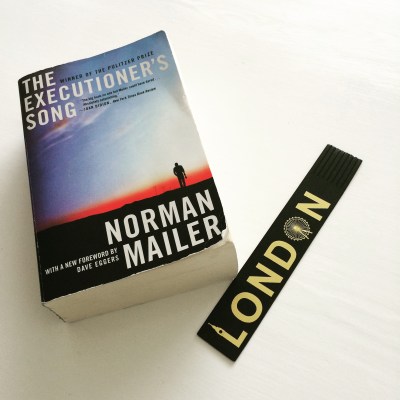
12 Classics in 2015 (2016 version): The Executioner’s Song

I set out to read 12 classics in 2015. Technically, I finished seven in 2015 before I, quite optimistically, took on The Executioner’s Song, the 1109 page Norman Mailer book about Gary Gilmore. The plan was to finish this book in 2015 and then sprinkle the remaining days of 2015 with four slim classics. I didn’t get there. I finished the last page of ES last Monday.

Having never read a book over 1,000 pages before, I was fooled by Dave Egger’s quote on the back of Mailer’s book. “…It’s the fastest 1,000 pages you will ever know.” Well, it is the fastest I’ve ever read a book of this length, but certainly not the shortest amount of time I have taken to cover 1,000 pages of prose.

What is obvious in my completion of this book is that it was good. I would not have continued past page 300 if it was poor. I knew nothing about Gilmore going into the book. I’m not sure I had ever heard of him. This, Eggers wrote in the introduction, is one of the best scenarios for reading ES. In fact, Eggers urges Gilmore-clueless people to stop reading the introduction at this point and skip to the boIMG_8500ok. That’s what I did and I am ever thankful for it, for if I knew Gilmore’s fate there would be no suspense to carry me through to the last page.

I can’t believe someone would undertake such a vast project to tell Gilmore’s story, but Mailer somehow did it and painted a thorough picture of all the primary actors in Gilmore’s life (and there were a lot), giving the reader a complex cast of characters, matched only by the complexity of Gilmore.

Knowing what we know about Gilmore, that he killed two people, you want to dismiss him as a sick, bad person. But it’s amazing the people he wins over from the time he is arrested to the time he is executed. People poised to make a lot of money off of Gilmore’s death decide in the end that they can’t do it. They respect, even love, Gilmore too much to do that to him. This was the most surprising part about the book. There was this side to Gilmore that was very intellectual, caring, and even nice. Although his temper could flare up in the briefest of exchanges.

I enjoyed The Executioner’s Song. The book was worthy of derailing my original plan of reading 12 classics in 2015, for by finishing this book alone I feel like I accomplished something significant. That said, I am quite relieved to know that I can move on to the books that have been stacking up while I made my way through The Executioner’s Song.

What Makes You Happy?

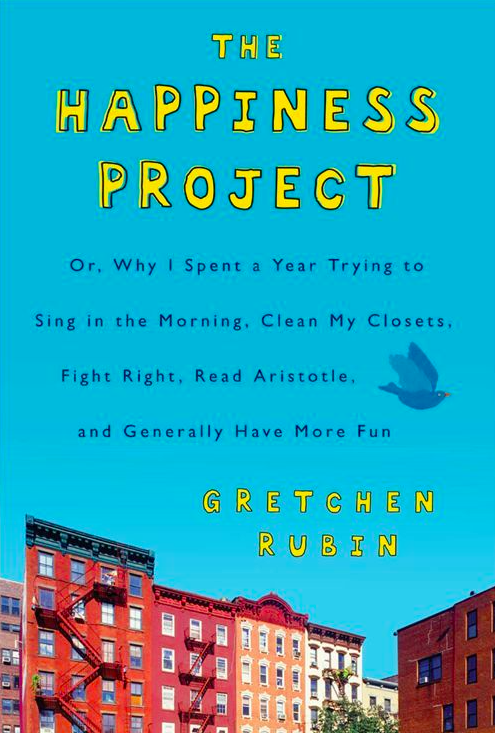
With encouragement from my wife, I am very slowly reading The Happiness Project by Gretchen Rubin. I have enjoyed reading about Rubin’s year-long journey to a happier life.

The book includes a nice mix of practical and philosophical advice for a happier life. In Screen Shot 2015-09-06 at 11.59.48 AMthe last chapter I read, Rubin spent a fair amount of time writing about what makes her happy. She kept asking herself, am I happy doing this? She asked her readers, what makes you happy? In response, Rubin and her blog readers concluded that what truly makes them happy is not always what they wish made them happy. For example, Rubin might be happiest being at home reading a book without interruption, but in her mind she is tormented by the thought that she might be happier on a hike even though she knows perfectly well that is not going to make her as happy.

Since reading the chapter I have been thinking about what sort of activities make me happy. At this point in my life, being able to do something without interruption makes me happiest. It does not really matter what that something is. If I can sit down and watch a movie without interruption, I am thrilled. Read a chapter of a book without being interrupted? So refreshing and invigorating. Refinishing an end table for our living room without an interruption? This actually give me a strong sense of accomplishment, which combined with the effort it takes to refinish furniture, gives me a lasting happiness that helps me through the menial tasks of SAHD duty: diaper changes, bottle service, dishes, laundry, house-cleaning, etc.

So, today, I set out to do a few things without interruption. One, go to Novo Coffee and read a couple of articles in Vanity Fair without interruption (done). Two, write a blog without interruption (currently in progress). Three, go home and eat lunch while watching an hour of television without interruption (coming soon). Four, work on refinishing an end table without the worry of being interrupted (also, coming soon).

Time for number three.

The House Is Not For Sale

The last time I had a garage sale I priced every item, including the house. There were no takers that day. And on Saturday, when I finally had another garage sale this house was not for sale.

Instead, this garage sale was one in a series of steps we needed to take in order to finish the basement. There is a lot of stuff down there that we do not use and no longer have a need to hold onto, such as English class notes from UW, which I mentioned a couple posts ago.

IMG_6938

Ready for the deals!

Saturday was a huge success for us. At the end of the day we did not move that much stuff back into the basement. The majority of goods we sold and then we had one carload of them left for Goodwill.

Among the items, which did not sell, is a dining room table with two leaf inserts and six chairs. Interested? Leave a comment because this thing is going up on Craigslist for a sweet price. There were some leftover books, a few from my grad school days at DU. It wasn’t all that surprising to know the demand for The Market for Force: The Consequences of Privatizing Security is not that high, but why not try? But my two copies of Goodfellas on DVD (one of them unopened!) didn’t sell either. Are people insane? Have they not seen this movie? One of the all-time best. Watch it. Tonight.

One of the puzzling things about garage sales is what sells and what does not sell. A sturdy, still-in-good-condition wingback chair from the American Revolution did not sell, but someone bought Gone In 60 Seconds (eww, 24% RottenTomatoes score) for a dollar? This does not make sense. And that chair, well, it’s not quite that old and it found its way back into the basement. I had a collection of Pepsi cans for the last 16 years. It was a set of 24 collector cans from the release of Star Wars Episode I: The Phantom Menace. They sold for $3 after pricing them down from $10. Although when I was 16 and collecting these cans I had a fantasy of selling them for a couple hundred dollars sometime in the not-too-distant future, but by 10am on Saturday, selling them for three bucks was one of the best moments of the day.

IMG_6940

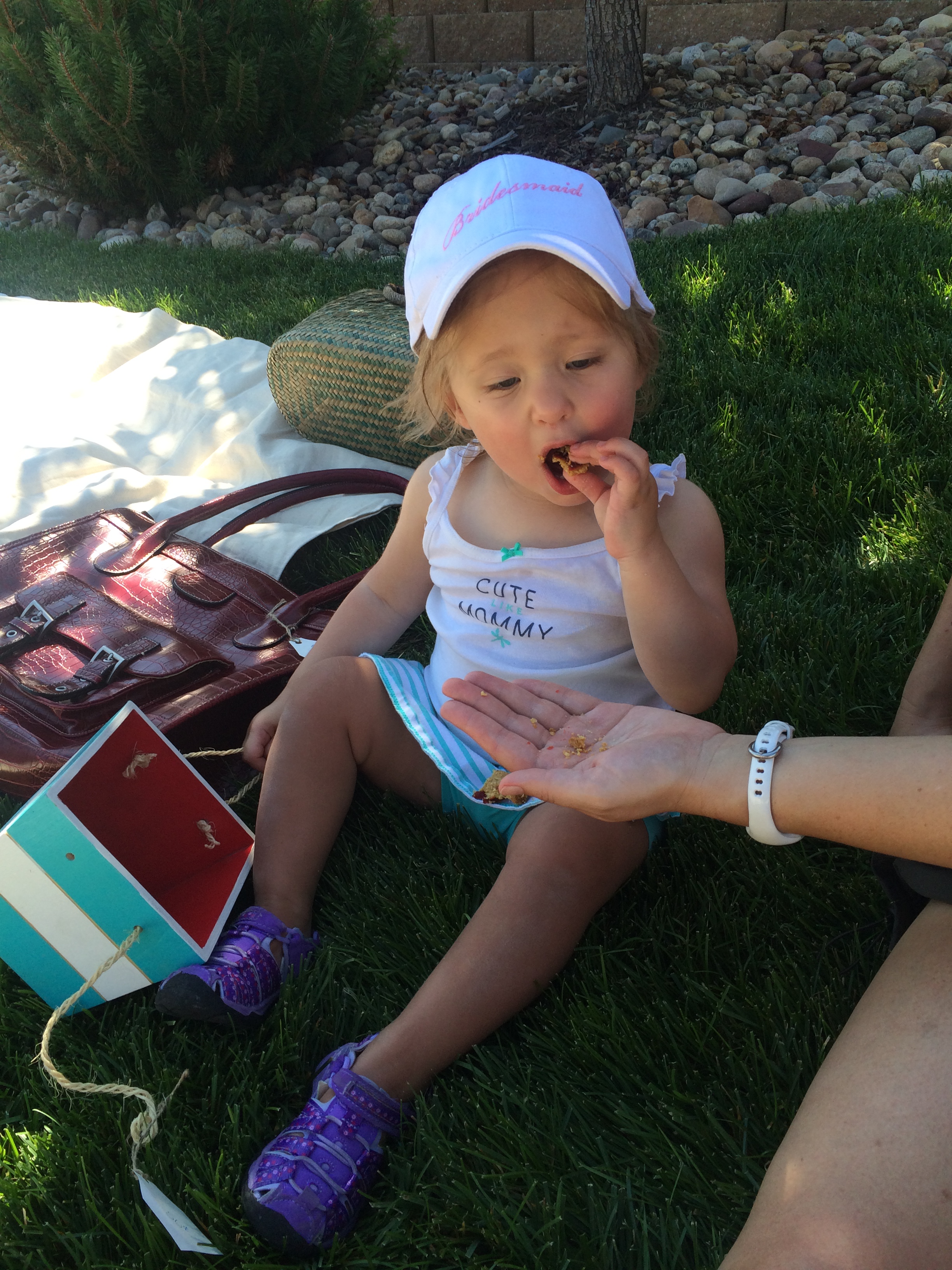
Tired now. Ready for a snack!

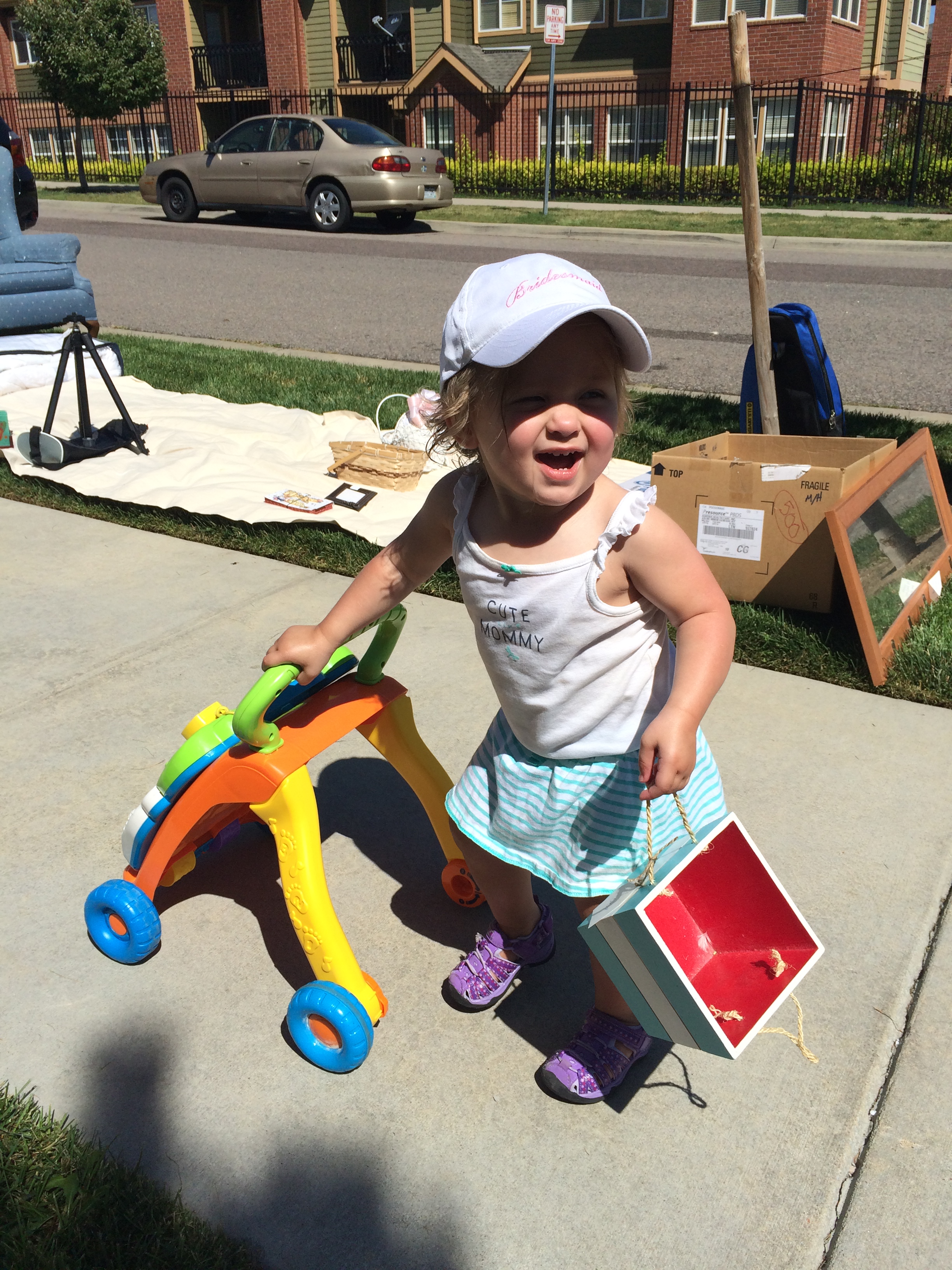
After the early rush of professional garage sale shoppers, who show up early or even before the sale starts, lump everything they want to buy in a pile, and then ask you what you will part with it for, there was quite the lull. I think we didn’t have any interest for an hour. This cute little lady came by with her push toy looking for some deals. She found some shade instead and a granola bar.

After the lull, the stragglers seriously impressed. One of them bought my Pepsi cans, size XXXL standard issue sweatpants from the University of Wyoming athletic department, a Starbucks shirt from my barista days, and Unbreakable on DVD. One big ticket item was left, my mountain bike. It was time to clear space in the garage for my next bike, which will not be a mountain bike. Plus, these are just some of the repairs the bike needed: new rear tire, new rear wheel, new disc brake pads, new bike seat, some spoke fixing on the front wheel, and a thorough tuneup. After a few hours, I did not think it was going to move. Right about the time we were thinking of packing everything up it sold. I was a little proud of the bike in this moment and of how I had kept it together for so long, even when it meant using gorilla glue to hold the spokes in place.

Now that the bike was gone and it was going on 12, we started packing up. A couple lucky shoppers got an old digital camera for free and a copy of Command and Conquer: Generals for nothing!

But still, the table and chairs remain untouched. Someone still has yet to get that lucky!

The Next Book For London

The next book I read to London has impossibly big shoes to fill. What can knock Screen Shot 2015-08-11 at 4.39.35 PM4,100 pages of Harry Potter off the top? Well, it isn’t Bill Bryson’s A Short History of Nearly Everything or ASHONE for short. That’s right, I went full nonfiction science writing for the next book. I needed a change of pace and I am quite sure London won’t notice, except for the expanded vocabulary in Bryson’s work compared to HP.

I love Bill Bryson’s writing. Somehow I had owned ASHONE for ten years and had never read it. London and I cracked open the book a couple of weeks ago, validating my purchase of this book in a Borders (remember them?) in Longmont, Colorado all those years ago. We are only a hundred pages in, but I’ve found that I am not enjoying this as much as his travel writing. There just aren’t as many opportunities in science writing for Bryson to add his signature humor. That said, it’s still an excellent book. Bryson makes the hardest of subjects accessible by writing about them in the common tongue.

One of my favorite passages early on in the book is from chapter two:

…it isn’t possible, in any practical terms, to draw the solar system to scale. Even if you added lots of fold-out pages to your textbooks or used a really long sheet of poster paper, you wouldn’t come close. On a diagram of the solar system to scale, with Earth reduced to about the diameter of a pea, Jupiter would be over a thousand feet away and Pluto would be a mile and a half distant (and about the size of a bacterium, so you wouldn’t be able to see it anyway). On the same scale, Proxima Centauri, our nearest star, would be almost ten thousand miles away. Even if you shrank down everything so that Jupiter was as small as the period at the end of this sentence, and Pluto was no bigger than a molecule, Pluto would still be over thirty-five feet away.

I absolutely love reading about how huge space is. And this is just our solar system.

I always think about God when I think of space, its scale, its never-ending mysteries, because for me, space has always been one of those things in which I see the presence and power of God. Pure awe.

I’m looking forward to the rest of this no-longer-dusty Bryson book.

DVDs $1, Stories Are Free

This house and its occupants are prepping for a garage sale this week. London’s help is extremely limited to nonexistent. She takes a long time examining every little thing we hand her, so she won’t be determining what we are getting rid of and what we are saving. She is most helpful when she decides to take a long morning nap on a Sunday so we can dig through the basement for potential hot ticket items.

We found lots of things to sell yesterday and just as much to throw away or donate. I discovered I had three copies of Goodfellas. (Hey, if there’s one movie to own several copies of it’s that one.) I have a DVD player to sell, but I can’t seem to locate the power cord or the remote. I am finally going to sell my Star Wars Pepsi can collection from one movie, which was both the most anticipated movie of all time and the most disappointing movie of all time, The Phantom Menace. But this can collection? Pristine. Complete. It represents a lot of work. It represents a lot of soda drinking.

For some reason I still had the majority of my class notes from the University of Wyoming. I chucked them all, but kept a few stories to possibly share on here. I threw out two boxes of old New Yorkers, magazines I had been saving because there was at least one tantalizing article in each magazine. I had lofty visions of getting to all of them some day, but having so many magazines and books I want to read around the house can really stress me out. It almost leads to less reading because I see the stacks everywhere and just think, I’ll never make it, why start now?

So, to those stories. I’m going to close this post with one. Please note, these are not my words. It was an assignment in an undergrad writing class for which you had to use a minimum number of sources to build one story or essay using nothing but quotes, a literary collage. And, here it is…

What I recall isn’t pain but a sense of jarring reversal, as of all motion, sound, and light encountering their massive opposites. I felt grass and dirt against my cheek, and sorrow that Dad was shot, and confusion that I couldn’t reach him. (1)

As I saw the last blue line of my native land fade away like a cloud in the horizon, it seemed as if I had closed one volume of the world and its concerns, and had time for meditation before I opened another. (2)

I shut my eyes, the old morte settled its grip, and the next country gathered itself under my feet. (1)

The grey rain-curtain turned all to silver glass and was rolled back, and he beheld white shores and beyond them a far green country under a swift sunrise. (3)

I waded ashore with measureless relief. The bank was an even slope of waving knee-high grasses and I came up into them and turned to look back. It was a wide river, mistakable for a lake or even an ocean unless you’d been wading and knew its current. Somehow I’d crossed it and somehow was unsurprised at having done so. (1)

There came into view a man, or so it seemed. (4) He had a blue coat and a long brown beard; his eyes were blue and bright, and his face was red as a ripe apple, but creased into a hundred wrinkles of laughter. In his hands he carried on a large leaf as on a tray a small pile of white water-lilies. (4)

“This is what we all find when we reach this country. We’ve all been wrong! That’s the great joke. There’s no need to go on pretending one was right! After that we begin living.” (5)

The words uttered by the person without, affected me as somewhat singular, but what chiefly rendered them remarkable was the tone that accompanied them. It was wholly new. I cannot pretend to communicate the impression that was made upon me by these accents or to detect the degree in which force and sweetness were blended in them. They were articulated with a distinctness that was unexampled in my experience. But this was not all. (6)

“We do not want you to become lazy, but to imitate those who through faith and patience inherit what has been promised.” (7)

It (the words) imparted to me an emotion altogether involuntary and uncontrollable. When he uttered the words my heart overflowed with sympathy and my eyes with unbidden tears. (6)

He sat down on a rock and swung his feet in a stream–it was deep and swift; it would take him in a moment. I seized his arm. Please, I said. Soon, he replied, which makes better sense under the rules of that country than ours. Very soon! he added, clasping my hands; then unable to keep from laughing, he pushed off from the rock like a boy going for the first cold swim of spring; and the current got him. (1)

Is there a single person on whom I can press belief? No sir. All I can do is say, Here’s how it went. Here’s what I saw. I’ve been there and am going back. Make of it what you will. (1)


Sources:

(1) Enger, Leif. Peace Like a River. Atlantic Monthly: New York, 2001.

(2) Irving, Washington. The Legend of Sleepy Hollow and Other Stories. Penguin: New York, 1978.

(3) Tolkien, J.R.R. Return of the King. Houghton Mifflin: Boston, 1955.

(4) Tolkien, J.R.R. The Fellowship of the Ring. Houghton Mifflin: Boston, 1954.

(5) Lewis, C.S. The Great Divorce. Harper: San Francisco, 1946.

(6) Brown, Charles Brockden. Wieland. Oxford: New York, 1994.

(7) Hebrews 6:12. Bible.
 

Blogging Away Resistance

You may have noticed that for a while in the late spring and early summer I was writing a lot on here. Every weekday I would sit down and write something. I was going strong. I was practicing my craft and sharing whatever came to mind. Traffic to the blog steadily increased too.

And then nothing.

Two-week and three-week blocks would pass without me writing anything at all. And when I wrote, the posts weren’t so much related to raising London at all. There were a few book reviews and a little something about Jon Stewart’s last show.

Some of this absence is explained by some summer and spring trips. We are once again free to move about the country with no complications other than those standard hiccups that come with a baby (even though she wears 3T clothing, she’s still technically a baby).

The rest of the absence can be attributed to me thinking it is healthy to take a break from writing every so often and then just a dearth of ideas. The writing break I’ve always been a fan of. It is healthy, but this break has been unhealthily long due to this creeping feeling that I am just contributing to the noise, that is, the saturation of our world by parenting blogs.

I have been having an internal debate about what is worthy of writing about. There is a part of me that wants to write as much as I can on here. And there is also this part that just does not want to spew forth words just for the sake of it. There is a part of me that realizes the stupidity in having a blog about fatherhood. There are thousands of them out there. And there have been billions of fathers before I became a father. What do I have to contribute to fatherhood that has not already been contributed? Is there anything original for me to unearth, create, or ideate?

Well, for a while now the part of me that answers no to that question has been winning the debate. And I think that is the resistance Steven Pressfield writes about in his amazing work, The War of Art.

Coming up with words to share on this blog is moderately difficult for me. But giving into resistance and batting away those words while admonishing myself for ever thinking they were worth putting out there is very, very easy to do. This is the “War of Art,” and it is so unbelievably hard to be in when you think of yourself as a creative, whether you are drawing, writing, painting, sculpting, photographing, or whatever it is that you create.

I have not written these words anywhere else. Sitting down with my computer now and explaining my absence was as much for me as it was for the followers of this blog. I hope it means I return to regular blogging, but even as I write this I fear the next time the fuel gauge reads empty. That thought alone is almost enough to put a halt to the journey right this minute, but I am not there yet.

Pressfield writes that resistance will bury you. Okay, maybe I was a little buried there for a while, but for now, for now I am above ground.

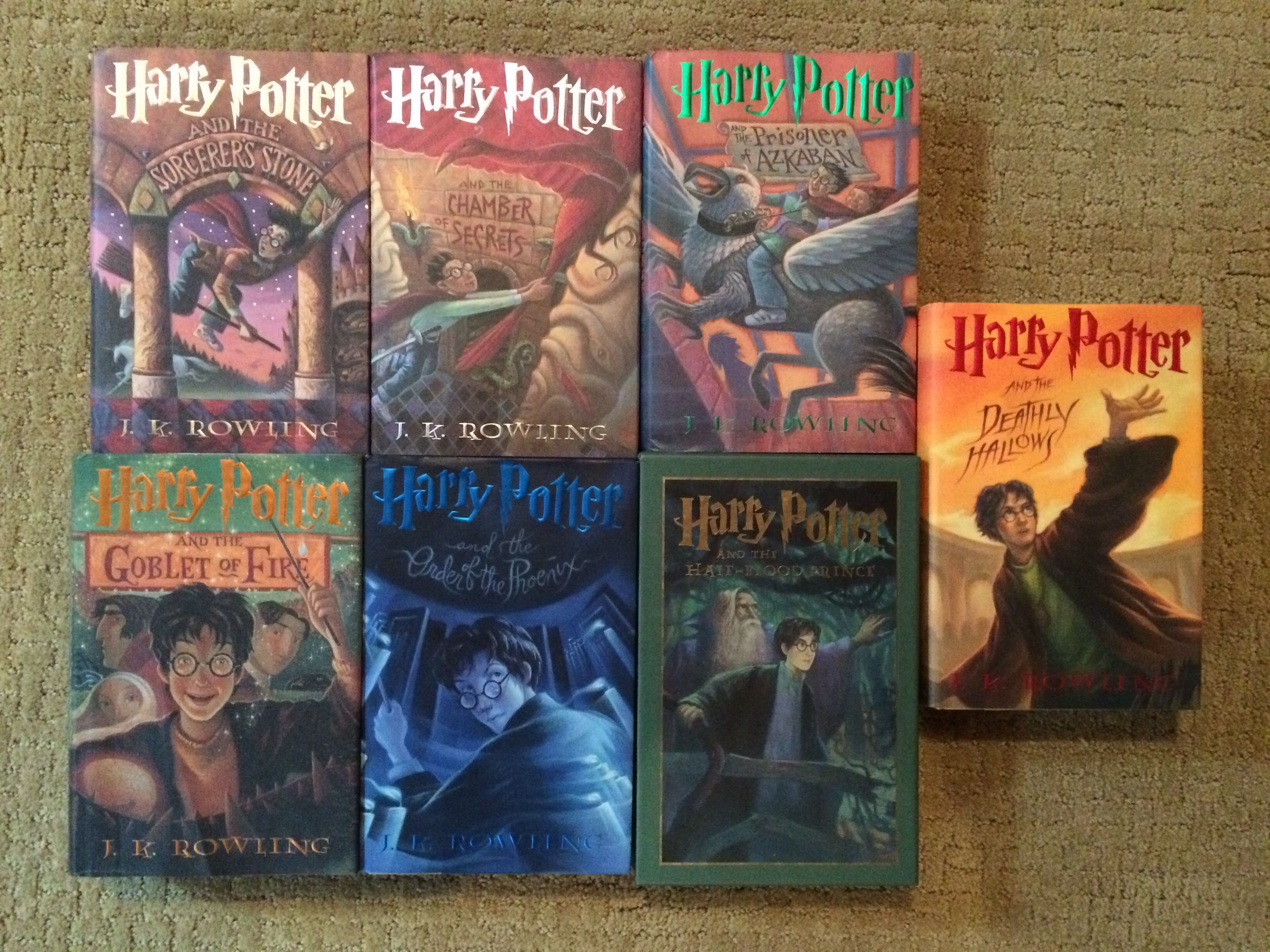
4,100 Pages of Harry Potter

On July 16th, I read the last page of the Harry Potter books to London. It had taken me one year, two months, and four days to read that page and the previous 4,099 to her. Before May 12, 2014, I had never made an earnest attempt at even reading the first book. I had made more of an attempt at watching the movies, but had only made it through the first two and started and failed to finish the third movie on several occasions.

By the time I got to page 759 of Harry Potter and the Deathly Hallows, I felt I was finishing more than a book, but a saga of both literature and life. The obvious saga, that of Harry Potter’s journey from Four Privet Drive to the climactic duel with Lord Voldemort, and the less obvious saga, of London’s journey from her 102nd day in the NICU (the day I started the first book) to her fourteenth month at home, and her seventeenth month of life.

HP Books

Beautiful artwork on all the covers of these increasingly heavy books.

When I cracked open Harry Potter and the Sorcerer’s Stone it was an act of therapy. I did not know if I would finish all the books. I did not know if I would be able to read all of them to London. However, as time went by, it became clearer and clearer to me that I would finish the books, that London would hear every page of these books, and that just because we got out of the NICU did not mean the reading of the books ceased to be therapeutic.

In the beginning, it was easy to find time to read Harry Potter to London. I would place her on a pillow in my lap and could read for as long as I like really, assuming she was oxygenating well and in a comfortable position. When she left the NICU, I read several times a day to her, while she was on the floor making cooing noises, while she was falling asleep, and while she was taking a feeding from her NG tube. Later on, I only read to her as she fell asleep for naps. And a little later on from that, she stopped falling asleep if I was by her side reading Harry Potter. This coincided with her ability to pull to a standing position, so she would stand inside her crib and reach out for the pages of the book and get frustrated that she couldn’t grab them.

Eventually, I had to start reading Harry Potter to her when she was in the living room playing with toys. By this last stage, I knew that my voice comforted her. I could read a whole chapter and sometimes two while she played. I may have pushed the limit on July 16, when I read the last sixty pages to her in one sitting as she drained all the fun out of one toy to the next until she was clearly wondering why I had been reading to her for so long without any breaks.

On more than one occasion during the last several days of reading Harry Potter I choked up because it would dawn on me that I am almost done with the books, or I would remember in a flash how far London has come over these 4,100 pages, so incredibly far as you may know.

I take great joy in knowing that I will be able to read these books once again to London when she is older and able to follow the plot. Perhaps I won’t read every word aloud to her. She might take over. That is fine with me. I know I will always be reading with London.

*Special thanks to my wife’s family who let me borrow all of their pristine, hard cover, first edition Harry Potter books.

12 Classics in 2015: The Stranger

I enjoyed picking up another slim volume, knowing I would finish this next book in two or three sittings. The Stranger, by Albert Camus, is a study of the absurd arc of all lives. It focuses on one man, Meursault, who kills a man on the beach in the first part of the book. Meursault’s trial constitutes the second part of the book.

Meursault, to me, felt very little emotion other than his lust for Maria, his girlfriend and, possibly, future wife. And although I saw some justification of him shooting the man on the beach, Meursault seemed to hold none of the same justification. He seemed only to defend his atheistic beliefs, and nothing else. He is a sad figure, not because I am a believer and he is an atheist, but because he seems utterly defeated by the absurdity of life. He refuses to use religion or the legal system to comfort or free himself because he recognizes the futility in prolonging the truth: that we will be born, we will die, and then no longer matter. All of us.

Meursault is a Debbie Downer, but Camus channels his philosophy quite well through Meursault’s actions and words. Interestingly, Meursault becomes happiest when he gives up all hope of a life, long or short, and accepts that any path he goes down ends the same.

I certainly don’t see eye to eye with Camus on this. I recognize that life can indeed be absurd and it will yell at us again and again, “resistance is futile,” but resisting is one of the hardest and most rewarding parts of life. It amplifies everything, the valleys, the peaks, the springs, and the winters of our lives. I believe it makes for a richer life, which looks better to me than Meursault’s fate of a jail cell and decapitation.

12 Classics in 2015: The Jungle

The Jungle is widely known as the book that turned the public’s gaze upon the meat industry. Months after the novel’s publication, the Food and Drug Act went into effect. The public was disturbed to find out that their chances of eating rotten and diseased food were quite good, as the condition of the slaughterhouses was revolting and what oversight existed at the time was a farce.

This was a positive reaction from the public, but Upton Sinclair did not mean to turn the people’s fervor toward the meat industry alone. Sinclair’s primary protestations regarded the labor conditions and complete lack of workers’ rights. Indeed, that is what struck me about the book. Sure, the descriptions of the making of sausage with scraps of meat and innards from the floor and the drains, and the tubercular cows passing right by the “screener”, are disturbing. But the human suffering detailed in the book is far more painful to endure. It lasts from shortly after the first chapter to the very last (357th) page.

The book’s main character is Jurgis Rudkus. You get the impression that the lion’s share of his life is lived out on these pages. What life Jurgis does have plays out like a train wreck. You see everything coming before he does. Blow after blow Jurgis is dealt with no means to protect himself or to save his family from abject poverty. My heart ached for Jurgis and every member of his family and for all those wasting away in Packingtown, the meat-packing area of Chicago.

I am thankful that workers’ rights are a thing now. No one spoke of them in The Jungle until the very last pages of the book, which is a screed in support of Socialism, one of Sinclair’s great causes.

The struggle of the working class is still very real. More than once I thought of fast-food workers, who are campaigning for greater pay because of the poverty they are forced into by trying to support a family on the current minimum wage, and I recognized that they are a group of people who would be at the heart of The Jungle if it were written today. Sinclair would be pleased to know that these workers don’t have to work 7-5:30 Monday thru Saturday just to keep their job, but many still work those hours because one job is not enough. A second is needed to scrape by.

The Jungle is a serious book with an intensely dark and sad narrative, but also a book with a surprising appeal to the reader to read just one more page. I found it enticing, even though with every new page Jurgis encountered his next setback or you could make out the train wreck on the horizon a little better. Out of the six classic books I have read this year, The Jungle has surprised me the most with its novel subject matter and its desperate plea for help from the immigrant masses who are still growing, tending, picking, and packing our food.

12 Classics: Brave New World

I would not quite believe Suzanne Collins if she said she took no inspiration from Aldous Huxley’s Brave New World for her Hunger Games series of books. Some of the elements in the books are too close to one another for it to be a coincidence.

Moving on.

I read a classic book looking for that one element that explains why said book is classified as a classic. Sometimes it is the quality of the writing, or the twisted, complex plot that you never thought someone could come up with. There are too many elements of a classic book to write about them all, but I will mention one more, sometimes it is a particular passage, which resonates more strongly than any other portion of the book. For me, this was the element in Brave New World that made it a classic.

The passage I am speaking of takes place near the end of the book, when the Savage is speaking with Mustapha Mond. The Savage is challenging Mond on the decision to “civilize” a society in the way that Mond and other directors have. Mond attempts to justify why he and other directors/controllers are correct. Both men frequently reference Othello to support their arguments, although Othello benefits the Savage’s points more appropriately.

The Savage speaks of the “feelies” the “civilized,” modern equivalent of a book or movie, i.e. mass entertainment. He says, “Othello’s good, Othello’s better than those feelies.”

“Of course it is,” the Controller agreed. “But that’s the price we have to pay for stability. You’ve got to choose between happiness and what people used to call high art. We’ve sacrificed the high art. We have the feelies and the scent organ instead.”

Mond later mentions science as being in the same category as high art:

“Yes,” Mustapha Mond was saying, “that’s another item in the cost of stability. It isn’t only art that’s incompatible with happiness; it’s also science. Science is dangerous; we have to keep it most carefully chained and muzzled.”

What a prescient passage. Keeping science under lock and key has become a huge task for climate change deniers, oil companies, and pleasant men like Senator Jim Inhofe who brought a snowball into Congress to support his argument that global warming is a hoax. Mind you, it was February…in Washington D.C.

The Savage and Mond argue back and forth for quite a few pages. The Savage closes with a point about the inconveniences in life, the inconveniences Mond and others have tried so hard to eliminate.

“But I like the inconveniences.”

“We don’t,” said the Controller. “We prefer to do things comfortably.”

“But I don’t want comfort. I want God, I want poetry, I want real danger, I want freedom, I want goodness. I want sin.”

“In fact,” said Mustapha Mond, “you’re claiming the right to be unhappy.”

“All right then,” said the Savage defiantly, “I’m claiming the right to be unhappy.”

“Not to mention the right to grow old and ugly and impotent; the right to have syphilis and cancer; the right to have too little to eat; the right to be lousy; the right to live in constant apprehension of what may happen tomorrow; the right to catch typhoid; the right to be tortured by unspeakable pains of every kind.” There was a long silence.

“I claim them all,” said the Savage at last.

Mustapha Mond shrugged his shoulders. “You’re welcome,” he said.

This discussion is why Brave New World is, at least for me, a classic. Inconveniences are certainly not all pleasant, but they are the price we pay for freedom. They make for a fuller, richer life; a life, which thanks to inconveniences, produces high art. I like high art.

What Not To Read

Once London arrived, I was intent on researching preemies because I did not know a thing about them. The very kind nurses gave me a book on day two or three, cannot remember exactly, but I took it with interest. It was The Preemie Primer, written by an MD who gave birth to preemie triplets. Interested in what I would find out about our situation, I opened to the prologue and started reading, right there in the NICU. But how could any brand new parent of a preemie get past this passage detailing the very premature birth of one of the author’s triplets:

And then the worst words that I have ever heard, “Do you want to hold your son? He is dying.”

That is the first sentence of a paragraph. I did not make it to the second, at least not right then. I started to cry and quickly shut the book and put it aside, not touching it for weeks to come. Now, half a year later, I think I can enjoy what this book has to offer. However, I would not recommend it to brand new parents of preemies. At the very least, I would skip the prologue altogether. The thing about a book like this and others (like What to Expect When You’re Expecting) that aim to guide you through a critical time in your life, is that they do present all the worst case scenarios. There are good intentions, I am sure, but reading through them all is like getting on WebMD and self-diagnosing every time you come down with a weird rash or a string of very serious headaches. In other words, reading them can do more harm than good.

That said, Preemie Primer seems to be enjoyed by many readers, so I do intend to read relevant passages in the coming days, weeks, and months. Just don’t crack it open when there is even a chance of hearing those same words (quoted above) spoken to you.