Welcome to the Pump House: Adventures in Fatherhood and Breast Milk Management

A version of this post appeared on my blog years ago when London wasn’t even a year old. But I just tweaked it a bit, slimmed it down , and added here and there. I think it’s better now. Here it is…

Never in my wildest dreams, as I prepared for fatherhood, did I think I was going to spend so much time with lactation nurses, reviewing the intricacies of hand expressing (including motions), analyzing breast milk volumes, discussing engorgement, and just how much breast milk one could fit in a chest freezer.

A few hours prior to my meeting with lactation consultants, thinking there were three more months to learn these things, I didn’t even know lactation nurses existed. I knew that some babies were born prematurely, but I didn’t know my wife’s breast milk would still come in just as early as our daughter wanted out at 26 weeks gestation.

So it was that our 109-day stay in the neonatal intensive care unit (NICU) started with a crash course in breast milk. Within those first days of life for my daughter (London), my wife (Kate) and I spoke at great length with not just one lactation nurse, but several of them about breast milk and breasts, starting with a nurse asking my wife if she was going to pump breastmilk. Partly due to the trauma of the last 24 hours, and partly due to my complete lack of knowledge about breastfeeding, I had not thought a bit about breast milk or pumping. Kate was of a similar mindset at that particular moment, but we were both satisfied to know that there was a good chance Kate’s milk would come in. The early drops of colostrum, the nutrient-dense milk first released by the mammary glands, often come in shortly after the placenta detaches from the uterine wall, no matter the gestational age.

A couple of hours later a lactation nurse wheeled into our room something that looked like a medieval torture device. They were calling it the Symphony. They hooked Kate up to it and it hummed and sucked for 18 minutes. At the end of that first session, we could just barely make out two milliliters of colostrum. A few hours later Kate produced 2.6ml and then later that night 3.8ml. The next day, January 31, marked Kate’s first 24 hours of pumping. She produced 32.6ml that day, or 1.1 ounce. The lactation team handed us a log with the direction that we were to write down when Kate pumped, for how long, and the total volume.

We then received a DVD to watch, which would apparently help Kate get more milk by hand expressing and provide tips to alleviate the pain of engorgement. We were to watch it and return it to the NICU team afterwards. That same day, we popped the DVD into my laptop to watch some before going to bed. One minute into this educational video, the biggest breast and nipple either of us had seen appeared on screen. Kate laughed so hard she began to worry she might injure herself being only two days clear of a C-section. Everything hurt. If we continued watching, we put Kate’s health at risk. I slammed the laptop shut. Tears ran down our cheeks from laughing so hard.

Who knows who is responsible for making this particular lactation video, but may I make one small suggestion on behalf of my wife and all women who have recently had C-sections? Great. Do not make the first breasts on the video also be the largest breasts known to mankind. They should not be comically large, needing 3-4 hands to get them under control. In fact, this video is a danger to new mothers everywhere, they might literally bust open their gut laughing from it, like we almost did.

Thus, it fell on me to watch the lactation video alone, gleaning from it any helpful tips and then sharing them with Kate. She was impressed. It wasn’t like Kate’s breast milk volumes needed any help. Not long after London was born, I was spending part of everyday rearranging containers of breast milk in the chest freezer in the basement—the chest freezer we needed to buy solely to store breast milk. Kate and I would joke that I knew more about hand expressing breast milk than she did so I should print up some business cards and walk around the NICU offering my services to anyone who needed them. Hand Expressions by Bryce. Simple and to the point.

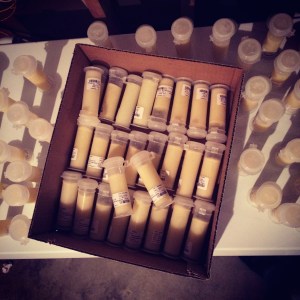
By day of life 57 for our little girl, Kate was producing 1,863ml a day, or 63oz of breast milk. To put that in perspective, London was fed a total of 800ml on day 57, the most she had ever consumed in one day. In fact, it took London a long time to drink as much milk in one day as Kate got from one 20-minute pump. A point was reached where no amount of rearranging the breast milk in the freezer would make room for more. I picked up a second chest freezer at Costco and Kate started to fill that, too.

For the months London was in the NICU we rented a Symphony pump, which at the time retailed for $1500-2500, and kept it in our bedroom. We started to call it the pump house. When at home, Kate disappeared every three to four hours to spend some quality time with the Symphony. As all moms know that schedule wreaks havoc on sleep and work responsibilities, but Kate did an excellent job. I did what I could by waking with her every time throughout the night, assisting in bottling of the milk, labeling and recording volumes, washing pump parts, and then delivering milk to the freezers in the basement. So, at our house, at least two times a night, Netflix and chill was swapped out for Netflix and pump.

As Kate tapered off the pump, we were just filling up the second chest freezer and the lactation nurses understood why Kate was putting an end to pumping. She had developed a reputation in the NICU as a super producer. At London’s discharge, on May 19th, 109 days after she was born, the NICU staff wrote messages to us. One of our favorites from the lactation team wrote, “Your mom was a rock star with pumping. She could have fed three babies in the NICU!”

Next week, London will be six-months-old and I can thaw breast milk from three months back. And right now it’s lunch time for the little girl, to the chest freezer I go.
A 1 ml Bottle

A long way from a full feeding, but a good start.

There were about two months of training from the day (February 27, 2014) I took this video of London until she could take a crack at an actual bottle. What an amazing step for her this was. A 1 ml syringe holds quite a bit more milk than that cotton swab we used to put in her mouth. We were thrilled in this moment.

I have posted very few videos on this blog so far, but I have so many I would eventually like to share and perhaps write about. Plus, on days I don’t have a chunk of time to write at length about raising London, sharing a video is a great option.

Welcome to the Pumphouse

Never in my wildest dreams did I think I was going to spend so much time with lactation nurses. We discussed the intricacies of hand expressing (whilst using hand motions), breast milk volumes, engorgement, and just how much breast milk one could fit in a chest freezer. I had no clue that my wife’s breast milk would still come in even though London was born at 26 weeks. I did not know there was such a job as a lactation nurse. But, like so many other things about London’s birth and care, I learned soon enough.

Breast milk, I was told, quite often comes in as soon as the placenta detaches from the uterine wall, no matter the gestational age. And, I soon found out, there is not just one lactation nurse in the NICU, there is a whole damn team, and I spoke at great length about breast milk and breasts with each one of them.

IMG_3159

From the early days, when I thought this was a lot of breast milk.

The day of London’s birth, a lactation nurse stopped by Kate’s room to ask if she was going to pump breast milk. I had not even thought about that. The trauma of the last 16 hours was still settling in and thinking about and planning for the future had not yet crossed my mind. I think Kate was sort of at this point too, but we both were satisfied to know that there was a good chance Kate’s milk would come in. Let us begin then. Lactation brought in a breast pump that looked like a medieval torture device. They were calling it the “Symphony.” They hooked Kate up and the Symphony ran for 18 minutes and at the end you could just barely make out two milliliters of colostrum. A few hours later Kate produced 2.6mls and then later that night 3.8mls. The next day, January 31, was Kate’s first 24 hours of pumping. She produced 32.6mls that day, or 1.1 ounce. Lactation handed us a log, in which we kept track of when Kate pumped, for how long she pumped, and total volume.

A few days later, once we were home, lactation gave us a DVD to watch. Apparently, the DVD would help Kate get more milk by hand expressing and it would provide tips to alleviate the pain of engorgement. We were to watch it and return it in a timely fashion. On the night we received the DVD we popped it into my laptop to watch it before going to bed. We watched approximately one minute before Kate was laughing so hard it was painful, no really, it was very painful to laugh for Kate. She had had a C-section a few days ago. Kate was clearly in too much pain. If we continued watching we would only laugh harder, so I slammed the laptop shut. I had tears running down my cheeks I had been laughing so hard. I don’t know who is responsible for making lactation videos like this, but perhaps, now this is just a suggestion, do not make the first breasts on the video also the largest breasts known to mankind. In fact, moving forward, I would advise the filmmakers to not feature these breasts in any lactation video, ever. They were comically large, needing 3-4 hands to handle them. They were cringe inducing. They gave us an attack of the giggles like nothing had before. Actually, it is dangerous to watch this lactation video. You might literally bust your gut laughing if you have just had a C-section. Or, like me, you might become scared of laughing to death.

We decided that only I should watch the hand expression video. It was too dangerous for Kate to watch again. I would get myself in a very serious mindset and then watch it, hoping to tell Kate what I learned. It took a couple weeks to finally watch the video though. Lactation had twice asked for it back, the first time Kate and I told them the truth, we had tried watching it once already but couldn’t stop laughing. I am not sure lactation found this amusing. The second time they asked for the DVD I knew I had to buckle down and watch. So, one of those days at the NICU I brought my laptop and the DVD with me. While Kate was holding London, I backed my chair up to one wall of the pod, put on my headphones, and watched the lactation video. I kept my cool, not even bursting out in tears or shrieks of disgust. Not once, I tell you.

I shared with Kate what I had learned. She was impressed. Not like Kate’s breast milk volumes needed help. I mean, by now I was spending part of everyday rearranging containers of breast milk in the chest freezer, the chest freezer we needed to buy solely to store breast milk. But Kate’s volumes did increase and she was feeling better too. We joked that I knew more about hand expressing breast milk than she did so I should try to make a little money from it. I could print some business cards and walk around the NICU offering my services to anyone who needed them. I even had a business name, “Hand Expressions by Bryce.” Simple and to the point.

By day 57, or March 28, Kate was producing 1,863mls a day, or 63 ounces of breast milk. To put that in perspective, London took a total of 800mls yesterday  (July 23) and that is the most she has ever eaten in one day. In fact, it took London a long time to drink as much milk in one day as Kate got from one 20 minute pump. After a while I could no longer rearrange the breast milk in the chest freezer. It was full. It took us a while to accept that we were going to need a second chest freezer for milk, but I finally broke down and snagged the second one at Costco, one I had been eyeing for a couple of weeks.

IMG_3564

In foreground, first chest freezer maxed out with breast milk. In background, second chest freezer at the ready.

For a few months we rented a Symphony, which retails for $1500-2500, and kept it upstairs in our room where Kate did most of her pumping. We started to call it the Pumphouse. If we were home, Kate had to sneak off to the Pumphouse every three to four hours to spend some quality time with the Symphony. It was very tough keeping that schedule through the night, but Kate did an excellent job. I woke with her every time throughout the night and assisted in the bottling of the milk, the cleaning of the breast pump parts, the labeling, and then I would deliver the milk to the chest freezer in the basement. While Kate was hooked up to the Symphony we would queue up Netflix. We blew through the second season of House of Cards in thirty minute blasts. We moved on to movies, watching thirty minutes at a time of those too.

Toward the end of April, Kate was tapering off with the pumping. She had not dried up. No, no, no. We had filled over half of that second chest freezer. It was just getting to be too much for Kate to work full time and pump. But by then, the lactation nurses understood why Kate was putting an end to the pumping. Kate had a reputation around the NICU as a “super producer.” One day, a lactation nurse stopped by just to tell us that there might be another mom in the NICU who is producing more milk than Kate. It was impressive for all of us to hear. Good for her.

Much later, when it was time for us to bring London home, we had London’s staff write on one page of the journal we had been keeping about her NICU stay. One of our favorites from the lactation team wrote, “London, Just want you to know what a rock star your Mom was with pumping for you! She could have fed 3 babies in the NICU!! You are a lucky little girl to have the parents you do!”

I too believe Kate was a rock star with pumping. Heck, next week London is six-months-old and I can still dig around in our chest freezer for milk from March. Speaking of milk , it’s 11:30, time to feed her again. To the chest freezer I go.