Welcome to the Pump House: Adventures in Fatherhood and Breast Milk Management

A version of this post appeared on my blog years ago when London wasn’t even a year old. But I just tweaked it a bit, slimmed it down , and added here and there. I think it’s better now. Here it is…

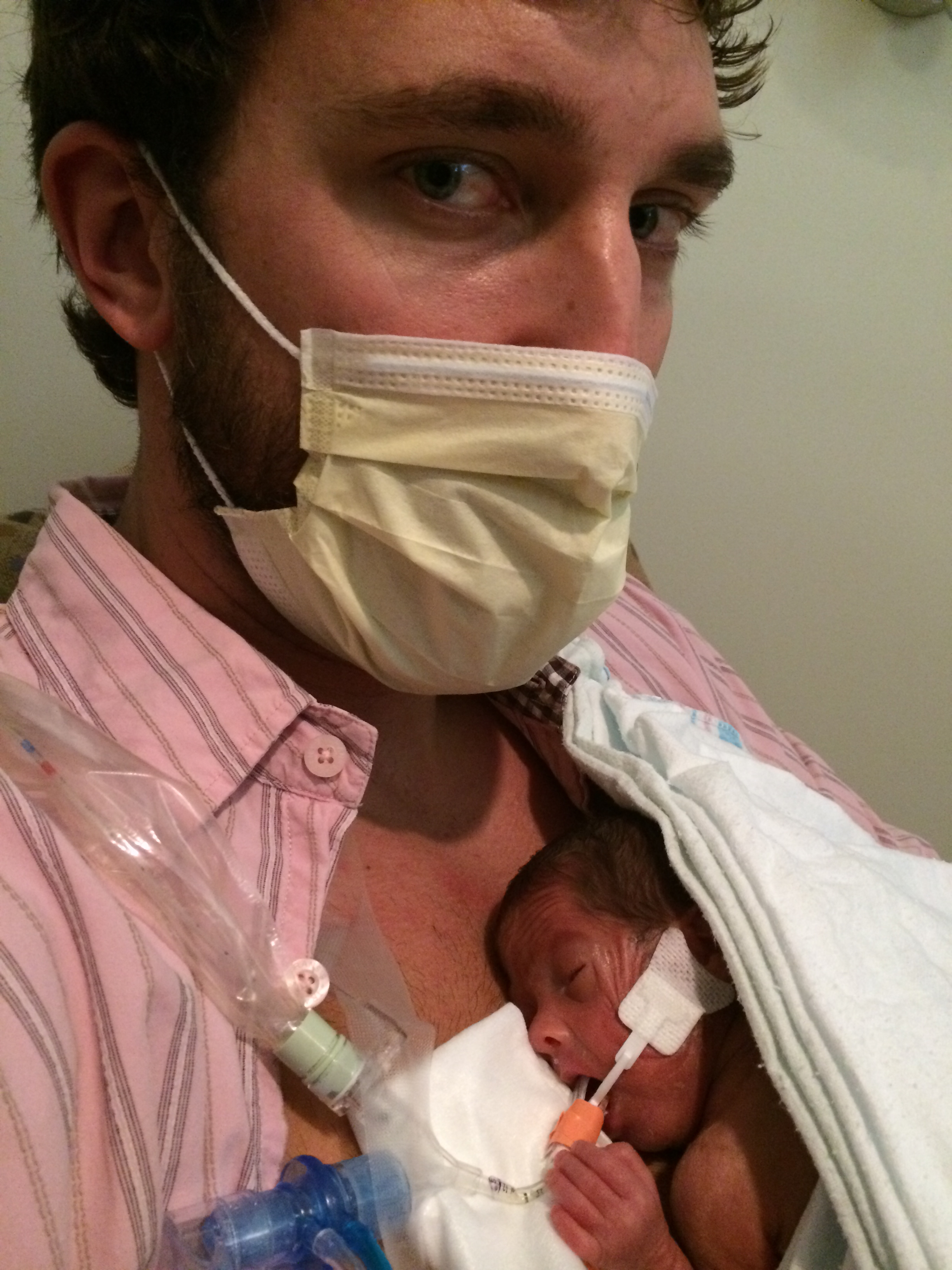
Never in my wildest dreams, as I prepared for fatherhood, did I think I was going to spend so much time with lactation nurses, reviewing the intricacies of hand expressing (including motions), analyzing breast milk volumes, discussing engorgement, and just how much breast milk one could fit in a chest freezer.

A few hours prior to my meeting with lactation consultants, thinking there were three more months to learn these things, I didn’t even know lactation nurses existed. I knew that some babies were born prematurely, but I didn’t know my wife’s breast milk would still come in just as early as our daughter wanted out at 26 weeks gestation.

So it was that our 109-day stay in the neonatal intensive care unit (NICU) started with a crash course in breast milk. Within those first days of life for my daughter (London), my wife (Kate) and I spoke at great length with not just one lactation nurse, but several of them about breast milk and breasts, starting with a nurse asking my wife if she was going to pump breastmilk. Partly due to the trauma of the last 24 hours, and partly due to my complete lack of knowledge about breastfeeding, I had not thought a bit about breast milk or pumping. Kate was of a similar mindset at that particular moment, but we were both satisfied to know that there was a good chance Kate’s milk would come in. The early drops of colostrum, the nutrient-dense milk first released by the mammary glands, often come in shortly after the placenta detaches from the uterine wall, no matter the gestational age.

A couple of hours later a lactation nurse wheeled into our room something that looked like a medieval torture device. They were calling it the Symphony. They hooked Kate up to it and it hummed and sucked for 18 minutes. At the end of that first session, we could just barely make out two milliliters of colostrum. A few hours later Kate produced 2.6ml and then later that night 3.8ml. The next day, January 31, marked Kate’s first 24 hours of pumping. She produced 32.6ml that day, or 1.1 ounce. The lactation team handed us a log with the direction that we were to write down when Kate pumped, for how long, and the total volume.

We then received a DVD to watch, which would apparently help Kate get more milk by hand expressing and provide tips to alleviate the pain of engorgement. We were to watch it and return it to the NICU team afterwards. That same day, we popped the DVD into my laptop to watch some before going to bed. One minute into this educational video, the biggest breast and nipple either of us had seen appeared on screen. Kate laughed so hard she began to worry she might injure herself being only two days clear of a C-section. Everything hurt. If we continued watching, we put Kate’s health at risk. I slammed the laptop shut. Tears ran down our cheeks from laughing so hard.

Who knows who is responsible for making this particular lactation video, but may I make one small suggestion on behalf of my wife and all women who have recently had C-sections? Great. Do not make the first breasts on the video also be the largest breasts known to mankind. They should not be comically large, needing 3-4 hands to get them under control. In fact, this video is a danger to new mothers everywhere, they might literally bust open their gut laughing from it, like we almost did.

Thus, it fell on me to watch the lactation video alone, gleaning from it any helpful tips and then sharing them with Kate. She was impressed. It wasn’t like Kate’s breast milk volumes needed any help. Not long after London was born, I was spending part of everyday rearranging containers of breast milk in the chest freezer in the basement—the chest freezer we needed to buy solely to store breast milk. Kate and I would joke that I knew more about hand expressing breast milk than she did so I should print up some business cards and walk around the NICU offering my services to anyone who needed them. Hand Expressions by Bryce. Simple and to the point.

By day of life 57 for our little girl, Kate was producing 1,863ml a day, or 63oz of breast milk. To put that in perspective, London was fed a total of 800ml on day 57, the most she had ever consumed in one day. In fact, it took London a long time to drink as much milk in one day as Kate got from one 20-minute pump. A point was reached where no amount of rearranging the breast milk in the freezer would make room for more. I picked up a second chest freezer at Costco and Kate started to fill that, too.

For the months London was in the NICU we rented a Symphony pump, which at the time retailed for $1500-2500, and kept it in our bedroom. We started to call it the pump house. When at home, Kate disappeared every three to four hours to spend some quality time with the Symphony. As all moms know that schedule wreaks havoc on sleep and work responsibilities, but Kate did an excellent job. I did what I could by waking with her every time throughout the night, assisting in bottling of the milk, labeling and recording volumes, washing pump parts, and then delivering milk to the freezers in the basement. So, at our house, at least two times a night, Netflix and chill was swapped out for Netflix and pump.

As Kate tapered off the pump, we were just filling up the second chest freezer and the lactation nurses understood why Kate was putting an end to pumping. She had developed a reputation in the NICU as a super producer. At London’s discharge, on May 19th, 109 days after she was born, the NICU staff wrote messages to us. One of our favorites from the lactation team wrote, “Your mom was a rock star with pumping. She could have fed three babies in the NICU!”

Next week, London will be six-months-old and I can thaw breast milk from three months back. And right now it’s lunch time for the little girl, to the chest freezer I go.
How to Help a NICU Parent

A friend recently asked me for some advice. She knows someone who just IMG_3089_127883had a preemie at or around 26 weeks gestation and wanted to know how she could help them out, what to say, what not to say, etc. She gave me permission to post my response to her. It follows:

I am happy to share my advice. Some of it will be based on the assumption that you are in the same town as your brother and Erin and their new daughter, Harper.

Well, having a kid in the NICU is the most exhausting thing Kate and I have ever been through. Very important question: is this their first kid? If not, well, it’ll be even more exhausting than our journey. Anyway, exhausting, so the last thing I ever wanted to do when getting home from the hospital every day was cook. It’s sort of become a cliche, but cooking for them would probably be a huge help. I don’t think Kate and I went to the grocery store for 3 weeks after London was born. Without all the meals we received, we couldn’t give London as much attention as we did. We had one less thing to worry about and that was huge because having a 26-weeker is an all-consuming worry.

The first few days of NICU care are possibly the worst. Once the baby makes it a week, things can start to get a little easier. So now could be the most terrifying of days for your brother and his wife. It all sort of depends on Harper’s situation. Was this an emergency c-section? Did they have 24 hour notice so they could get some steroids to Harper before she was born? London did not have the benefit of steroids before she was born, which really set her back for some time. She was on the ventilator for nearly three weeks, if I’m remembering correctly. I’m not sure what I’m getting at here, but maybe it’s just that I know I was very open about London’s health and situation throughout her NICU stay. I sent out near-daily email updates to a large group of people. I would have never been able to tell all those people independently. So if your brother is open to the idea, I’d recommend that. Or if someone in the family wants to keep other family members and friends dialed into the situation by doing email updates then that would be a big help too.

I’ve completely forgot to mention that it’s so great they named her. I know that naming her is a commitment of the heart and soul that you resist when you see such a small and fragile human being. But it’s a big step and it might bring them some hope. I remember when London was just ten minutes old and being transferred from the OR to the NICU while Kate was still on the operating table, the doctor asked me what her name was, and I was just put on the spot and had to say it loudly enough that everyone in the OR could hear it. I didn’t know it then, but in hindsight, that was a pivotal moment of accepting as truth something I still couldn’t believe was happening.

In terms of what not to say, that’s always tough to answer. You know? It depends on the person’s tolerance of the cliche, like, “Everything’s going to be alright.” We heard that a few times and I may have even said it later on in London’s NICU stay, like in month 2 and 3, but I did not like hearing it in the first few days or couple of weeks even. I just wanted to know the specifics of London’s situation and all I wanted to share were the specifics. I didn’t want to speculate with family members and friends. I just tried to avoid the “what ifs”, so maybe help them do that.

I’ll stop writing after this next point. At three months early, Harper is going to be in the NICU for a long time. It’s important for your brother and Erin to get time away from the NICU. That won’t be right now, obviously, but later on it will be. As a NICU parent you feel the urge to be at the NICU as much as possible, but it is essential to get away from time to time. We wanted our health and our sanity while London was in the hospital and I think we may have lost both if we stayed there round the clock for the first month. Our NICU nurses were exceptional in that they all encouraged us to take breaks from being at London’s bedside. Clearly, we still went to the hospital every day for 109 days, but the time away from the hospital was almost as important as the time there. We needed a chance at rest and revival before facing the NICU’s minute by minute ups and downs. So, when it’s time, encourage your brother and Erin to get away, even if it takes you spending some hours by Harper’s side. Perhaps they will be uncomfortable with it at first, but they will appreciate it.

How’s that for a disjointed email? I mean, there are so many things that come to mind. Please, let me know if you have other questions. Sorry they are going through this. I hope Harper is doing well.

*All names in this post have been changed. 

Have A Preemie, It’s Such A Deal

I am here to be honest with you. Having a preemie is such a deal both in cost and effort. Think of all the deals you have come across in your life. Think of the deals you expect to encounter in the future. Let your imagination run wild. I really doubt the deal you have in mind will come even close to being as good a deal as I am about to share with you.

1. Delivery is really fast. You don’t even have time to anticipate it. One night, you’ll be at home watching TV (in our case, I was trying to watch the latest episode of True Detective on HBO), and you will be truly concerned about everyday tasks, leaning over to your spouse and saying, “Oh gosh, we still have to clean the kitchen.” Then the pain will come. You’ll make a smart decision to go to the hospital to get some drugs or something and be sent home. So, still, having a baby won’t even be on your radar. But then the water breaks and well, you know something is going to happen. You’re not quite sure what. And then a few hours later you have a kid. Very little pain. Lots of drugs. A lot of very nice people working to help you deliver this baby as quickly and as painlessly as possible. And it is. The scar will heal up very nicely.

2. No third trimester. “Wow, killer deal!” You might say. Well, you are spot on. From what I hear, that third trimester is just a pain in the ass, or more like the lower back. Fatigue? Ha, you won’t even get to the worst of it. Frequent urination? You’re safe. A two pound baby does not make you urinate more. Heartburn? Okay, you might still get this if you have a preemie, but it’s not what you think. It’s just because you had tacos with the hot salsa on them, not because you are growing a human being. Swelling? Nope. You’ll be able to wear your wedding ring right up to delivery. Weight gain? Are you freaking kidding me? As soon as you develop the slightest baby bump you’ll be hours away from delivery, saved from the expand-a-pants, saved from the waddle, the stretch marks, and the need to have a whole different wardrobe for that third trimester.

3. Best babysitting in the world. As soon as your baby arrives, NICU nurses, will be with your baby 24/7 until the baby leaves the NICU. The earlier the baby, the more days you’ll get this amazing babysitting at a relatively low cost. You can still go out for dinner. You can go home to sleep. In addition to the nurses there are many other professionals checking in on your baby, making sure she is comfortable and developing as expected. You might be a little stressed about leaving your baby in the NICU at first, but, oddly, you get used to it. You still need to enjoy your free time before you have a baby at home. You weren’t expecting to have a baby this soon. You had three more months. Take them. The NICU team has you covered.

4. The lighter your baby the better. Truly, if you have a really small baby, you just qualified for all sorts of assistance regardless of your income. You will learn about supplemental security income. You’ll get a check from the Feds once a month that has to be used on baby things. Easy enough. And then for some reason you’ll get a little bonus check when your baby leaves the hospital. Sort of like the Feds just saying, “Hey, congratulations! And thanks for paying all your taxes all those years. This is how we roll. We actually do some good stuff with the money you give us. Here’s some back.” Then, if you’re lucky enough to live in Colorado, your little, teeny, tiny baby qualifies for at home physical therapy and occupational therapy visits. Three times a month, they come to you, assess your baby, tell you what the baby needs to do better, tell you where the baby might be a little ahead, and, this is all at no extra cost to you. This time it is like the state saying, “Thanks for paying your taxes. You struck gold with this little girl and now we are going to pay people to help you with her development.”

5. People give in emergencies. The more traumatic the experience, the more people you will hear from, the more flowers you will receive, the more food will show up at your doorstep, the more aid in your mailbox, the more touching notes you will receive from people you’ve met once or have never met before, the more baby clothes you will receive, and the more diaper cakes you’ll be gifted. People will feel for you. They’ll fork over some really excellent gifts and meals. Truly, what a steal.

6. Having a preemie could very well be cheaper than having a full-term baby. When you have a preemie, she needs a place to stay. These places are called neonatal intensive care units or NICUs. A night at our NICU costs as much as the Peninsula Suite at the Peninsula, Chicago, or almost $9,000 a night. Multiplied by 109. No one is going to stick you with that bill. Trust me. In fact, when your bill arrives you could end up paying less than 1% of your total stay. I mean, if you have very solid insurance, you might just pay .007% of your total hospital bill. Double-O-Seven.

7. After hours visiting at the hospital. You know, typically when you show up at our hospital after 8 you have to sign in and say who you are going to visit. They give you a sticker that you immediately throw in the trash. What a waste. It’s a real hassle. You don’t want to stop and talk with anyone, you’re going to see your baby for crying out loud. Worry not. You’ll live at the hospital. After you’re stopped once or twice, you’ll just look over at the security desk when you next enter the hospital after hours and you’ll get in with the head nod you always see guys giving each other.

8. You get to write about it and people will read. And maybe, after you’ve gone through all this and cried a thousand times for your child’s life and watched her vital signs plummet to numbers that you just associate with death, you’ll be able to find some humor in the whole experience and put a spin on it like I just did.

If You’re Just Now Getting Here

I probably should have done this sooner, but if you’re just now finding this blog via a tweet, Facebook share, or web search, then you should know that it all started with a series of posts detailing London’s birth. These posts are the foundation of this blog and, for their author, the hardest to write and the hardest to reread.

Feel free to scroll down through the archives, but if you’re looking for square one, and for getting a better feeling of how this family got its start, follow the links below. A quick word about the original posts, there are thirteen of them, but they aren’t very long posts so reading all parts is not a big ask.

London’s Birth Part I. 

Part II.

Part III.

Part IV.

Part V.

Part VI.

Part VII.

Part VIII. 

Part IX.

Part X.

Part XI.

Part XII.

Part XIII.

Why Was London Early?

*In which I try to fill in some medical details I left out of the posts regarding London’s birth.

The doctors never exactly figured out why London was born early. London’s premature birth may or may not have been related to a very small blood clot seen in one ultrasound quite a few weeks before London was born, but the doctors never seemed overly concerned with what they saw.

We don’t know why Kate started to have contractions, but we were very thankful we went to the hospital when they started. As noted in an older post, once Kate’s water broke we knew things were very serious, but we learned shortly after her water broke that doctors can successfully put fluid back into the uterus so the baby is once again protected. They tried this for Kate and, obviously, it didn’t work.

The next option the doctors had was to simply stabilize London and Kate so they could theoretically rest for a week, hopefully, until London was delivered. This would have given London a huge boost. She could have received all the benefits of betamethasone, which would have drastically strengthened her for the outside world and would have better protected her from the stresses of delivery.

London’s heart rate kept dropping due to her funic presentation, this is “where the umbilical cord points toward the internal cervical os or lower uterine segment.” In the most serious cases, this can lead to an umbilical cord prolapse. This is when the umbilical cord “protrudes into the cervical canal,” and why London’s heart rate would occasionally drop due to Kate’s contracting cervix. A medical website describes the situation as “an obstetric emergency that in a viable fetus necessitates an expeditious delivery.” The same medical website, radiopaedia.org, reports that umbilical cord prolapse occurs in 0.2 to 0.5% of all pregnancies.

So we will never know what set this all in motion, but we do have a clear reason why London needed to come out as quickly as possible. On January 30th, had we not been near a hospital that could perform an “expeditious delivery,” I would not be here today writing about raising London. Kate and London’s treatment in the hospital was miraculous, a true marvel, but it was just as miraculous to us that we were a ten-minute drive from a top-of-the-line NICU.

London’s Birth: Part X, Into the NICU

*This is another post in an ongoing series. Scroll all the way down or click to part I to get to the beginning.

Right outside the double doors the charge nurse introduced herself. She guided me through a winding path of at least sterile-looking hospital hallways. Now was as good a time as any, “Can I get a new mask?”

“Of course,” she said, stopping at a counter and getting me one and several tissues. I pulled my mask away and took a peek at the inside, not a pretty sight.

I followed the charge nurse to a pod. Each baby in the NICU we were walking into stays in a pod, not a room necessarily, but more like a cubicle with walls nearly to the ceiling. We walked the length of the NICU, took a left and there was London, skinny, vented, cleaned, and holding on. The doctors kept telling me she was receiving surfactant, which is a mixture of fat and proteins made in the lungs, but preemies are often born before their lungs can produce enough surfactant. The mixture coats the alveoli, or air sacs in the lungs, and this prevents the alveoli from sticking together when the baby exhales. A nurse said London’s lungs were like a hardened sponge right now, not ready for life outside the womb.

I stood there for five to ten minutes, all the while an occasional nurse and doctor would tell me about what they are doing or what they plan on doing. I did not retain that much. I was just locked to my daughter and I was in sort of an emotionless state, unable to fully register the last six hours. I was thinking enough to take my phone out and snap a picture of her. I was hesitant to get close. I had the same feeling I had earlier in the OR, stepping up to the bedside and taking a picture of London meant I was getting closer to her. I was letting my guard down. I was starting to realize that five and a half months ago we embraced the idea of creating a life we ultimately had no control over. The unknown and deeply frightening future belonging to my daughter was coming into sharp focus. I took two quick pictures. London with a full head of hair turned to her left, eyes fused shut, gaping mouth with the endotracheal tube snaking out of it, monitors on her chest, blood pressure cuff and pulse ox on right arm, umbilical chord clamped shut, plastic covering her lower body to keep it humid, and a nurse’s blue-gloved hand holding her legs down. I said a quick prayer when I took the picture, please God, do not let this be the only picture I get to take of her.

Sometime later, the team was prepping London to place a peripherally inserted central catheter or PICC line and an umbilical catheter. They told me it was a good time to go check on Kate because they would be working for a while. I thought that sounded great. I took a picture of London’s pod number, “Pod 3, 423,” not knowing if I would be able to find my way back or if I would need that information later on. I started stepping away from the pod and realized I had no clue where Kate was now. Someone took me to a room, which looked like it was used to just house patients in limbo who might be fresh out of surgery and do not have a room to go to. There were four hospital beds and four curtains, but none of them were drawn. Kate was the only patient there. She looked great to me because she was still here, conscious, and strong, but she looked amazingly tired, which is to be expected. I know I looked like hell. We chatted about London and where she was placed in the NICU, what they were doing to her, her weight and height. 2 lbs, 6oz and 14.75 inches long.

London’s Birth: Part IX, What’s her name?

*This is another post in an ongoing series. Scroll all the way down or click to part I to get to the beginning.

Throughout the operation there were tears slowly dripping from my eyes and my nose was a leaky faucet. I was aware that my snot had flowed through my mask and even in that moment I was mildly annoyed with the thought of having to ask for another mask. I would ask later, when the time seemed right. Until then, I tried to minimize the flow of tears and snot.

It may sound like my eyes were wandering once my daughter was out of Kate, but they weren’t. I glanced for split seconds here and there, but my eyes were essentially locked on the little human being in front of me. Vented now, the doctors seemed a little more relaxed with her and ready to move. They told me where we were going. It went in one ear and out the other. I would follow them anywhere. They started to roll my daughter a bit, making for the double doors I had come through to enter the OR. They halted for a second, one NP turning to me and asking, “What’s her name?”

I had not yet imagined when I would announce to those present in any room the name of my daughter, but if I had, it would never have crossed my mind that this would be how I would introduce her to the world. “Her name is London,” I announced. It sounded weird giving a name to her at this stage because when your child is born this small and fragile, they almost seem like a science experiment. I had started to become aware of a disturbing, but natural protection mechanism that sets in when you see your preemie like this. I wanted to protect myself from her in a way. I didn’t want to become so attached to her just in case I lost her in the next hour, but giving a name to her instantly made it harder to keep my distance.

London and the team working on her started moving out, rolling right by Kate’s face and slowing down a bit so she might possibly get a glimpse of London’s face. I saw Kate strain her head to try to see her baby before we went through the doors. I stopped and gave Kate a huge kiss, an exchange of tears cheek to cheek, and a word about how London is vented. I also checked that I should keep on walking with London and the team. Kate nodded yes and I was off through the double doors with an “I love you” and one last glance at the amazing team sewing up my wife.

London’s Birth: Part VIII, 18 People

*This is another post in an ongoing series. Scroll all the way down or click to part I to get to the beginning.

I confirmed with Kate that I was to go be with the baby now. We kissed. I told her she was doing great and walked to the foot of Kate’s bed where the doctors had placed my daughter’s very small bed.

In front of me was an impossibly small baby girl. To call her a baby is not quite accurate. She looked more like a very, very small, skinny human being. There was no fat on her and she had none of the cuddly attributes that full-term babies have. There were seven doctors and residents attending to her, looking for signs of breathing, mostly. They seemed to poke and prod here and there with their hands and a few tools.

Immediately to my left, Kate was on the operating table, with her incision still wide open. I didn’t stare long, but I felt comfortable looking at the incision and the tissue and organs that were being rearranged so they could settle back into place. I turned my head ninety degrees right and continued to watch the doctors revive my daughter. I saw them prepping a blade to start the intubation when another doctor informed me that was exactly what they were being forced to do. She said this was very common. She was tall, had blond hair, and I remember a minute after my baby girl arrived on her miniature bed, she referred to her as a him. I clarified, “It’s a girl, right?” She looked again, “Oh, I’m so sorry.”

My daughter was successfully intubated a moment later. Her head and neck seemed impossibly flexible for the doctors to place the blade and insert the endotracheal tube. I looked left to Kate again. A nurse walked right in front of me carrying a metal dish with a big red blob in it that had what looked like puncture wounds. It was the deflated, tragic looking placenta that had prematurely detached from the uterine wall, aka placental abruption.

The OR was highly organized chaos to my uninitiated eyes. I took a moment, counting all the people in the room saving my wife and daughter. Eighteen. It was the beginning of a deep, new appreciation for the professionals around me. I was learning in the quickest and most explicit way possible that the quickest way to my heart was to save the two people dearest to me. It was early to have this revelation because I didn’t know if everything was going to turn out fine, but I still felt like I would love and cherish these people for the rest of my life because of their effort here.

London’s Birth: Part VII, 27 Minutes Later

These posts are in reverse chronological order. Read earlier posts first. They can be found by scrolling all the way down or clicking the links provided here: Part I, Part II, Part III, Part IV, Part V, and Part VI.

The only time I have ever seen a C-section setup in an OR was on ER. Well, in that respect, the set of ER got it right. Kate’s neck and head were peeking out from a curtain draped across the top of her shoulders. There was a nurse standing to the right of Kate’s head. There was a chair positioned to the left of Kate for me to sit in. I walked over and sat in it. I gave her a kiss. We exchanged “I love yous” and I sat down.

At this point, we didn’t have to discuss whether or not I would watch the baby come out or whether I would go be with the baby once she was out. Just a few days ago at home over dinner we had talked about what we would do in the case of a C-section. I said I would sit by Kate and would want to be present for everything. We agreed that I would go be with the baby once she was out of Kate, if Kate was clearly doing okay. I also expressed interest in seeing the baby being pulled out. In hindsight, it is incredible that we had this discussion already.

When seated next to Kate, I couldn’t even see the doctors working on her lower body. Kate said all she felt was pressure. I could see Kate’s head and shoulders shifting up and down and left to right on the bed as the doctors peeled away the layers, pushed things to the side, and cleared a path to the uterus.

The urgency of the C-section and the speed at which it all happened was astounding. I was not next to Kate long before the nurse next to her spoke up, “They are about to pull her out. Do you want to look?”

“Yes,” I said. The nurse would tell me when to stand up and look. “Okay.”

“Alright, stand now if you want to see,” she said.

I hesitated just for a second or two, perhaps not quite ready to see what I was about to see, scared to see what I was about to see, or just trying to register the moment. I’m sitting by my wife behind a curtain and on the other side is the rest of my wife’s body with a significant opening in it from which they are pulling out this human being we made, our daughter, who will be in my thoughts for the rest of my life no matter what happens in the next few minutes, hours, or days.

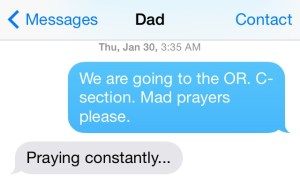
I rose from my chair and saw two doctors lifting my daughter up out of Kate. My daughter’s foot, the last part of her touching Kate, was just slipping the protective casing that had collapsed around her. Nothing could have prepared me for that view. It was beyond beautiful and it literally took my breath away. My legs gave out a bit and I had to sit down quickly. I was crying and Kate was looking at me expectantly. “She is the most beautiful thing I’ve ever seen,” I reported. We smiled through our tears. It was 4:02am, twenty-seven minutes since I had texted my dad, saying we were going to the OR.

London’s Birth: Part VI, At the Doors of the OR

Parts ONE, TWO, THREE, FOUR, and FIVE of this series should be read first.

The walk to the operating room was extraordinarily difficult. Dwelling on a worst-case scenario was unavoidable at times. Kate occasionally cried while she was being pushed toward the OR. The doctor told us that they would do their best to use local anesthesia so Kate could stay awake and so that they wouldn’t have to intubate her. I was told that I couldn’t come into the OR until the team had determined what type of anesthesia Kate would need.

At the huge double doors to the OR I had to say goodbye to Kate. No other goodbye I’ve had in my life had been that hard. How long was I saying goodbye for? I didn’t know for sure. Five minutes? I hope so. Five hours? I hope not. Five days because they had to intubate her and then there were complications? I don’t know how I would have gotten through it. But there was also the question in the back of my mind, for forever? The team pushed her through the doors and I was alone in this barren anteroom with two chairs and a couple of carts with masks, gloves, and other sterile clothing.

I did not expect to be alone at this point. I thought someone might stay with me. I sat down on one of the two chairs. At this point I continued praying, which I had not stopped doing for a while. It felt more like begging at this point or, more accurately, making demands of God. I sat with my head in my hands.

In a few minutes the doctors were attempting to place the epidural. Kate was screaming like she was being cut open. The trauma of having an emergency C-Section at 26 weeks coupled with the pain of the needle is enough to make any woman scream. I didn’t know what sounds to expect from the OR at this point, but that was as much as I could handle. Still seated, I think I may have been rocking back and forth at this point, still with my head in my hands.

The doors to the OR were to my right. A few doctors went through them once they got gowned up. Some of them wore clear shields that covered their whole face. One knows exactly what these are for. They’ll protect the doctors’ faces from splatters from cutting my wife open, moving aside some organs, and pulling a little human being out.

A doctor came through a different set of doors to my left. As she gowned up and scrubbed in she spoke with a healthy dose of authority, giving me a one-minute crash course on 26-weekers. “They have an 85% survival rate,” she said. That is higher than I thought it would be, I thought. “A common complication is with the eyes. It’s called ROP. It can be fixed with laser surgery,” she continued. And with that she walked through the doors. She was just very matter of fact and did not give me a parting “goodbye” or “see you in there.” But I completely understood. She was going into the OR to save the two most precious people in my life. If I could have sped her up somehow I would have. Godspeed, Lady.

A few more minutes passed and a different doctor came out of the OR with good news. “Kate is on a local anesthetic and doing great. You can come in now.”

London’s Birth: Part V, “We gotta get that baby out.”

This is a post in a series about my daughter’s birth. Read parts one, two, three, and four first.

Around 3:20am our doctor came into the room and made the call. The baby needed to come out now. Her heart rate was dropping too much and too frequently to safely leave her in Kate any longer. We were terrified, but I kept telling Kate silly things like, “It’s gonna be okay,” or, “We’re gonna get through this.” Kate was crying a lot, but also trying to compose herself. I remember her really losing it when a nurse and I were had to work Kate’s bra off in order to prep for the OR.

My scrubs were delivered to our room. They looked like a flight suit. I put them on backwards at first. A nurse pointed it out, but she said it didn’t matter. It mattered to me, so I turned the one-piece around, but didn’t quite zip it up yet.

You can easily argue that nothing in the future is certain. That is why so many of us worry. Especially during traumatic moments, we start to consider all the wildest and scariest scenarios. Kate and I had arrived at that point. “You know what to do if anything happens,” Kate said. “You know about my life insurance. You would have to contact my employer.”

IMG_3726 - Version 2

“Yes, I know,” I said. “But I’m not going to have to deal with that.” In response, Kate probably said, I know, but I can’t remember. I was at her side and just crying with her and telling her over and over, it’s going to be okay, she’s going to be okay.

Before I tucked myself into my scrubs and isolated my phone in my jeans pocket, I sent out text messages to both sets of parents and then we were off to the OR. It was 3:35am.