A distinct feeling came over me as I looked at Kate’s eyes, huge and unblinking, staring straight ahead at London, the feeling that I could say nothing and do nothing to comfort her. I had never felt this. Though there seemed to be little value in it, I stood next to her and put my arm around her shoulders and held her tight while we both looked on, wondering if we were watching London pass away in front of us.
Thirty minutes earlier Kate had been holding London. It was a less than comfortable kangaroo care for mom and daughter. London never seemed completely content on Kate’s chest. She would squirm every other minute and toward the end of Kate’s hold time, as we bumped up to another of London’s cares, London was desatting more than usual. Eileen, London’s primary that day, was not too concerned. Neither were we. London did this every once in a while and usually when we placed her back in the isolette or changed her position, she would stabilize.
We got London back in her bed and proceeded with her cares. She initially checked out fine, a little desatting still, but nothing too serious. We had moved on to her diaper change. London decided to fill up the new diaper before we even had it sealed, so we slid a freshie underneath that one and took the soiled one away. She did the same thing with the next diaper so we got a third. Her bowels were working just fine. Before we were able to seal up the third, London started to desat again, but the saturation number was dropping further and faster than we had previously seen. I saw it in Eileen, not panic, but a flicker of concern across her face that told me she seemed to know that turning around to crank up the oxygen on the ventilator was not what London needed at the moment.
I stood at the foot of London’s isolette and watched as Kate handed Eileen the resuscitation bag and mask as Eileen had requested. Eileen quickly placed it over London’s nose and mouth and began squeezing oxygen into London. There was no response. London’s saturation numbers were still dropping. Another nurse stepped up and asked Eileen if things were okay. I had heard nurses ask this of Eileen before, but had never heard Eileen request help until then. The second nurse came in and took Kate’s spot next to London. I took a step back, not wanting to be in the way, but probably out of fear as well. The nurses worked now with a sense of urgency we had not seen since London’s first minutes out of the womb.
London was not responding to anything, looking quite a bit more lifeless than a normal desatting episode. Not just her lips were blue, but her face was starting to turn ashen. More nurses had come to help. I am not aware of how many stood just outside of London’s pod, but I saw Eileen look at one and sternly say, “Go get the doctors.” Kate and I knew then that we would have to make way for more people in the pod. We stepped out to a position where we could still see London and the numbers on her monitor.
The doctors were at London’s isolette within seconds. They were talking fast. Eileen updating them on what had happened so far. I strained my head to see London’s face through the team around her bed. I got a glimpse of her body, she looked like she was shutting down. Her oxygen saturation number was a single digit and her heart rate was very low. I saw the fellow extubate London in what seemed like a half second. I strengthened my hold on Kate. We did not speak to each other, just stood, watching. Like the night London was born, my mind was in two places, there next to London’s pod, where I took in the frantic sight of my daughter’s life being saved, but also somewhere else, where I was cycling again and again through possible outcomes of all of this.
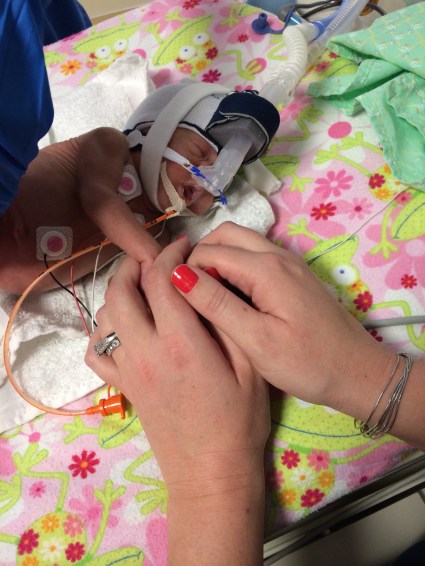
London minutes after her emergency extubation, totally oblivious to what she had just put her parents through.
A resident approached us and calmly informed us that they were moving London to CPAP. A minute later London’s stats had rebounded halfway. Nothing was breaking my gaze from that monitor. Her numbers kept creeping up as a doctor explained to us what might have happened. Her endotracheal tube might have been out of place or she might have just clamped down on it somehow. They did not know for sure. The pod had cleared out somewhat and we took steps toward London. Eileen, stoic and so professionally cool, was there helping London back up.
London’s stats were almost back to normal. Her color was improving. She did not have a clue about what just happened because she was inexplicably calm. Kate held out her hands to grab London’s arms. I took a picture. The episode was over. Moments earlier there had been 8 to 10 people around London’s isolette, she was blue, and Kate and I were watching and crying. The whole event was probably over in 8 minutes, but it felt like 20 for us. I did not know if this was par for the course at the NICU. It certainly did not seem like it. Over the next three months I did not see or hear about any other emergency like this happening in the NICU. The whole matter was boiled down to one line in London’s discharge report, “She was extubated to bubble CPAP of 8 on DOL 23.”
As I left the NICU on DOL 23, I did not know what else to say to Eileen that afternoon. I had said thank you a couple of times and felt so dumb saying it. Couldn’t I have come up with anything else to say to the nurse who had just helped save my daughter’s life? That was all I had then so I walked out of the NICU for the afternoon, thinking about how I have watched London’s life saved twice now and distilling that down to its bare bones:
I am a dad.
My daughter is incredibly small and fragile.
I just watched 8 people save her life, like I had three weeks prior.
The weight of that hit me like a strong kick to the chest as I walked out the hospital’s main entrance. I lost my breath and inhaled deeply. Then I exhaled, holding back a wave of tears and emotion fighting to come out. And then, when that emotion overcame me, it came out as a big, deep whimpering sigh of relief followed by an upward glance to take in the beauty of the crisp, blue February sky. I thought, wow, what a ride. Never thought I’d be on a ride like this. Don’t know where it’s going. Don’t know how many ups and downs are left, but I just experienced the nadir of our NICU stay so far and perhaps one of its highest points, London stabilizing on CPAP, all in a matter of minutes.
I found myself asking, did that really just happen? What’s next? I did not even want to know. I was enjoying my victory walk that afternoon, trying as hard as I could to not think of the battle we would inevitably fight the next day or the one after that. One day at a time.
 r parents have lived through.

 the FoCo dad