The Story of London’s Birth

IMG_0109

This picture…because it’s Cinco de Mayo!

A few months ago I wrote a post linking back to the story of London’s birth, the first posts on this blog. It had been a while since I had mentioned them and wanted to make sure people were aware of them, especially since they were now buried in the archives.

I have finally done something I should have done months ago. I have posted links to London’s birth story in the About the Author tab of this blog. I encourage you to read those posts if you have not.

In the meantime, happy Cinco de Mayo! I made a margarita last night following this recipe. It was delicious, but to make more tonight I had to raid the limes at the grocery store today. You will need a lot of limes. Enjoy!

Why Was London Early?

*In which I try to fill in some medical details I left out of the posts regarding London’s birth.

The doctors never exactly figured out why London was born early. London’s premature birth may or may not have been related to a very small blood clot seen in one ultrasound quite a few weeks before London was born, but the doctors never seemed overly concerned with what they saw.

We don’t know why Kate started to have contractions, but we were very thankful we went to the hospital when they started. As noted in an older post, once Kate’s water broke we knew things were very serious, but we learned shortly after her water broke that doctors can successfully put fluid back into the uterus so the baby is once again protected. They tried this for Kate and, obviously, it didn’t work.

The next option the doctors had was to simply stabilize London and Kate so they could theoretically rest for a week, hopefully, until London was delivered. This would have given London a huge boost. She could have received all the benefits of betamethasone, which would have drastically strengthened her for the outside world and would have better protected her from the stresses of delivery.

London’s heart rate kept dropping due to her funic presentation, this is “where the umbilical cord points toward the internal cervical os or lower uterine segment.” In the most serious cases, this can lead to an umbilical cord prolapse. This is when the umbilical cord “protrudes into the cervical canal,” and why London’s heart rate would occasionally drop due to Kate’s contracting cervix. A medical website describes the situation as “an obstetric emergency that in a viable fetus necessitates an expeditious delivery.” The same medical website, radiopaedia.org, reports that umbilical cord prolapse occurs in 0.2 to 0.5% of all pregnancies.

So we will never know what set this all in motion, but we do have a clear reason why London needed to come out as quickly as possible. On January 30th, had we not been near a hospital that could perform an “expeditious delivery,” I would not be here today writing about raising London. Kate and London’s treatment in the hospital was miraculous, a true marvel, but it was just as miraculous to us that we were a ten-minute drive from a top-of-the-line NICU.

London’s Birth: Part IX, What’s her name?

*This is another post in an ongoing series. Scroll all the way down or click to part I to get to the beginning.

Throughout the operation there were tears slowly dripping from my eyes and my nose was a leaky faucet. I was aware that my snot had flowed through my mask and even in that moment I was mildly annoyed with the thought of having to ask for another mask. I would ask later, when the time seemed right. Until then, I tried to minimize the flow of tears and snot.

It may sound like my eyes were wandering once my daughter was out of Kate, but they weren’t. I glanced for split seconds here and there, but my eyes were essentially locked on the little human being in front of me. Vented now, the doctors seemed a little more relaxed with her and ready to move. They told me where we were going. It went in one ear and out the other. I would follow them anywhere. They started to roll my daughter a bit, making for the double doors I had come through to enter the OR. They halted for a second, one NP turning to me and asking, “What’s her name?”

I had not yet imagined when I would announce to those present in any room the name of my daughter, but if I had, it would never have crossed my mind that this would be how I would introduce her to the world. “Her name is London,” I announced. It sounded weird giving a name to her at this stage because when your child is born this small and fragile, they almost seem like a science experiment. I had started to become aware of a disturbing, but natural protection mechanism that sets in when you see your preemie like this. I wanted to protect myself from her in a way. I didn’t want to become so attached to her just in case I lost her in the next hour, but giving a name to her instantly made it harder to keep my distance.

London and the team working on her started moving out, rolling right by Kate’s face and slowing down a bit so she might possibly get a glimpse of London’s face. I saw Kate strain her head to try to see her baby before we went through the doors. I stopped and gave Kate a huge kiss, an exchange of tears cheek to cheek, and a word about how London is vented. I also checked that I should keep on walking with London and the team. Kate nodded yes and I was off through the double doors with an “I love you” and one last glance at the amazing team sewing up my wife.

London’s Birth: Part VIII, 18 People

*This is another post in an ongoing series. Scroll all the way down or click to part I to get to the beginning.

I confirmed with Kate that I was to go be with the baby now. We kissed. I told her she was doing great and walked to the foot of Kate’s bed where the doctors had placed my daughter’s very small bed.

In front of me was an impossibly small baby girl. To call her a baby is not quite accurate. She looked more like a very, very small, skinny human being. There was no fat on her and she had none of the cuddly attributes that full-term babies have. There were seven doctors and residents attending to her, looking for signs of breathing, mostly. They seemed to poke and prod here and there with their hands and a few tools.

Immediately to my left, Kate was on the operating table, with her incision still wide open. I didn’t stare long, but I felt comfortable looking at the incision and the tissue and organs that were being rearranged so they could settle back into place. I turned my head ninety degrees right and continued to watch the doctors revive my daughter. I saw them prepping a blade to start the intubation when another doctor informed me that was exactly what they were being forced to do. She said this was very common. She was tall, had blond hair, and I remember a minute after my baby girl arrived on her miniature bed, she referred to her as a him. I clarified, “It’s a girl, right?” She looked again, “Oh, I’m so sorry.”

My daughter was successfully intubated a moment later. Her head and neck seemed impossibly flexible for the doctors to place the blade and insert the endotracheal tube. I looked left to Kate again. A nurse walked right in front of me carrying a metal dish with a big red blob in it that had what looked like puncture wounds. It was the deflated, tragic looking placenta that had prematurely detached from the uterine wall, aka placental abruption.

The OR was highly organized chaos to my uninitiated eyes. I took a moment, counting all the people in the room saving my wife and daughter. Eighteen. It was the beginning of a deep, new appreciation for the professionals around me. I was learning in the quickest and most explicit way possible that the quickest way to my heart was to save the two people dearest to me. It was early to have this revelation because I didn’t know if everything was going to turn out fine, but I still felt like I would love and cherish these people for the rest of my life because of their effort here.

London’s Birth: Part VII, 27 Minutes Later

These posts are in reverse chronological order. Read earlier posts first. They can be found by scrolling all the way down or clicking the links provided here: Part I, Part II, Part III, Part IV, Part V, and Part VI.

The only time I have ever seen a C-section setup in an OR was on ER. Well, in that respect, the set of ER got it right. Kate’s neck and head were peeking out from a curtain draped across the top of her shoulders. There was a nurse standing to the right of Kate’s head. There was a chair positioned to the left of Kate for me to sit in. I walked over and sat in it. I gave her a kiss. We exchanged “I love yous” and I sat down.

At this point, we didn’t have to discuss whether or not I would watch the baby come out or whether I would go be with the baby once she was out. Just a few days ago at home over dinner we had talked about what we would do in the case of a C-section. I said I would sit by Kate and would want to be present for everything. We agreed that I would go be with the baby once she was out of Kate, if Kate was clearly doing okay. I also expressed interest in seeing the baby being pulled out. In hindsight, it is incredible that we had this discussion already.

When seated next to Kate, I couldn’t even see the doctors working on her lower body. Kate said all she felt was pressure. I could see Kate’s head and shoulders shifting up and down and left to right on the bed as the doctors peeled away the layers, pushed things to the side, and cleared a path to the uterus.

The urgency of the C-section and the speed at which it all happened was astounding. I was not next to Kate long before the nurse next to her spoke up, “They are about to pull her out. Do you want to look?”

“Yes,” I said. The nurse would tell me when to stand up and look. “Okay.”

“Alright, stand now if you want to see,” she said.

I hesitated just for a second or two, perhaps not quite ready to see what I was about to see, scared to see what I was about to see, or just trying to register the moment. I’m sitting by my wife behind a curtain and on the other side is the rest of my wife’s body with a significant opening in it from which they are pulling out this human being we made, our daughter, who will be in my thoughts for the rest of my life no matter what happens in the next few minutes, hours, or days.

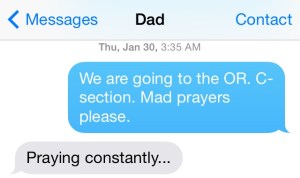
I rose from my chair and saw two doctors lifting my daughter up out of Kate. My daughter’s foot, the last part of her touching Kate, was just slipping the protective casing that had collapsed around her. Nothing could have prepared me for that view. It was beyond beautiful and it literally took my breath away. My legs gave out a bit and I had to sit down quickly. I was crying and Kate was looking at me expectantly. “She is the most beautiful thing I’ve ever seen,” I reported. We smiled through our tears. It was 4:02am, twenty-seven minutes since I had texted my dad, saying we were going to the OR.

London’s Birth: Part VI, At the Doors of the OR

Parts ONE, TWO, THREE, FOUR, and FIVE of this series should be read first.

The walk to the operating room was extraordinarily difficult. Dwelling on a worst-case scenario was unavoidable at times. Kate occasionally cried while she was being pushed toward the OR. The doctor told us that they would do their best to use local anesthesia so Kate could stay awake and so that they wouldn’t have to intubate her. I was told that I couldn’t come into the OR until the team had determined what type of anesthesia Kate would need.

At the huge double doors to the OR I had to say goodbye to Kate. No other goodbye I’ve had in my life had been that hard. How long was I saying goodbye for? I didn’t know for sure. Five minutes? I hope so. Five hours? I hope not. Five days because they had to intubate her and then there were complications? I don’t know how I would have gotten through it. But there was also the question in the back of my mind, for forever? The team pushed her through the doors and I was alone in this barren anteroom with two chairs and a couple of carts with masks, gloves, and other sterile clothing.

I did not expect to be alone at this point. I thought someone might stay with me. I sat down on one of the two chairs. At this point I continued praying, which I had not stopped doing for a while. It felt more like begging at this point or, more accurately, making demands of God. I sat with my head in my hands.

In a few minutes the doctors were attempting to place the epidural. Kate was screaming like she was being cut open. The trauma of having an emergency C-Section at 26 weeks coupled with the pain of the needle is enough to make any woman scream. I didn’t know what sounds to expect from the OR at this point, but that was as much as I could handle. Still seated, I think I may have been rocking back and forth at this point, still with my head in my hands.

The doors to the OR were to my right. A few doctors went through them once they got gowned up. Some of them wore clear shields that covered their whole face. One knows exactly what these are for. They’ll protect the doctors’ faces from splatters from cutting my wife open, moving aside some organs, and pulling a little human being out.

A doctor came through a different set of doors to my left. As she gowned up and scrubbed in she spoke with a healthy dose of authority, giving me a one-minute crash course on 26-weekers. “They have an 85% survival rate,” she said. That is higher than I thought it would be, I thought. “A common complication is with the eyes. It’s called ROP. It can be fixed with laser surgery,” she continued. And with that she walked through the doors. She was just very matter of fact and did not give me a parting “goodbye” or “see you in there.” But I completely understood. She was going into the OR to save the two most precious people in my life. If I could have sped her up somehow I would have. Godspeed, Lady.

A few more minutes passed and a different doctor came out of the OR with good news. “Kate is on a local anesthetic and doing great. You can come in now.”

London’s Birth: Part V, “We gotta get that baby out.”

This is a post in a series about my daughter’s birth. Read parts one, two, three, and four first.

Around 3:20am our doctor came into the room and made the call. The baby needed to come out now. Her heart rate was dropping too much and too frequently to safely leave her in Kate any longer. We were terrified, but I kept telling Kate silly things like, “It’s gonna be okay,” or, “We’re gonna get through this.” Kate was crying a lot, but also trying to compose herself. I remember her really losing it when a nurse and I were had to work Kate’s bra off in order to prep for the OR.

My scrubs were delivered to our room. They looked like a flight suit. I put them on backwards at first. A nurse pointed it out, but she said it didn’t matter. It mattered to me, so I turned the one-piece around, but didn’t quite zip it up yet.

You can easily argue that nothing in the future is certain. That is why so many of us worry. Especially during traumatic moments, we start to consider all the wildest and scariest scenarios. Kate and I had arrived at that point. “You know what to do if anything happens,” Kate said. “You know about my life insurance. You would have to contact my employer.”

IMG_3726 - Version 2

“Yes, I know,” I said. “But I’m not going to have to deal with that.” In response, Kate probably said, I know, but I can’t remember. I was at her side and just crying with her and telling her over and over, it’s going to be okay, she’s going to be okay.

Before I tucked myself into my scrubs and isolated my phone in my jeans pocket, I sent out text messages to both sets of parents and then we were off to the OR. It was 3:35am.

London’s Birth: Part IV, 2:30am Phone call

Just arriving? Read parts ONE, TWO, & THREE in this series before moving on.

The nurses placed monitors on Kate’s belly to watch the baby, but every time Kate had a contraction the baby’s heart rate dropped dramatically or the monitor was no longer picking the heartbeat up. Every time this happened the nurse had to come in and adjust the monitor to find the baby’s heartbeat. This happened so frequently it was pointless for a nurse to leave the room.

Absolutely ignorant of how the rest of the evening was going to unravel, Kate and I attempted to rest. I laid down on a couch, almost two feet shorter than me, but comfortable, and closed my eyes, but it was fruitless. The baby’s heart monitor would beep every couple of minutes; there were nurses in and out, and a few doctors here and there. After I while, I sat up. The doctor was in and out more often talking about the baby’s heartbeat. I don’t remember at all what time it was, but at some point in the evening, before we attempted to rest, we called Kate’s mom. We put her on speakerphone with the phone resting on Kate’s chest. Kate was getting IVs put in at the moment, one in each arm. The nurses were giving fluid, obviously, in hopes that there could be some fluid retention in Kate’s uterus, to build up a buffer for the baby. And in another arm she was starting to get some other drugs that I would learn a lot more about later on.

My mother-in-law went into a mom/nurse practitioner hybrid mode, which I can’t blame her for. She wanted to know all the technicalities. I just wanted Kate to tell her the basics and get off the phone because Kate should be resting. Eventually they hung up and I texted for a while with my mother-in-law. I tried to imply that Kate was really tired and shouldn’t be staying up and talking on the phone at the moment. The message was well received.

I had moved to the side of Kate’s bed as things continued to get a little more serious. I knew I had to call my parents. I hated knowing a call was necessary. By dialing them I was losing the last bit of me that thought everything was going to calm down soon. It meant I was giving into the seriousness of the situation because I was willing to introduce into my parents’ lives a horrible and scary scenario that would make them cry and worry like they haven’t done in years. My mom is old school. She doesn’t even sleep with her cell phone on usually. If it’s on, it’s in another room of the house. I went with my dad’s cell and after a few rings he picked up. I tried to imply right away that we were all still okay. Without saying it, I meant that we were all alive. I also tried to give him a few seconds to wake up and tune in his ears due to the difficulty of receiving a call at 2:30 in the morning. I just cut right to the chase and said, “Kate might be going into labor. Her water broke. We don’t know exactly what is going to happen, but this is what happened so far…”

I remember hearing my mom wake up in the background. She realized my dad was on the phone and not just talking to himself. My dad took a moment and recapped for my mom what I had told him. I heard it in my mom’s voice right away, shock, worry, and sadness. I disliked that I brought that upon them, but I had arrived at the point that not telling them was out of the question. We weren’t on the phone long, but I said I would keep them posted via text message about any changes on our end. We said our tearful goodbyes and hung up.

London’s Birth: Part III, Approaching Midnight

*If you’re just now getting here, read part I and part II of London’s Birth before continuing on.*

In came several nurses and the lead nurse started asking what happened. Well, it was pretty clear. All one had to look at was the bed Kate was on. The nurse got on the phone and the tone she used was one I hadn’t yet heard that night. She was speaking to a doctor, I presume, and she said that the patient in her room PROMed.  At the time, I didn’t know what that meant, but I was in a crash course and someone soon told me it meant premature rupture of membranes.

A team of residents came in and started to examine Kate. I was seated perpendicular to the bed so I could see Kate and sort of see what the doctors were doing. I don’t know how long the examination lasted, but in that time there were a lot of exchanges between Kate and I. We were both scared by now. We were shaking from the adrenaline. The residents needed Kate to scoot down the bed to have a better look at her. Kate was exhausted and scooting down the bed was tough and frightening for her. What made it worse, was that with each attempt at scooting she moved further and further into the pool of amniotic fluid and blood. She was not quite inconsolable, but I had never seen her like this. I held her hand. I broke it off. I then sat back and took a breath. Then I would stand over her and kiss her forehead, her cheek, her lips, and remind her that I love her and that, “Everything’s going to be okay,” which started to feel like more and more of a lie with each passing minute. And then I would start all of that over again.

At this stage, everyone knew the situation was serious and we were going to be here a while. They moved us to a birthing room. It was huge compared to the first room. A nice view, a giant tub in the bathroom, and intimidating lights in the ceiling angled right at Kate. I should clarify, the lights weren’t on, just a detail of the room that stood out.

This room had a plushier bed for Kate. She seemed almost comfortable, given the situation. I was encouraged to rest once they told us that they are just going to monitor the baby’s heartbeat and let the baby’s condition determine what they do tonight. At this stage, I had been paying attention to certain things but not really digesting what all of this meant. I remember at one point the nurse, a new one, her name was Amy, told us that we were here for good until the baby was born. Here being the hospital. Amazingly, this was the only time during the night I felt angry and it was a fleeting moment. I was angry about just the inconvenience of it all, thinking Kate would be bedridden for the rest of her pregnancy. Three more months like this…three more months like this! Kate would be miserable. I would live at home by myself. I would be miserable too. We would both be so lonely. In hindsight, I am embarrassed to share these feelings because they are selfish and they are devoid of the knowledge I would gain in the coming hours, that this baby was coming out and she was never going to be kept in there for any longer than she wanted.

London’s Birth: Part I, January 29, 2014, 10:00pm

It started with a wince. I was sitting on one couch. Kate was on the other. She looked like she was in pain.

“I just had a really painful contraction,” she told me.

I didn’t really think anything of it at the time. “Alright, well let’s not worry too much. Just get ready for bed and try to relax.”

Kate went upstairs and I gathered our dishes from the coffee table and started to wash them. Over the running water I heard Kate yell for me, but her sound was different. It was mixed in with her crying and once I put that together I dropped the scrubber and the dish I was cleaning. I hit the water off and bolted upstairs. Kate was waiting for me at the top.

She said she just had two more contractions and she was panicking. I guided her to the bed. We talked about our options. There were really just two. One, we just go ahead like it’s a normal night and we settle into bed and try to fall asleep, hoping the pain will just subside. And two, we call the hospital and see what they recommend. We noncommittally went with option two, still thinking we were overreacting. I grabbed some paperwork off the dresser and looked at a short list of reasons why we should call the hospital, painful contractions was there. “I think this is a good idea,” I said.

Kate called and explained what was going on. Up to four painful contractions in the last fifteen minutes. “Yep, you better come in just to be safe,” the lady on the other end of the line said.

I changed into jeans. I grabbed a book, Stoner by John Williams, and put on my heavy coat and we were out the door. It was 10pm.

On the way, Kate requested that I take the corners slowly. I did, but it was tough. Kate was clearly still in pain and I didn’t know how fast I had to be driving. We live ten minutes from the hospital. In that time Kate had another sharp, painful contraction.

I dropped her off at the main entrance. At that point, I was nervous to even let her walk a little bit by herself, but we agreed that she should start making her way to the fourth floor, where labor and delivery was located. I sped off to one of the visitor lots, parked in the first spot I saw, and sprinted into the hospital. Kate had barely made it to the reception desk on the fourth floor by the time I caught up with her.

We stated our situation and the receptionist told us to take a seat in the waiting room and someone would be with us in a minute. We shuffled over to a dark, square room tucked away in the corner of the 4th floor reception area. We sat down on a well-used sofa. CNN was on the one small television shoved high into a corner of the room. We were only alone for a couple minutes, but it felt like ten because already my mind was racing, trying to flip through scenarios, but it was so early in the night my imagination wasn’t going too wild. The way I saw this unfolding was that we were going to be called back to a room and the doctor was going to give us some magical drug that would stop the painful contractions and we might be out of there by midnight. Not bad. We wouldn’t lose much sleep. Kate would even be able to work in the morning. Maybe, at worst, she would have to come in a few hours late the next day.