12 Classics in 2015 (2016 version): The Executioner’s Song

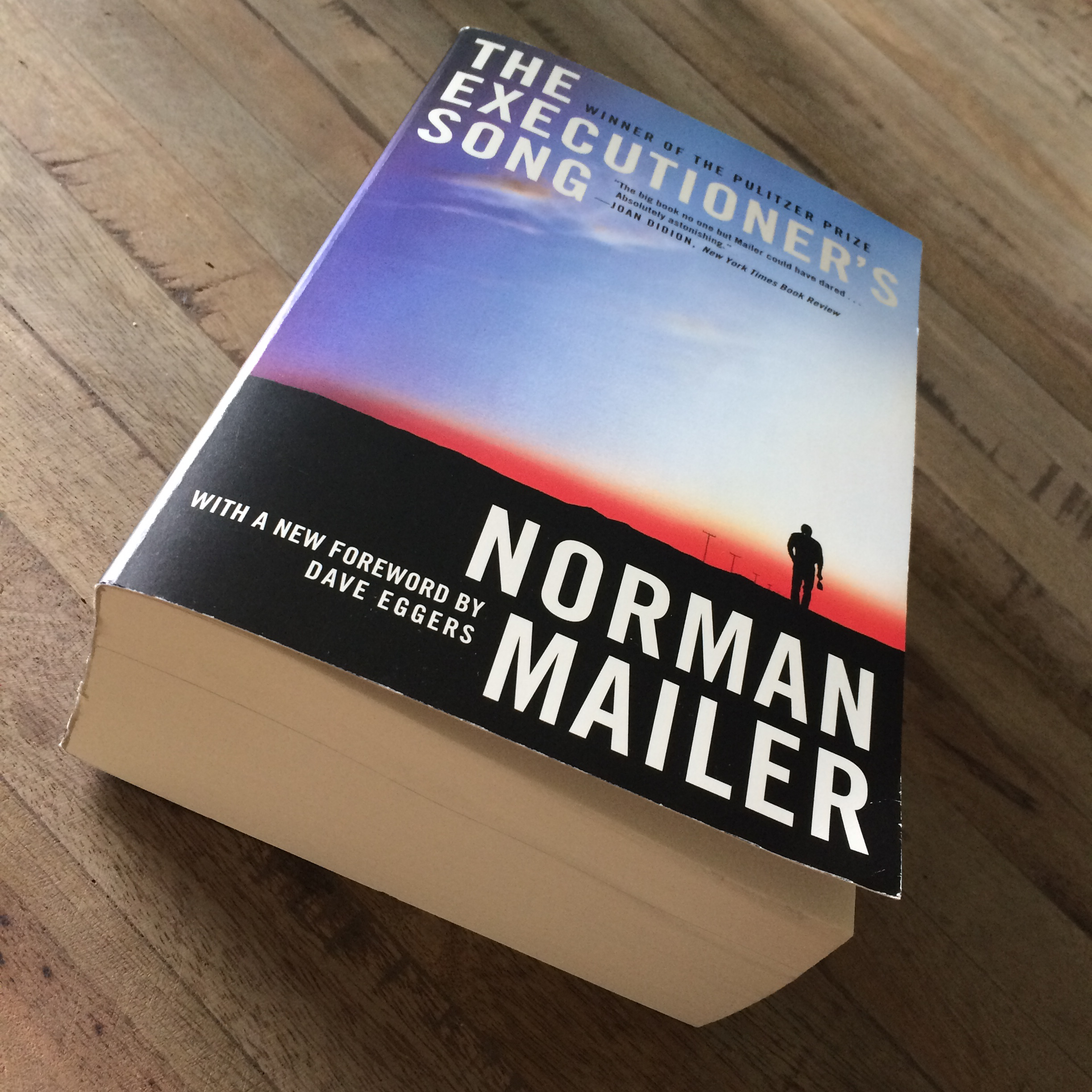
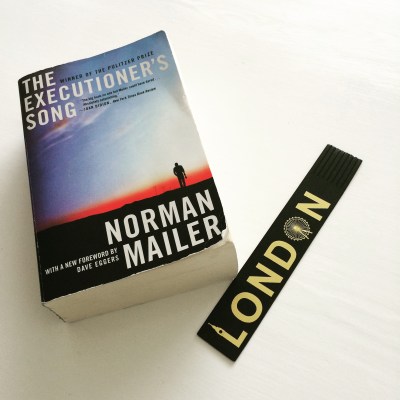
I set out to read 12 classics in 2015. Technically, I finished seven in 2015 before I, quite optimistically, took on The Executioner’s Song, the 1109 page Norman Mailer book about Gary Gilmore. The plan was to finish this book in 2015 and then sprinkle the remaining days of 2015 with four slim classics. I didn’t get there. I finished the last page of ES last Monday.

Having never read a book over 1,000 pages before, I was fooled by Dave Egger’s quote on the back of Mailer’s book. “…It’s the fastest 1,000 pages you will ever know.” Well, it is the fastest I’ve ever read a book of this length, but certainly not the shortest amount of time I have taken to cover 1,000 pages of prose.

What is obvious in my completion of this book is that it was good. I would not have continued past page 300 if it was poor. I knew nothing about Gilmore going into the book. I’m not sure I had ever heard of him. This, Eggers wrote in the introduction, is one of the best scenarios for reading ES. In fact, Eggers urges Gilmore-clueless people to stop reading the introduction at this point and skip to the boIMG_8500ok. That’s what I did and I am ever thankful for it, for if I knew Gilmore’s fate there would be no suspense to carry me through to the last page.

I can’t believe someone would undertake such a vast project to tell Gilmore’s story, but Mailer somehow did it and painted a thorough picture of all the primary actors in Gilmore’s life (and there were a lot), giving the reader a complex cast of characters, matched only by the complexity of Gilmore.

Knowing what we know about Gilmore, that he killed two people, you want to dismiss him as a sick, bad person. But it’s amazing the people he wins over from the time he is arrested to the time he is executed. People poised to make a lot of money off of Gilmore’s death decide in the end that they can’t do it. They respect, even love, Gilmore too much to do that to him. This was the most surprising part about the book. There was this side to Gilmore that was very intellectual, caring, and even nice. Although his temper could flare up in the briefest of exchanges.

I enjoyed The Executioner’s Song. The book was worthy of derailing my original plan of reading 12 classics in 2015, for by finishing this book alone I feel like I accomplished something significant. That said, I am quite relieved to know that I can move on to the books that have been stacking up while I made my way through The Executioner’s Song.

Emails and Poetry

I rely on my parents to send me inspirational emails every so often. Yesterday, on my 33rd birthday, I received such an email. My mom encouraged me to go to a blog she regularly reads, to read a specific poem, and to listen to a hymn.

The blog is Barnstorming.

The poem found in this post is “Sure On This Shining Night” by James Agee

Sure on this shining night
Of star made shadows round,
Kindness must watch for me
This side the ground. 
The late year lies down the north.
All is healed, all is health.
High summer holds the earth. 
Hearts all whole.
Sure on this shining night I weep for wonder wand’ring far alone
Of shadows on the stars.

The Derailing of a New Year’s Resolution

Things were going well. I was on track to read 12 classics in 2015, but then I set my IMG_6671eyes on The Executioner’s Song. Heck, Dave Eggers said it would be the fastest 1000 pages I would ever read. He wrote it on the back of this book. He was wrong, but that does not mean the book isn’t any good. It’s excellent. Every time I pick it up I am instantly drawn into Gary Gilmore’s story.

But the book is still 1000+ pages. No matter how excellent it is, I still have a baby at home who is sleeping less during the day than she used to and it’s the holidays so, naturally, there are more domestic duties to undertake in the short breaks I get while London is sleeping. There’s Christmas shopping (online), Christmas card and calendar building, and I’ve also spent the last few days frantically clearing the basement so our remodel can start this week.

I think I realized about two months ago that 12 classics in 2015 was not going to happen. I am pretty sure I won’t finish The Executioner’s Song in 2015, but I will finish it. I am enjoying it and it’s the first work by Norman Mailer that I have read. I just wanted to publicly confess to not achieving one goal for 2015. I am already thinking about a 2016 reading goal: No New Books. I have to finish all the books I have started, set down, and never gone back to. And when I’m done with those, I can start on books I already own, but have never read, which are quite a few.

The Next Book For London

The next book I read to London has impossibly big shoes to fill. What can knock Screen Shot 2015-08-11 at 4.39.35 PM4,100 pages of Harry Potter off the top? Well, it isn’t Bill Bryson’s A Short History of Nearly Everything or ASHONE for short. That’s right, I went full nonfiction science writing for the next book. I needed a change of pace and I am quite sure London won’t notice, except for the expanded vocabulary in Bryson’s work compared to HP.

I love Bill Bryson’s writing. Somehow I had owned ASHONE for ten years and had never read it. London and I cracked open the book a couple of weeks ago, validating my purchase of this book in a Borders (remember them?) in Longmont, Colorado all those years ago. We are only a hundred pages in, but I’ve found that I am not enjoying this as much as his travel writing. There just aren’t as many opportunities in science writing for Bryson to add his signature humor. That said, it’s still an excellent book. Bryson makes the hardest of subjects accessible by writing about them in the common tongue.

One of my favorite passages early on in the book is from chapter two:

…it isn’t possible, in any practical terms, to draw the solar system to scale. Even if you added lots of fold-out pages to your textbooks or used a really long sheet of poster paper, you wouldn’t come close. On a diagram of the solar system to scale, with Earth reduced to about the diameter of a pea, Jupiter would be over a thousand feet away and Pluto would be a mile and a half distant (and about the size of a bacterium, so you wouldn’t be able to see it anyway). On the same scale, Proxima Centauri, our nearest star, would be almost ten thousand miles away. Even if you shrank down everything so that Jupiter was as small as the period at the end of this sentence, and Pluto was no bigger than a molecule, Pluto would still be over thirty-five feet away.

I absolutely love reading about how huge space is. And this is just our solar system.

I always think about God when I think of space, its scale, its never-ending mysteries, because for me, space has always been one of those things in which I see the presence and power of God. Pure awe.

I’m looking forward to the rest of this no-longer-dusty Bryson book.

DVDs $1, Stories Are Free

This house and its occupants are prepping for a garage sale this week. London’s help is extremely limited to nonexistent. She takes a long time examining every little thing we hand her, so she won’t be determining what we are getting rid of and what we are saving. She is most helpful when she decides to take a long morning nap on a Sunday so we can dig through the basement for potential hot ticket items.

We found lots of things to sell yesterday and just as much to throw away or donate. I discovered I had three copies of Goodfellas. (Hey, if there’s one movie to own several copies of it’s that one.) I have a DVD player to sell, but I can’t seem to locate the power cord or the remote. I am finally going to sell my Star Wars Pepsi can collection from one movie, which was both the most anticipated movie of all time and the most disappointing movie of all time, The Phantom Menace. But this can collection? Pristine. Complete. It represents a lot of work. It represents a lot of soda drinking.

For some reason I still had the majority of my class notes from the University of Wyoming. I chucked them all, but kept a few stories to possibly share on here. I threw out two boxes of old New Yorkers, magazines I had been saving because there was at least one tantalizing article in each magazine. I had lofty visions of getting to all of them some day, but having so many magazines and books I want to read around the house can really stress me out. It almost leads to less reading because I see the stacks everywhere and just think, I’ll never make it, why start now?

So, to those stories. I’m going to close this post with one. Please note, these are not my words. It was an assignment in an undergrad writing class for which you had to use a minimum number of sources to build one story or essay using nothing but quotes, a literary collage. And, here it is…

What I recall isn’t pain but a sense of jarring reversal, as of all motion, sound, and light encountering their massive opposites. I felt grass and dirt against my cheek, and sorrow that Dad was shot, and confusion that I couldn’t reach him. (1)

As I saw the last blue line of my native land fade away like a cloud in the horizon, it seemed as if I had closed one volume of the world and its concerns, and had time for meditation before I opened another. (2)

I shut my eyes, the old morte settled its grip, and the next country gathered itself under my feet. (1)

The grey rain-curtain turned all to silver glass and was rolled back, and he beheld white shores and beyond them a far green country under a swift sunrise. (3)

I waded ashore with measureless relief. The bank was an even slope of waving knee-high grasses and I came up into them and turned to look back. It was a wide river, mistakable for a lake or even an ocean unless you’d been wading and knew its current. Somehow I’d crossed it and somehow was unsurprised at having done so. (1)

There came into view a man, or so it seemed. (4) He had a blue coat and a long brown beard; his eyes were blue and bright, and his face was red as a ripe apple, but creased into a hundred wrinkles of laughter. In his hands he carried on a large leaf as on a tray a small pile of white water-lilies. (4)

“This is what we all find when we reach this country. We’ve all been wrong! That’s the great joke. There’s no need to go on pretending one was right! After that we begin living.” (5)

The words uttered by the person without, affected me as somewhat singular, but what chiefly rendered them remarkable was the tone that accompanied them. It was wholly new. I cannot pretend to communicate the impression that was made upon me by these accents or to detect the degree in which force and sweetness were blended in them. They were articulated with a distinctness that was unexampled in my experience. But this was not all. (6)

“We do not want you to become lazy, but to imitate those who through faith and patience inherit what has been promised.” (7)

It (the words) imparted to me an emotion altogether involuntary and uncontrollable. When he uttered the words my heart overflowed with sympathy and my eyes with unbidden tears. (6)

He sat down on a rock and swung his feet in a stream–it was deep and swift; it would take him in a moment. I seized his arm. Please, I said. Soon, he replied, which makes better sense under the rules of that country than ours. Very soon! he added, clasping my hands; then unable to keep from laughing, he pushed off from the rock like a boy going for the first cold swim of spring; and the current got him. (1)

Is there a single person on whom I can press belief? No sir. All I can do is say, Here’s how it went. Here’s what I saw. I’ve been there and am going back. Make of it what you will. (1)


Sources:

(1) Enger, Leif. Peace Like a River. Atlantic Monthly: New York, 2001.

(2) Irving, Washington. The Legend of Sleepy Hollow and Other Stories. Penguin: New York, 1978.

(3) Tolkien, J.R.R. Return of the King. Houghton Mifflin: Boston, 1955.

(4) Tolkien, J.R.R. The Fellowship of the Ring. Houghton Mifflin: Boston, 1954.

(5) Lewis, C.S. The Great Divorce. Harper: San Francisco, 1946.

(6) Brown, Charles Brockden. Wieland. Oxford: New York, 1994.

(7) Hebrews 6:12. Bible.
 

4,100 Pages of Harry Potter

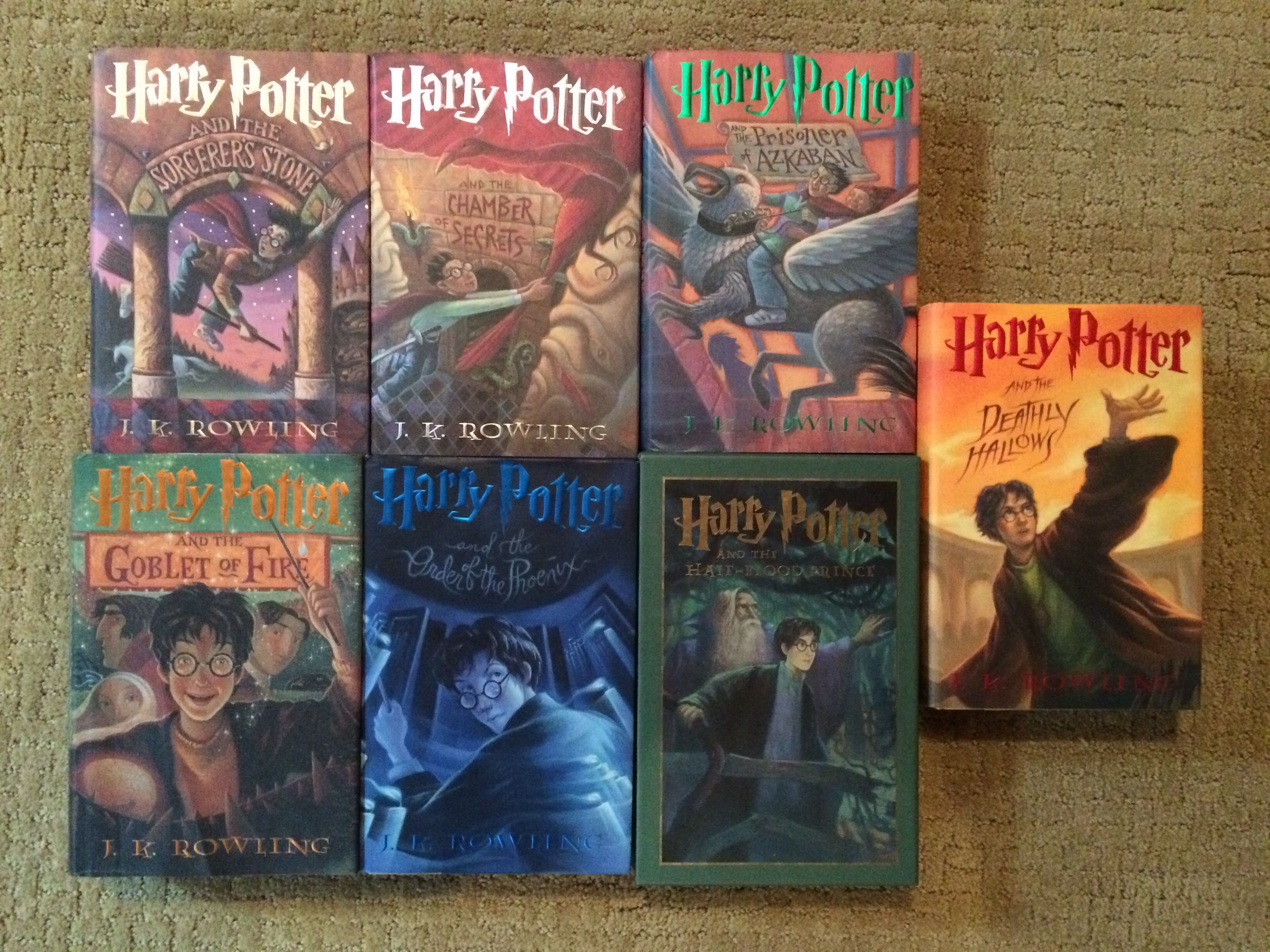
On July 16th, I read the last page of the Harry Potter books to London. It had taken me one year, two months, and four days to read that page and the previous 4,099 to her. Before May 12, 2014, I had never made an earnest attempt at even reading the first book. I had made more of an attempt at watching the movies, but had only made it through the first two and started and failed to finish the third movie on several occasions.

By the time I got to page 759 of Harry Potter and the Deathly Hallows, I felt I was finishing more than a book, but a saga of both literature and life. The obvious saga, that of Harry Potter’s journey from Four Privet Drive to the climactic duel with Lord Voldemort, and the less obvious saga, of London’s journey from her 102nd day in the NICU (the day I started the first book) to her fourteenth month at home, and her seventeenth month of life.

HP Books

Beautiful artwork on all the covers of these increasingly heavy books.

When I cracked open Harry Potter and the Sorcerer’s Stone it was an act of therapy. I did not know if I would finish all the books. I did not know if I would be able to read all of them to London. However, as time went by, it became clearer and clearer to me that I would finish the books, that London would hear every page of these books, and that just because we got out of the NICU did not mean the reading of the books ceased to be therapeutic.

In the beginning, it was easy to find time to read Harry Potter to London. I would place her on a pillow in my lap and could read for as long as I like really, assuming she was oxygenating well and in a comfortable position. When she left the NICU, I read several times a day to her, while she was on the floor making cooing noises, while she was falling asleep, and while she was taking a feeding from her NG tube. Later on, I only read to her as she fell asleep for naps. And a little later on from that, she stopped falling asleep if I was by her side reading Harry Potter. This coincided with her ability to pull to a standing position, so she would stand inside her crib and reach out for the pages of the book and get frustrated that she couldn’t grab them.

Eventually, I had to start reading Harry Potter to her when she was in the living room playing with toys. By this last stage, I knew that my voice comforted her. I could read a whole chapter and sometimes two while she played. I may have pushed the limit on July 16, when I read the last sixty pages to her in one sitting as she drained all the fun out of one toy to the next until she was clearly wondering why I had been reading to her for so long without any breaks.

On more than one occasion during the last several days of reading Harry Potter I choked up because it would dawn on me that I am almost done with the books, or I would remember in a flash how far London has come over these 4,100 pages, so incredibly far as you may know.

I take great joy in knowing that I will be able to read these books once again to London when she is older and able to follow the plot. Perhaps I won’t read every word aloud to her. She might take over. That is fine with me. I know I will always be reading with London.

*Special thanks to my wife’s family who let me borrow all of their pristine, hard cover, first edition Harry Potter books.

12 Classics in 2015: The Stranger

I enjoyed picking up another slim volume, knowing I would finish this next book in two or three sittings. The Stranger, by Albert Camus, is a study of the absurd arc of all lives. It focuses on one man, Meursault, who kills a man on the beach in the first part of the book. Meursault’s trial constitutes the second part of the book.

Meursault, to me, felt very little emotion other than his lust for Maria, his girlfriend and, possibly, future wife. And although I saw some justification of him shooting the man on the beach, Meursault seemed to hold none of the same justification. He seemed only to defend his atheistic beliefs, and nothing else. He is a sad figure, not because I am a believer and he is an atheist, but because he seems utterly defeated by the absurdity of life. He refuses to use religion or the legal system to comfort or free himself because he recognizes the futility in prolonging the truth: that we will be born, we will die, and then no longer matter. All of us.

Meursault is a Debbie Downer, but Camus channels his philosophy quite well through Meursault’s actions and words. Interestingly, Meursault becomes happiest when he gives up all hope of a life, long or short, and accepts that any path he goes down ends the same.

I certainly don’t see eye to eye with Camus on this. I recognize that life can indeed be absurd and it will yell at us again and again, “resistance is futile,” but resisting is one of the hardest and most rewarding parts of life. It amplifies everything, the valleys, the peaks, the springs, and the winters of our lives. I believe it makes for a richer life, which looks better to me than Meursault’s fate of a jail cell and decapitation.

12 Classics in 2015: The Jungle

The Jungle is widely known as the book that turned the public’s gaze upon the meat industry. Months after the novel’s publication, the Food and Drug Act went into effect. The public was disturbed to find out that their chances of eating rotten and diseased food were quite good, as the condition of the slaughterhouses was revolting and what oversight existed at the time was a farce.

This was a positive reaction from the public, but Upton Sinclair did not mean to turn the people’s fervor toward the meat industry alone. Sinclair’s primary protestations regarded the labor conditions and complete lack of workers’ rights. Indeed, that is what struck me about the book. Sure, the descriptions of the making of sausage with scraps of meat and innards from the floor and the drains, and the tubercular cows passing right by the “screener”, are disturbing. But the human suffering detailed in the book is far more painful to endure. It lasts from shortly after the first chapter to the very last (357th) page.

The book’s main character is Jurgis Rudkus. You get the impression that the lion’s share of his life is lived out on these pages. What life Jurgis does have plays out like a train wreck. You see everything coming before he does. Blow after blow Jurgis is dealt with no means to protect himself or to save his family from abject poverty. My heart ached for Jurgis and every member of his family and for all those wasting away in Packingtown, the meat-packing area of Chicago.

I am thankful that workers’ rights are a thing now. No one spoke of them in The Jungle until the very last pages of the book, which is a screed in support of Socialism, one of Sinclair’s great causes.

The struggle of the working class is still very real. More than once I thought of fast-food workers, who are campaigning for greater pay because of the poverty they are forced into by trying to support a family on the current minimum wage, and I recognized that they are a group of people who would be at the heart of The Jungle if it were written today. Sinclair would be pleased to know that these workers don’t have to work 7-5:30 Monday thru Saturday just to keep their job, but many still work those hours because one job is not enough. A second is needed to scrape by.

The Jungle is a serious book with an intensely dark and sad narrative, but also a book with a surprising appeal to the reader to read just one more page. I found it enticing, even though with every new page Jurgis encountered his next setback or you could make out the train wreck on the horizon a little better. Out of the six classic books I have read this year, The Jungle has surprised me the most with its novel subject matter and its desperate plea for help from the immigrant masses who are still growing, tending, picking, and packing our food.

12 Classics in 2015: The Old Man and the Sea

Reading 12 classics in 2015 would be a lot easier if you could knock out each one of them during a flight, like I did this short book on the way home from DC. In order to read some of the longer books I have selected for this task, such as Moby Dick, Midnight’s Children, and The Executioner’s Song, I needed to select some very short works.

_BKP1117

2013. Cayucos, CA.

The Old Man and the Sea is a delightfully simple plot that I will not rehash here. A warning though, it being such a short book most of the plot will be revealed by merely writing a few paragraphs about it.

While I read this book I thought about chasing goals, the way we chase them, and the people we leave in our wake while we chase those goals. Once the old man, Santiago, commits to catching the giant marlin he has hooked, there is no turning back. However, along the way, on nearly every other page, the old man thinks of the young boy, his apprentice Manolin, who had fished with him in the past and regrets his decision to not take the young boy out with him this day.

Pride and the necessity to make a living pushes the old man out to sea, the catch seeming impossible for hours and then days, but finally the marlin weakens and starts circling the boat. At this point, the old man’s energy and hand strength is somewhat revived. He pulls the marlin in against all odds and lines up the eighteen feet of marlin next to his boat. What a prize! Bask now in the glory of your catch because it will be rotted, decayed, or poisoned by the time you expect to reap the bounty.

Indeed, by the time the old man gets to shore, he has eighteen feet of skeletal remains alongside his boat and the old man himself is nearly dead. Would the ending have been different if the young boy had been allowed to fish with the old man on this journey? I think we are led to think that way. The victory for the old man is that he made it home at all and he can now take Manolin out fishing once again. Together, perhaps, they will catch a big marlin, but the biggest catch of all was lost. Be it pride, stubbornness, or just a foolhardy decision to go for the big prize, the old man did it. Better to try and fail than to not try at all. For if the old man had cut his line after the marlin towed him out to sea for a day, the decision would have eaten at him for the rest of his life.

I revere Hemingway’s writing. It’s the stuff I will aspire to for as long as I write. I will never get there, but it is fun to imagine. I will also never get to the point where I will shoot myself in the head with a shotgun. Exquisite writing and shotgun-assisted suicide I leave to you, Ernest.

12 Classics in 2015: Midnight’s Children

For my fourth act, I read Salman Rushdie’s Midnight’s Children51yqNUCZu6L

When you study literature Rushdie’s works come up a lot in discussion. And yet, I made it through an English undergraduate program without ever being assigned one novel or short story by Salman Rushdie. In my graduate studies in International Relations, his name came up quite a bit too because of my focus on the Middle East. But no Rushdie reading assignment there either. Of course, when a professor would ever mention Rushdie in my undergraduate or graduate courses my classmates would nod their heads. I would too. We all knew who he was. But had we read his stuff? Maybe my peers had. I had not. So, I picked up Midnight’s Children, admired the cover, and dove in. It was March 30th.

And now it is May 12th. What exactly happened between the aforementioned dates, pardon me, between the covers of the book, I am not entirely sure. But I am not too worried about that because a major theme of the book is the unreliability of Saleem’s narrative. He reminds you again and again that this may not be the way things happened exactly, but it is how he is remembering them at this precise moment. Padma (Saleem’s future wife) reminds Saleem of his story’s inaccuracies as well whenever he has screwed up the date of a significant event, such as Gandhi’s assassination.

Saleem’s story starts long before his birth, with the telling of how his grandfather met his wife, but the story really picks up when Saleem is born at exactly midnight on August 15, 1947, the day India became an independent country. All the babies born in India during its first hour of existence end up acquiring special powers. One of them can time travel. Another is a powerful witch. Saleem, being born at the precise moment India was born, is the most powerful. He can read people’s minds. And he can feel the presence of all those born that fateful night, the young ones known as Midnight’s Children. He can read minds from afar and explore the memories of anyone he wishes.

Eventually, Saleem loses that gift, but acquires another, the ability to smell nearly everything, from love to the exact scent of every human he has ever come into contact with. Over 533 pages, his story unfolds like that of Forrest Gump. Saleem is intimately involved with his country’s dealings for much of the book. Finally, he catches up to his 31-year-old self who is telling the story, only to close the novel (spoiler alert) with the prediction of his own death on the day he turns 32.

Saleem’s journey is epic. There is no point in sharing the entirety of it here or ever, really. I would feel different, I think, if I had loved the book. But this book, which might be the heaviest lifting I will do throughout this New Year’s resolution of mine, was one of the most confusing books I have ever read. Perhaps, the most confusing book that I have ever finished. For most of the book, I consulted chapter summaries on Spark Notes. Of course, I read the chapter first and only then would I read Spark Notes. It was a rough start, having no idea what really happened after I finished the very first chapter. In my defense, it was late afternoon, I was sitting outside in the sun, and London was napping. But I had my coffee? It didn’t matter. In fact, coffee can’t really help you through this book. But Spark Notes did, so I actually felt a connection to the story from time to time.

The thing about Midnight’s Children is that it is damn respectable for the quality of the writing. The style is unbelievable. Rushdie’s vocabulary is astonishing and there are sentences that flow so well I read them a few times for the sheer delight in their finely-tuned form. The book won the Booker prize in 1981. And then, for the 40th anniversary of the Booker prize, it was voted Best of the Booker, the best novel to have won that prize in 40 years. That is one huge honor, which certainly played a role in my selection of this particular work of Rushdie’s. I have got to read such an acclaimed book.

I did. It did not live up to what I would expect for the Best of the Booker award, but the book will certainly stick with me for a while. And now, when a professor mentions Rushdie’s name I can nod my head without feeling like such a dolt.

12 Classics: A Brief History of Time

Inspired by the recent movie, The Theory of Everything, I picked up a nonfiction classic I had never 60899438read, Stephen Hawking’s A Brief History of Time. I have had this book around the house for five years and I had never cracked it open and, before doing so, I reminded myself that I may understand no more than 5-10 pages of it.

I’m happy to report I may have understood 11. For an English Major, I fared pretty well.

Someone had told Hawking that for every equation he puts in the book the book sales are going to drop by half. Hawking said he vowed to put only one in the book, Einstein’s famous equation. Hawking’s decision helped me understand 11 pages. Had he felt differently, I may not have understood such a high number of pages.

Most of A Brief History of Time was very difficult to follow even without equations thrown in here and there. The pages I really enjoyed were well written explanations of science factoids I had once heard, but had since forgotten, or they were completely new to me. For example, someone somewhere in my past had told me about the possibility of travel at the speed of light, that is, how it’s not really possible. Hawking very thoughtfully explained it this way:

As an object approaches the speed of light, its mass rises ever more quickly, so it takes more and more energy to speed it up further. It can in fact never reach the speed of light, because by then its mass would have become infinite, and by the equivalence of mass and energy, it would have taken an infinite amount of energy to get it there.

Yeah, I had completely forgotten about that. I guess I do not think about traveling at the speed of light enough because if I had I am sure I would have kept the “equivalence of mass and energy” fresh in my mind.

Abundant were the facts in this book that were completely new to me. One that I read over and over again was about the density of White Dwarfs:

…with a radius of a few thousand miles and a density of hundreds of tons per cubic inch.

That’s dense. But wait, there is more. Neutron stars have “a radius of only ten miles or so and a density of hundreds of millions of tons per cubic inch.”

Holy. That is crazy. I kept picturing one of those very popular whiskey rocks and imagining it weighing a hundred million tons. Trying to wrap my head around that made for a sleepy afternoon.

This book made for a lot of sleepy afternoons. Ultimately, I enjoyed it. There were two rewards for finishing A Brief History of Time. One, the typical joy one gets from finishing any book. Two, the deep satisfaction of knowing I will never have the desire or need to pick this book up again. It may as well weigh a million tons now that I have set it down.

12 Classics: Brave New World

I would not quite believe Suzanne Collins if she said she took no inspiration from Aldous Huxley’s Brave New World for her Hunger Games series of books. Some of the elements in the books are too close to one another for it to be a coincidence.

Moving on.

I read a classic book looking for that one element that explains why said book is classified as a classic. Sometimes it is the quality of the writing, or the twisted, complex plot that you never thought someone could come up with. There are too many elements of a classic book to write about them all, but I will mention one more, sometimes it is a particular passage, which resonates more strongly than any other portion of the book. For me, this was the element in Brave New World that made it a classic.

The passage I am speaking of takes place near the end of the book, when the Savage is speaking with Mustapha Mond. The Savage is challenging Mond on the decision to “civilize” a society in the way that Mond and other directors have. Mond attempts to justify why he and other directors/controllers are correct. Both men frequently reference Othello to support their arguments, although Othello benefits the Savage’s points more appropriately.

The Savage speaks of the “feelies” the “civilized,” modern equivalent of a book or movie, i.e. mass entertainment. He says, “Othello’s good, Othello’s better than those feelies.”

“Of course it is,” the Controller agreed. “But that’s the price we have to pay for stability. You’ve got to choose between happiness and what people used to call high art. We’ve sacrificed the high art. We have the feelies and the scent organ instead.”

Mond later mentions science as being in the same category as high art:

“Yes,” Mustapha Mond was saying, “that’s another item in the cost of stability. It isn’t only art that’s incompatible with happiness; it’s also science. Science is dangerous; we have to keep it most carefully chained and muzzled.”

What a prescient passage. Keeping science under lock and key has become a huge task for climate change deniers, oil companies, and pleasant men like Senator Jim Inhofe who brought a snowball into Congress to support his argument that global warming is a hoax. Mind you, it was February…in Washington D.C.

The Savage and Mond argue back and forth for quite a few pages. The Savage closes with a point about the inconveniences in life, the inconveniences Mond and others have tried so hard to eliminate.

“But I like the inconveniences.”

“We don’t,” said the Controller. “We prefer to do things comfortably.”

“But I don’t want comfort. I want God, I want poetry, I want real danger, I want freedom, I want goodness. I want sin.”

“In fact,” said Mustapha Mond, “you’re claiming the right to be unhappy.”

“All right then,” said the Savage defiantly, “I’m claiming the right to be unhappy.”

“Not to mention the right to grow old and ugly and impotent; the right to have syphilis and cancer; the right to have too little to eat; the right to be lousy; the right to live in constant apprehension of what may happen tomorrow; the right to catch typhoid; the right to be tortured by unspeakable pains of every kind.” There was a long silence.

“I claim them all,” said the Savage at last.

Mustapha Mond shrugged his shoulders. “You’re welcome,” he said.

This discussion is why Brave New World is, at least for me, a classic. Inconveniences are certainly not all pleasant, but they are the price we pay for freedom. They make for a fuller, richer life; a life, which thanks to inconveniences, produces high art. I like high art.

12 Classics in 2015

In 2015, like in 2009, I am reading 12 classics I have never read before. The first book, Moby-Dick, is almost out of the way. I am on page 430 of 624.

There are quite a few things I did not know about Moby-Dick, but two of them stand out. One, the length. I was thinking of 400 pages max. When I had seen the book on shelves it never looked quite this long. There are lots of words on each page. It takes a while to just read two full pages, especially when there are two paragraphs on each of those pages. The text is consistently all the way to the margins. I know, I sound like a middle-schooler after being presented with his first giant book with no pictures at all and small print.

And two, I was unaware of all the diversions Melville takes throughout the book. These chapters vary widely on topics, but all are pertaining to the whale. There were several chapters on the classification of whales. There were a few more on the accuracy and inaccuracy of depictions of whales in drawings, paintings, and sculpture. There was an ode to the whale tail. As annoying and out of place as these chapters might seem at first, they become enjoyable when Melville continues with the Pequod’s story and you, as the reader, have the whaling knowledge necessary to easily follow the what, why, and how of the whaling profession.

I hold Moby-Dick responsible for my lack of blogging lately. I am now quite invested and interested in the remaining pages of this book. With every bit of free time I feel the need to knock out a few pages because I just never know exactly when London is going to wake up. And, of course, the end of this book is in sight and I have other books stacked by the window tempting me with their perfectly square corners and pristine pages.