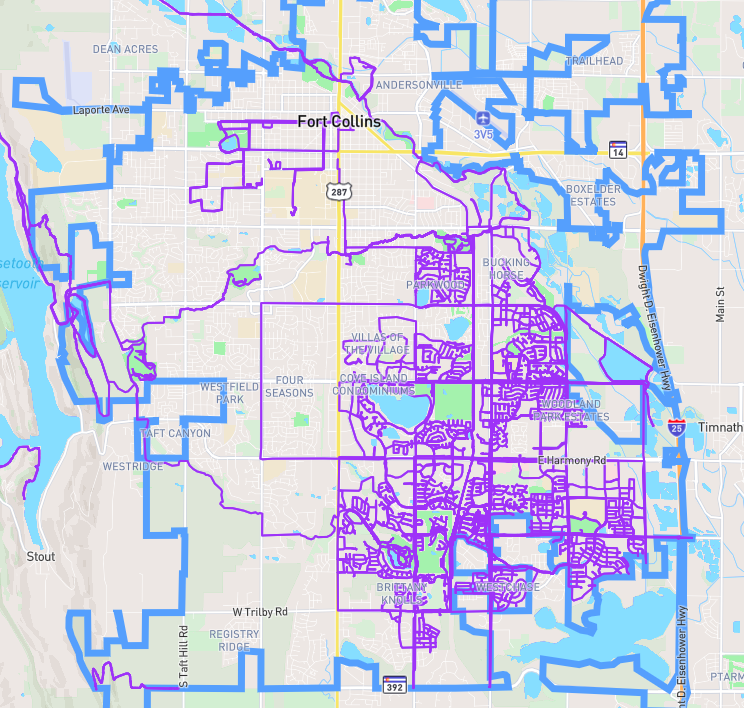
When I look at my map on CityStrides, I see progress, hours of running, thousands of miles, and quite a bit of time spent mapping out a six mile run, ensuring that I spend as much of those six miles on brand new blocks. The thing that irritates me more than anything though are whole neighborhoods I have not run in or major streets I have not run even one block of. My Fort Collins completion stands at 29.09%, meaning I have run 29.09% of streets in Fort Collins. Prior to moving here, that number was right around 6-7%.
I was introduced to CityStrides by a fellow running-addict in early 2021. It’s a website that you can upload running activity to. It easily accommodates gps data from Strava, Garmin, and SportTracks. Using that data, the website keeps track of how many streets within city boundaries you have run. Essentially, it creates your own, personal heat map, giving you progress for each street, and showing you red nodes on a map, indicating portions of a street you have not run. In November of 2021, when I began my CityStrides journey, my Denver map looked like this…
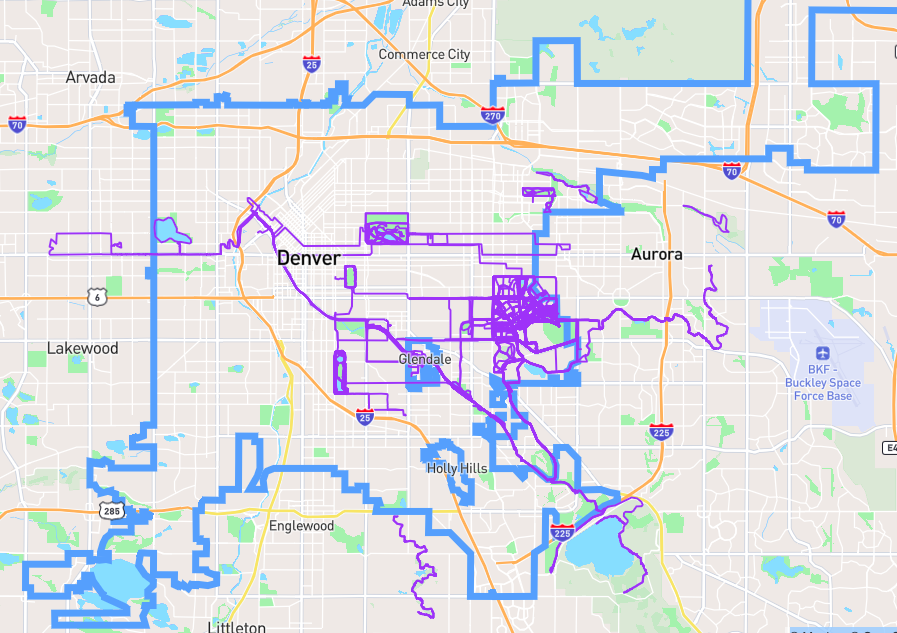
I started small, running every street in the neighborhood. That took just a week to ten days of running. By then I was addicted. Though progress was slow (sometimes a six mile run would only get you 0.20% of Denver’s streets), I loved seeing more of Denver on foot and getting into City Strides tends to bump your mileage up quite a bit. When you have a five mile run planned, but there are some streets nearby you haven’t touched, that run can easily become a seven miler. There came a point, I’m not sure when, that I had to start driving to and from streets I had not run. No sane person is going to run 8 miles in one direction to run two new streets and then run 8 miles back. As I progressed outward from my east Denver location, striding became much more time consuming, meaning I couldn’t attack new streets every day. Sometimes my schedule only allowed for one to two runs a week devoted solely to new streets. After 4.5 years of this adventure, I moved from Denver to Fort Collins. My Denver percentage stands at 41.19% and out of 2755 runners trying to complete Denver streets, I am 6th on the ranking. My map looks like this.
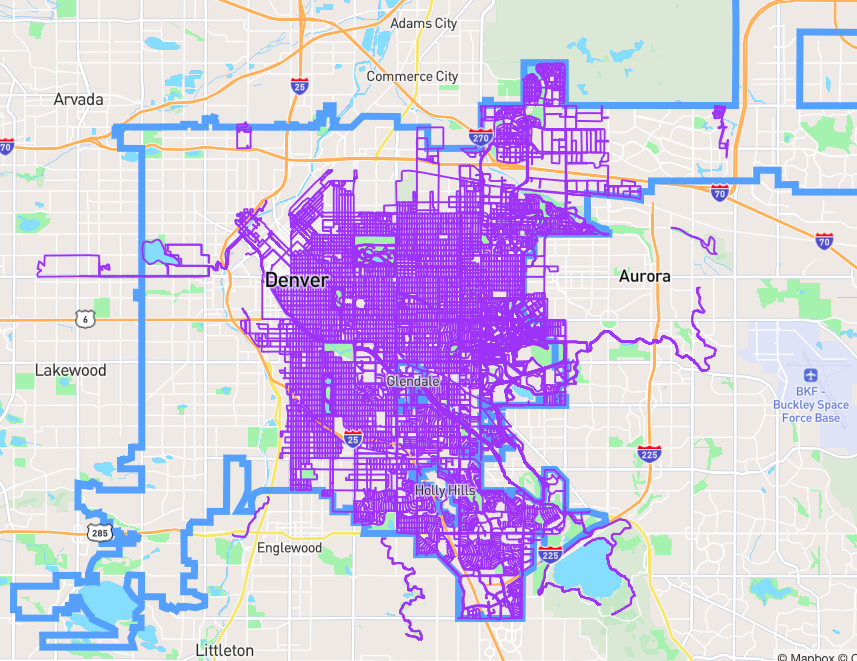
Zooming in gives you a better idea of the tedious nature of a CityStrides obsession.

Striding will inevitably push you into some awkward and uncomfortable situations. It’s sort of weird running into every cul-de-sac, but it’s even weirder running into one that’s so short only four homes line its edges and one of the homeowners gives you the bombastic side eye. (Thanks to London for that term). Then there were a few gated neighborhoods that you just had to have a well-timed entry into. Just act natural, that was the MO. Look like you belong. Wave at the security guard in the gatehouse and keep chugging. Then you have your different neighborhoods, the ones you didn’t feel terribly safe running in, but if you did it in the middle of the day you could convince yourself nothing bad is going to happen. Then there was Colfax. Who wants to run on Colfax at 6am? I stepped over a lot of things, used condoms, needles, and sacks of stuff no one wanted to know the contents of. I once gave a wide berth to a gentleman walking down the sidewalk with a real axe, like he was fresh off the set of Train Dreams, but with more of a Mad Max Fury Road vibe.
There are no exceptions in CityStrides. If the street is within that blue wall, it needs to be run. If it doesn’t have sidewalks it counts. If it’s essentially an interstate onramp, but still labeled and named as a street by the city, it counts until it physically joins the interstate. If it’s a wide boulevard with a wide grassy median, like Monaco, it counts AND you need to run both sides of it. If it’s just a much wider street than others, I’m looking at you Colorado Boulevard, you have to run both sides of it. Denver is a behemoth and I am not sure at what percentage I would have given up the ghost had we not moved from there. Even if I had made it to 90% completion in Denver, I don’t feel like I would go all the way due to the insane collection of streets surrounding DIA that also count, including the streets for departures and arrivals at the main terminal. Some runners have been pulled over by police for running out there. I mean, completely reasonable if you think about it, but if I were the runner I would be quite annoyed and a bit worried.
Nevertheless, I left Denver happy with all the different city blocks I had visited on my runs. Fort Collins is a gentler beast, although one with many more awkward cul-de-sacs to run into and many more bombastic side eyes to fend off. Completion of 90% or above is quite achievable. It will take years, but what better way to stay fit, get outside in all kinds of weather, and visit every nook and cranny of the new hometown? This runner can’t think of one.
 the FoCo dad