Welcome to the Pump House: Adventures in Fatherhood and Breast Milk Management

A version of this post appeared on my blog years ago when London wasn’t even a year old. But I just tweaked it a bit, slimmed it down , and added here and there. I think it’s better now. Here it is…

Never in my wildest dreams, as I prepared for fatherhood, did I think I was going to spend so much time with lactation nurses, reviewing the intricacies of hand expressing (including motions), analyzing breast milk volumes, discussing engorgement, and just how much breast milk one could fit in a chest freezer.

A few hours prior to my meeting with lactation consultants, thinking there were three more months to learn these things, I didn’t even know lactation nurses existed. I knew that some babies were born prematurely, but I didn’t know my wife’s breast milk would still come in just as early as our daughter wanted out at 26 weeks gestation.

So it was that our 109-day stay in the neonatal intensive care unit (NICU) started with a crash course in breast milk. Within those first days of life for my daughter (London), my wife (Kate) and I spoke at great length with not just one lactation nurse, but several of them about breast milk and breasts, starting with a nurse asking my wife if she was going to pump breastmilk. Partly due to the trauma of the last 24 hours, and partly due to my complete lack of knowledge about breastfeeding, I had not thought a bit about breast milk or pumping. Kate was of a similar mindset at that particular moment, but we were both satisfied to know that there was a good chance Kate’s milk would come in. The early drops of colostrum, the nutrient-dense milk first released by the mammary glands, often come in shortly after the placenta detaches from the uterine wall, no matter the gestational age.

A couple of hours later a lactation nurse wheeled into our room something that looked like a medieval torture device. They were calling it the Symphony. They hooked Kate up to it and it hummed and sucked for 18 minutes. At the end of that first session, we could just barely make out two milliliters of colostrum. A few hours later Kate produced 2.6ml and then later that night 3.8ml. The next day, January 31, marked Kate’s first 24 hours of pumping. She produced 32.6ml that day, or 1.1 ounce. The lactation team handed us a log with the direction that we were to write down when Kate pumped, for how long, and the total volume.

We then received a DVD to watch, which would apparently help Kate get more milk by hand expressing and provide tips to alleviate the pain of engorgement. We were to watch it and return it to the NICU team afterwards. That same day, we popped the DVD into my laptop to watch some before going to bed. One minute into this educational video, the biggest breast and nipple either of us had seen appeared on screen. Kate laughed so hard she began to worry she might injure herself being only two days clear of a C-section. Everything hurt. If we continued watching, we put Kate’s health at risk. I slammed the laptop shut. Tears ran down our cheeks from laughing so hard.

Who knows who is responsible for making this particular lactation video, but may I make one small suggestion on behalf of my wife and all women who have recently had C-sections? Great. Do not make the first breasts on the video also be the largest breasts known to mankind. They should not be comically large, needing 3-4 hands to get them under control. In fact, this video is a danger to new mothers everywhere, they might literally bust open their gut laughing from it, like we almost did.

Thus, it fell on me to watch the lactation video alone, gleaning from it any helpful tips and then sharing them with Kate. She was impressed. It wasn’t like Kate’s breast milk volumes needed any help. Not long after London was born, I was spending part of everyday rearranging containers of breast milk in the chest freezer in the basement—the chest freezer we needed to buy solely to store breast milk. Kate and I would joke that I knew more about hand expressing breast milk than she did so I should print up some business cards and walk around the NICU offering my services to anyone who needed them. Hand Expressions by Bryce. Simple and to the point.

By day of life 57 for our little girl, Kate was producing 1,863ml a day, or 63oz of breast milk. To put that in perspective, London was fed a total of 800ml on day 57, the most she had ever consumed in one day. In fact, it took London a long time to drink as much milk in one day as Kate got from one 20-minute pump. A point was reached where no amount of rearranging the breast milk in the freezer would make room for more. I picked up a second chest freezer at Costco and Kate started to fill that, too.

For the months London was in the NICU we rented a Symphony pump, which at the time retailed for $1500-2500, and kept it in our bedroom. We started to call it the pump house. When at home, Kate disappeared every three to four hours to spend some quality time with the Symphony. As all moms know that schedule wreaks havoc on sleep and work responsibilities, but Kate did an excellent job. I did what I could by waking with her every time throughout the night, assisting in bottling of the milk, labeling and recording volumes, washing pump parts, and then delivering milk to the freezers in the basement. So, at our house, at least two times a night, Netflix and chill was swapped out for Netflix and pump.

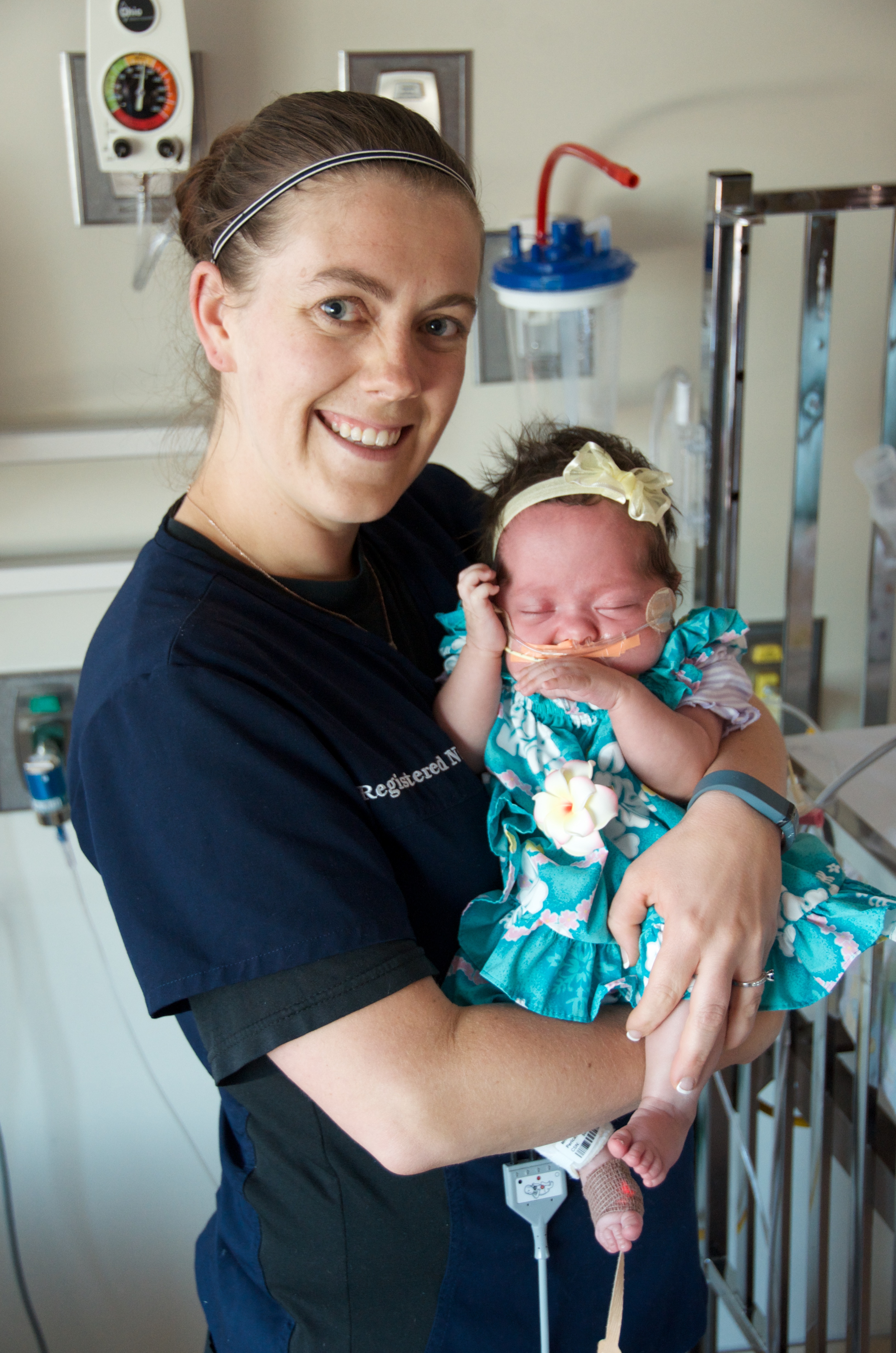
As Kate tapered off the pump, we were just filling up the second chest freezer and the lactation nurses understood why Kate was putting an end to pumping. She had developed a reputation in the NICU as a super producer. At London’s discharge, on May 19th, 109 days after she was born, the NICU staff wrote messages to us. One of our favorites from the lactation team wrote, “Your mom was a rock star with pumping. She could have fed three babies in the NICU!”

Next week, London will be six-months-old and I can thaw breast milk from three months back. And right now it’s lunch time for the little girl, to the chest freezer I go.
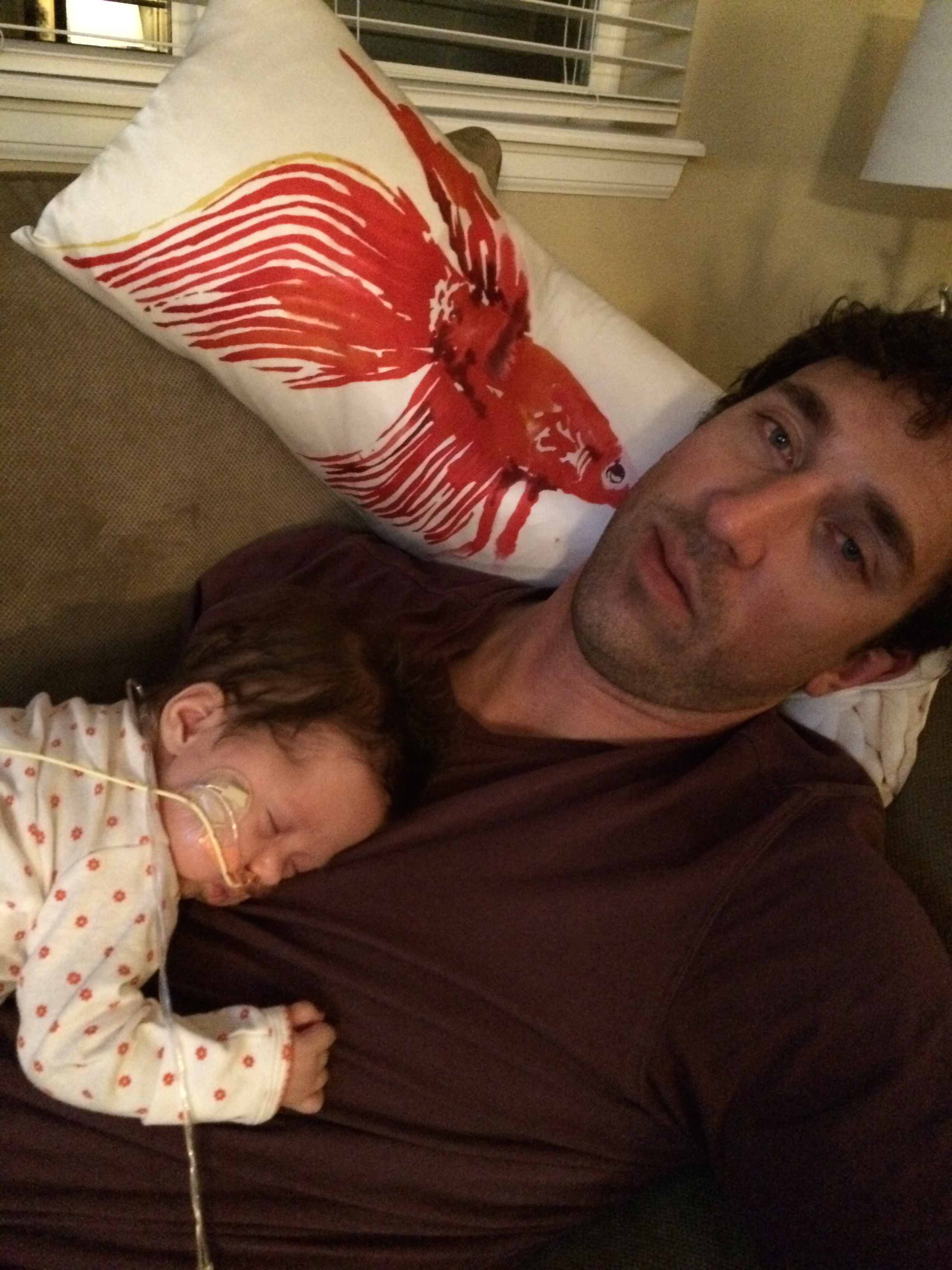
One Year Ago Today, We Left the NICU

IMG_4165

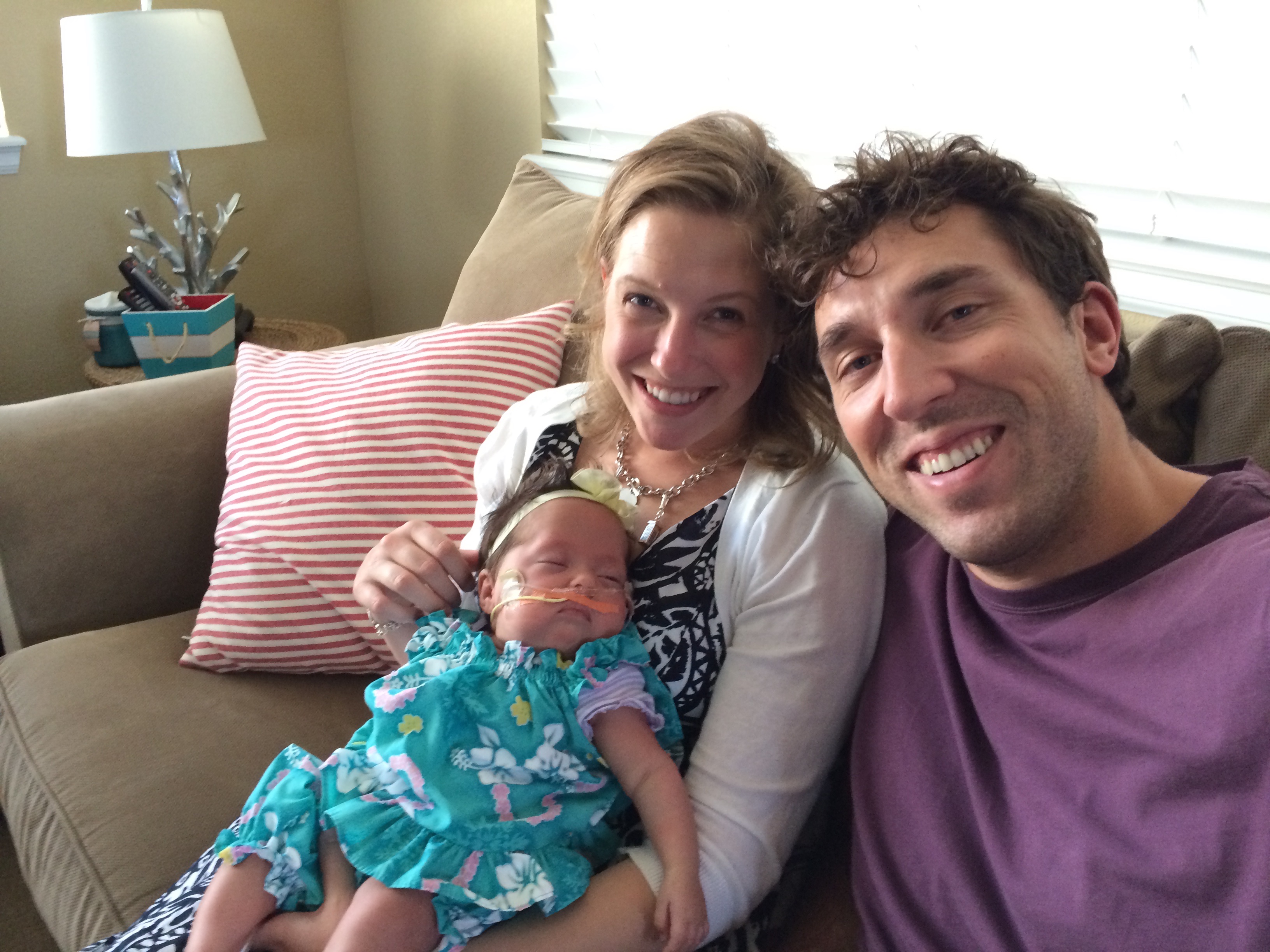
London’s first night home. I already look horrible.

Today is the one-year anniversary of London’s big move from the NICU to her new home. Reflecting on that day a year later, I think I made the right choice by not overthinking what a big change it was going to be for London and for us.

I knew it would be an exhausting transition, but my thinking was that I would roll with the punches, get knocked down a few times (which I did), adapt my style (easy, give up sleep), and then hang on for dear life and at some point in the future I would come out a practiced and knowledgable parent (still looking to the future on that one, at least in some regards). To me, going through that process seemed easier than trying to be ahead of the curve. Plus, that would take time to read and figure out what I was doing wrong. After 109 days in the NICU and then starting parenthood all over again when London came home, we did not have time for that.

Learning London’s cues taught me nearly everything I needed to know about taking care of her this last year. A few cues are exclusive to taking care of a preemie, like knowing when to stop the bottle feed and move forward with the tube feed, or knowing when 1/8th liter flow was not enough or if it was just right. I relied on London’s pediatrician, her nurses, her physical therapist, her occupational therapist, and both sets of grandparents to fill in the gaps in my knowledge.

FullSizeRender-3

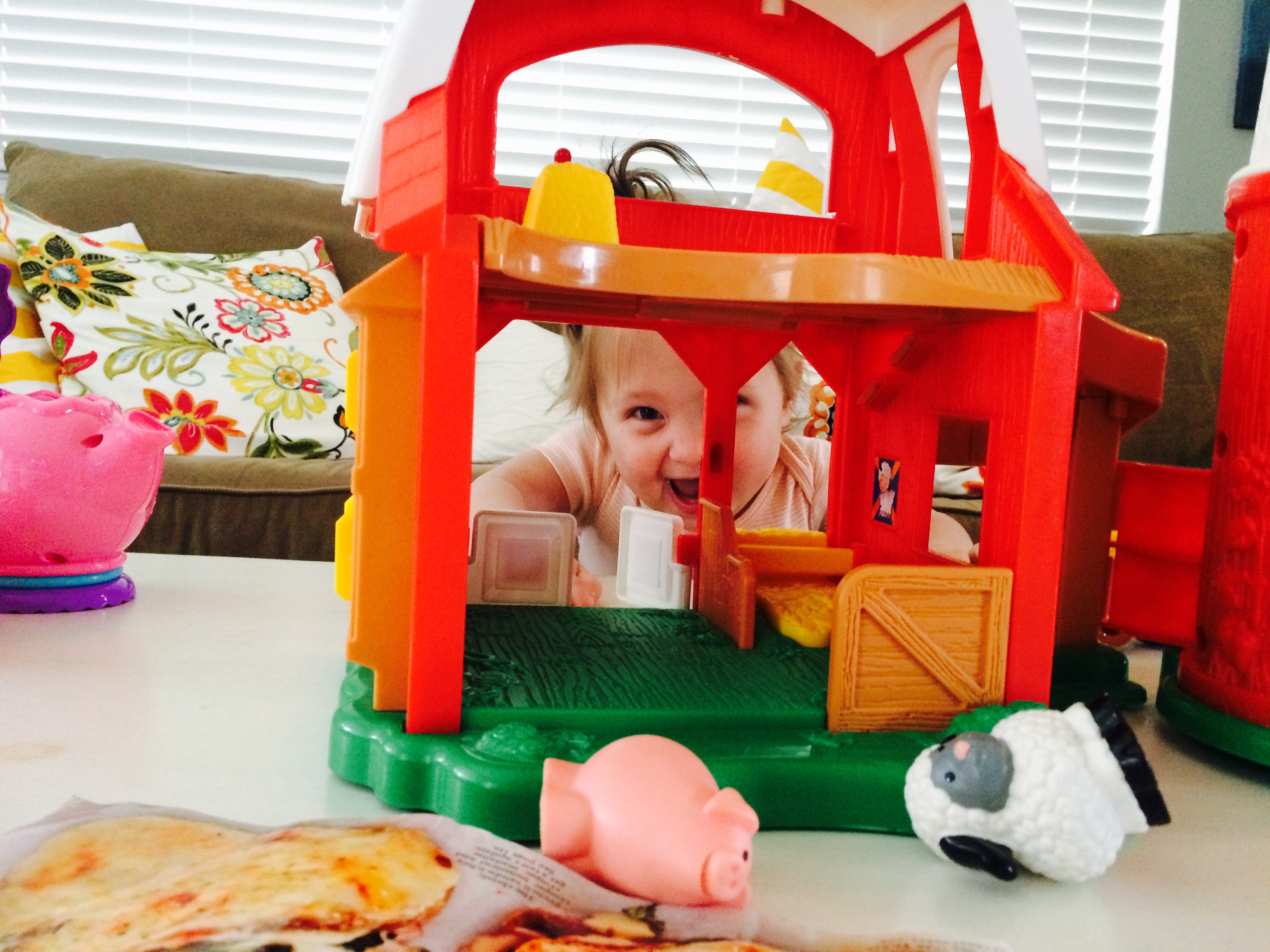
Today. Playing with her Little People farm.

A year later, London is far easier to take care of than she was with all the accessories she came home with. And, I am far more rested than those first days and weeks she was home. I am still tired most of the time, but I have coffee for that.

London’s first year home bears the mark of many a preemie: daily doctor’s appointments at first, then weekly, and then gradually monthly, with some major scares along the way. I hope and pray her second year at home will be smoother than that, that it will bear more marks of hope and promise than it will remnants of her harrowing beginning.

The Story of London’s Birth

IMG_0109

This picture…because it’s Cinco de Mayo!

A few months ago I wrote a post linking back to the story of London’s birth, the first posts on this blog. It had been a while since I had mentioned them and wanted to make sure people were aware of them, especially since they were now buried in the archives.

I have finally done something I should have done months ago. I have posted links to London’s birth story in the About the Author tab of this blog. I encourage you to read those posts if you have not.

In the meantime, happy Cinco de Mayo! I made a margarita last night following this recipe. It was delicious, but to make more tonight I had to raid the limes at the grocery store today. You will need a lot of limes. Enjoy!

Pictures: Leaving the NICU

_BKP2732


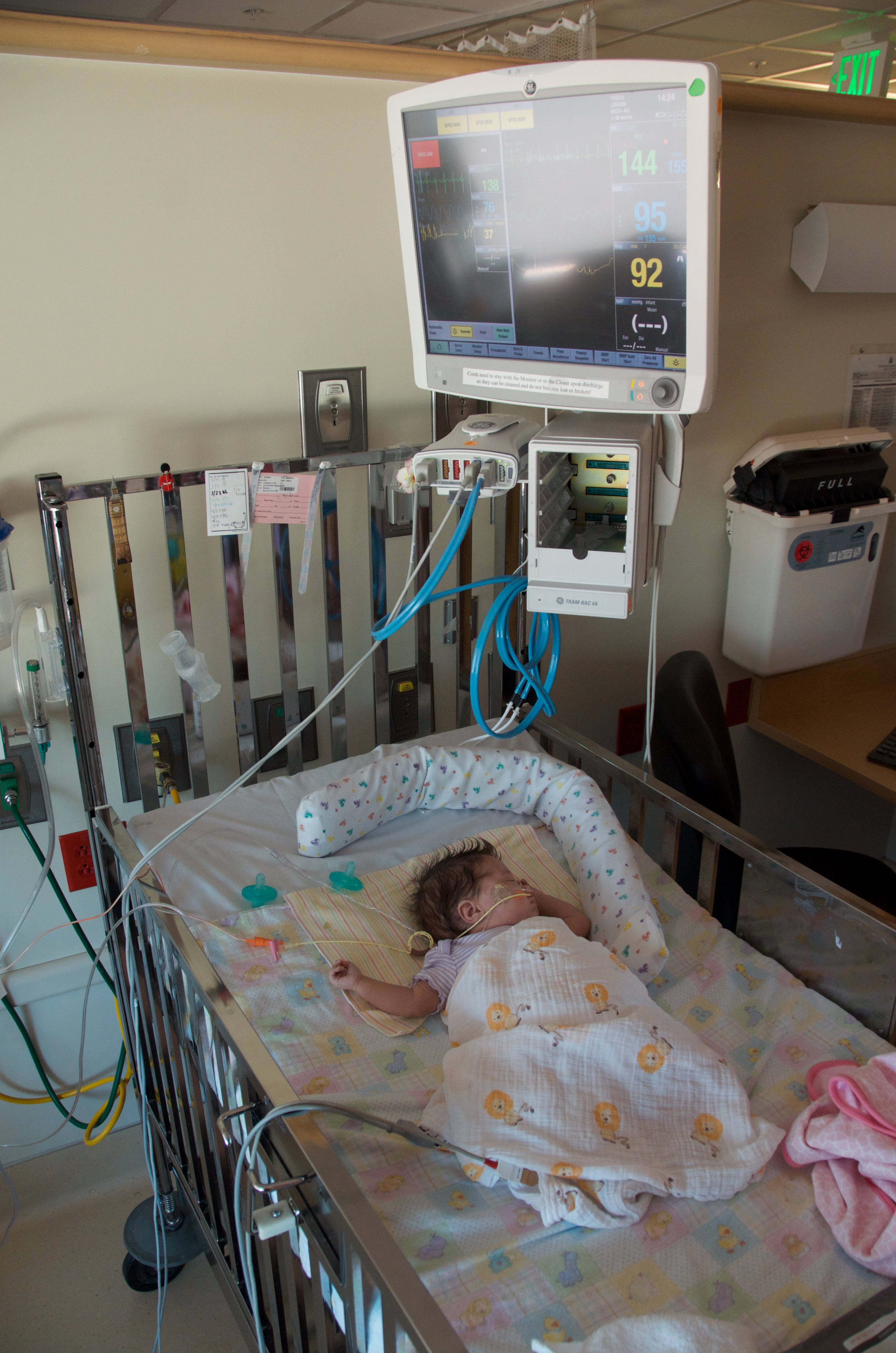
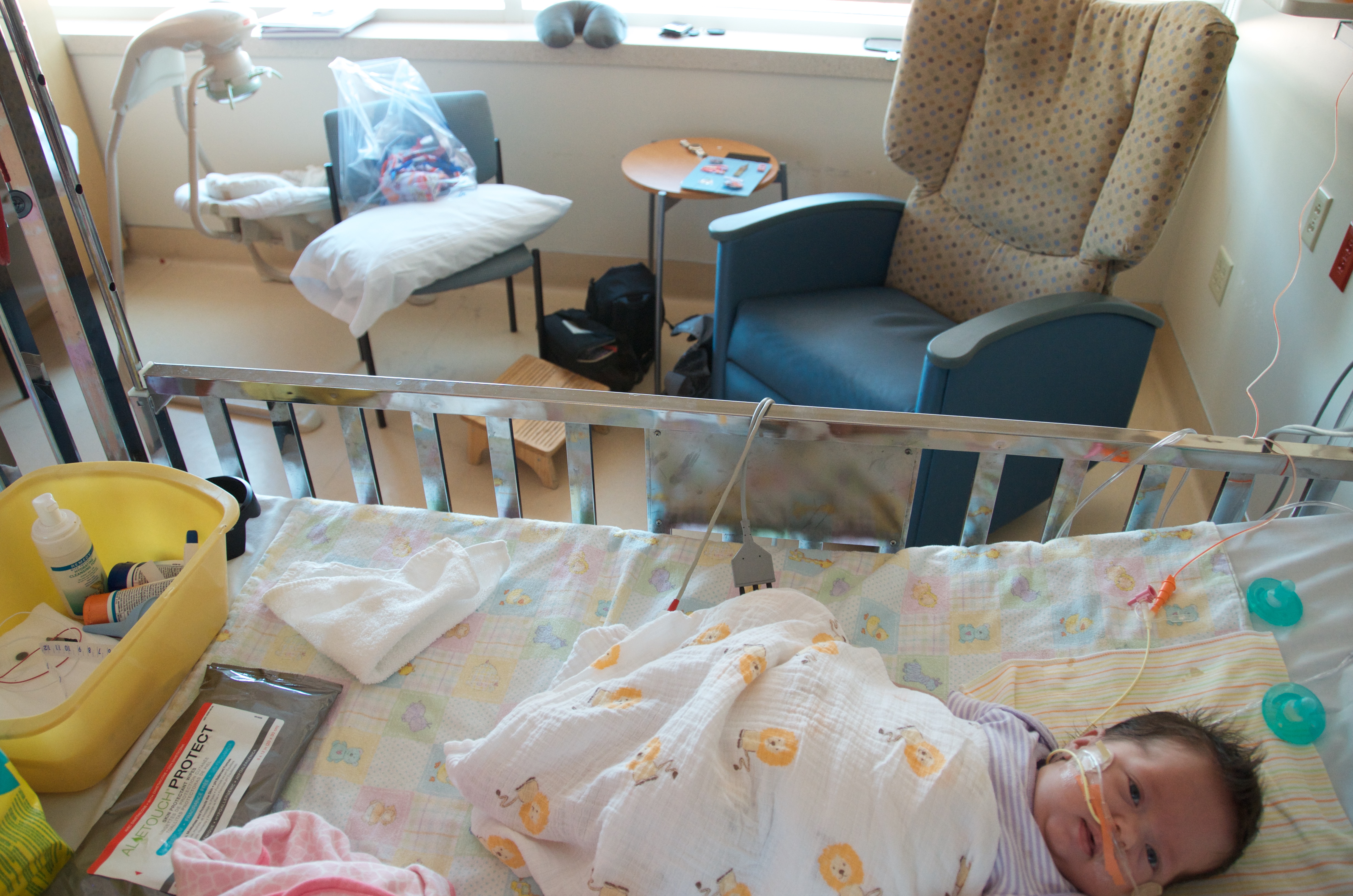
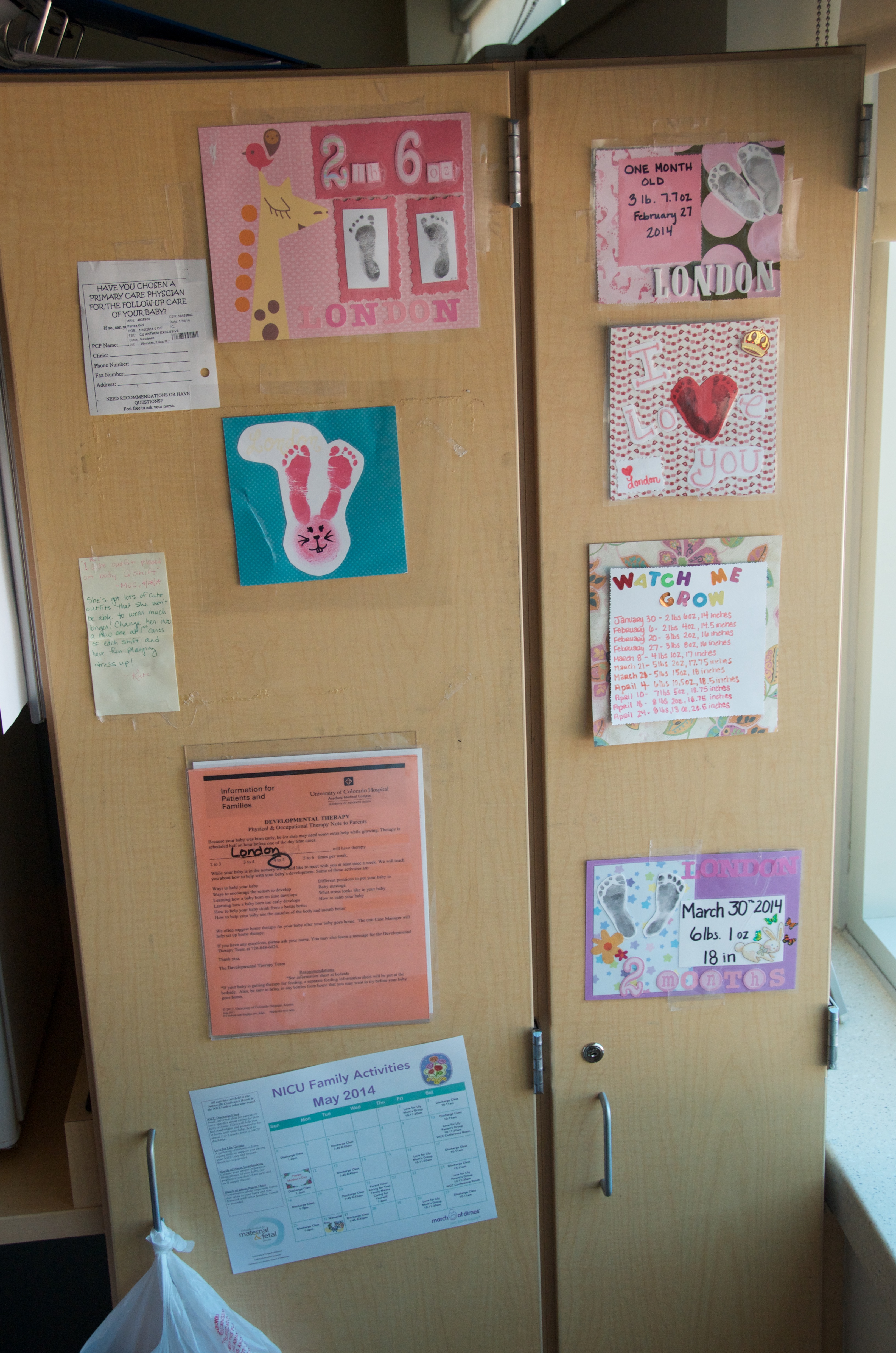
The day of London’s discharge from the NICU I brought the Nikon to take some higher res photos of her room and its surroundings. Although we never wanted a baby in the NICU, it did become a home for us after three and a half months. I suppose anywhere your baby has to stay will inevitably feel like a second home. I wanted to capture even the mundane things of the room, like the chairs we sat in everyday, or the closet doors displaying her footprints and growth progress. So, some of these shots will just not have much appeal to you, but I thought I would share them anyway because they mean so much to our little family.

_BKP2735

London resting in her NICU bed. For her, the day was not so monumental as it was for us. She had no idea what was in store. We did, and we could hardly contain our excitement and nervousness.

_BKP2741

This is one of those pictures that is more for our benefit than for yours. I wanted to capture what I saw from this side of the bed, where I actually rarely stood. I stood on the other side all the time. But at least from this angle you get a feel for what was in the rest of the room and the amazing windows we had in the room.

_BKP2745

The closet in London’s room with several footprints, a growth chart, a physical therapy schedule, a note from Kate, and the top of a bag holding London’s dirty clothes. Again, just trying to capture it like it was before all this stuff came home with us.

_BKP2746

The million-dollar view. It doesn’t look like it, but it’s the only window this size in any of the NICU’s pods. We scored in a major way.

_BKP2748

I took all the stickers we had placed on things around the room and put them on the iPad. The outcast Leprechaun was a treat from our Irish primary nurse. When he was on the lamp for months, I had placed a Union Jack flag in his hand. Eileen was not amused.

_BKP2763

Dear Megan, London’s primary, on the last day she was responsible for taking care of London.

IMG_4148

Spent a lot of days in both of those chairs, usually with coffee on the side table and always with my Timbuk2 bag filled with magazines or books to read when, or if, I could get some time to do so.

IMG_4149

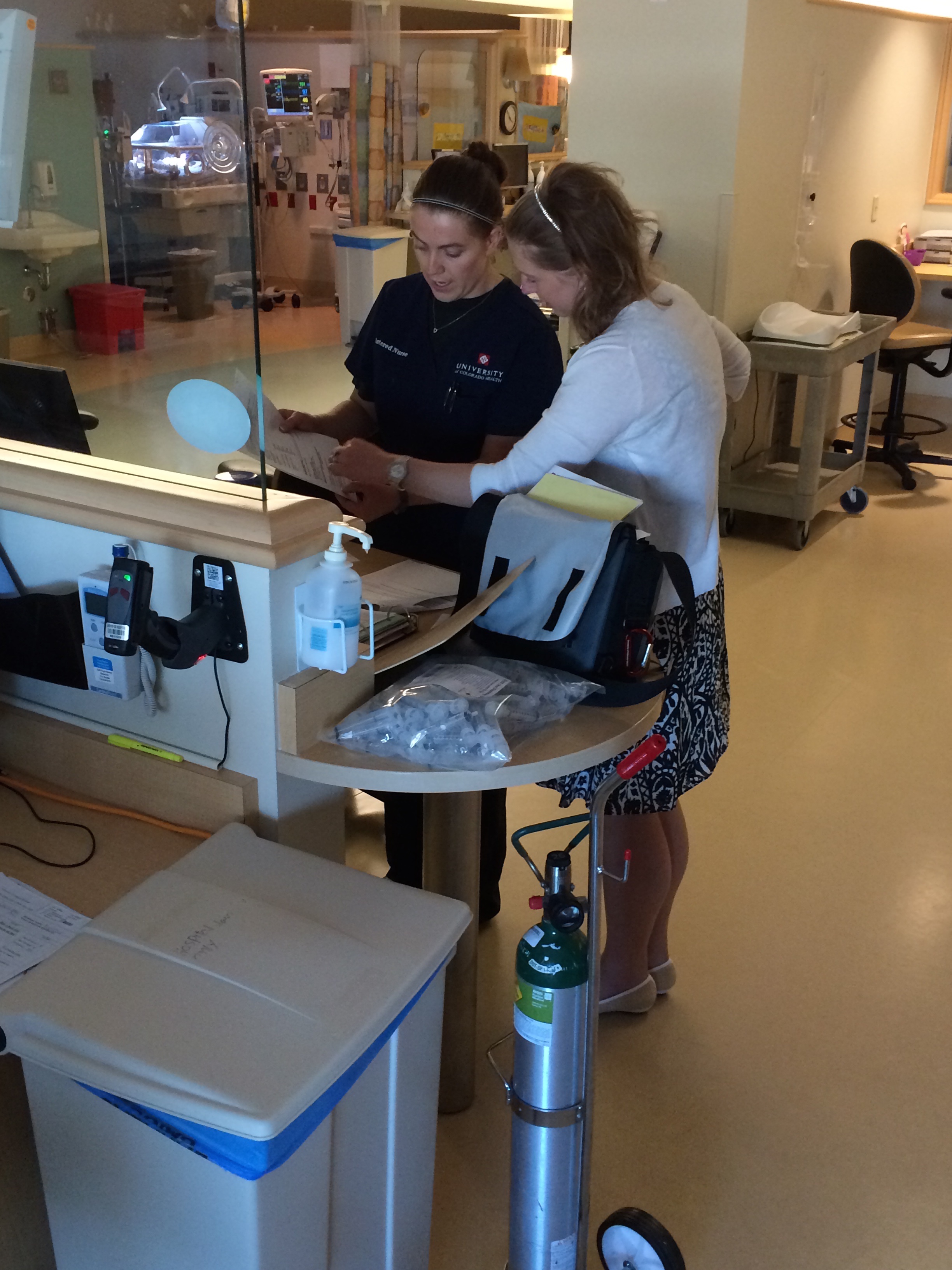
Megan and Kate going over some paperwork before we finish packing the room up and carry London out of there once and for all. There’s no way to explain just how nervous you feel about taking your daughter home from the hospital after she has been there for almost four months. You absolutely need to get everything right and you also need to know again and again what exactly needs to be done if there is a problem with something once you are home. In less than an hour there is not going to be a team of nurses and doctors on the other side of the curtain able to answer your every question.

IMG_2423

Moments after all three of us stepped outside the hospital, 109 days after we frantically arrived, thinking we’d spend just a few hours there.

IMG_4157

Home. The adventure begins anew.

To the Internet, Not So Fast

Back in 2007 I had a troubling sickness. It started with migraines, then it transitioned to the frightening Bell’s Palsy, and whatever I had did not stop there. I developed iritis (inflammation of the iris, which makes the whites of your eyes blood red and the photophobia can be unforgiving). I had partial hearing loss in one ear. Doctors ran me through a battery of tests. In a few months I had a CT, blood draws, many eye exams, an MRI with and without contrast, X-rays, and a flexibility test, where the doctor looked for signs of Ankylosing Spondylitis, a symptom of which can be stiffness and pain in the spine and neck.

The tests turned up nothing of concern, but the symptoms continued to give me plenty of reasons to worry. In between visits to the doctor I would sometimes have a lapse of judgment during which I logged onto the internet and did some self-diagnosing. What I found was terrifying. There was an encyclopedia of diseases and unheard of (to me) maladies that could, in theory, give me some of the symptoms I had. Brain tumors. Cancers. Crohn’s disease. Thinking about it all scared me. The doctors, I knew, were doing their best to give me an answer. For a time, I thought that their lack of explanation was a bad sign. When I was firmly convinced of this I went to the internet. Ultimately, what I found led to prolonged worry and who knows, maybe some of the symptoms would have gone away sooner if I was not giving them their unwarranted attention.

By 2008, all of my aches, pains, and inflammation were gone. Most likely a virus had attacked me and, my body, with some hiccups along the way, crushed it. However, if any of the symptoms had returned in the seven years since I would not have consulted the internet. I would have gone to a doctor.

To have this lesson in my back pocket heading into London’s bumpy start to life was an unexpected blessing. London’s actual and possible complications from prematurity were a tsunami of information compared to my sickness years ago. The first wave of preemie particulars and statistics hit even before London was born. While I was waiting outside the operating room a doctor came by and ran down a random list of possible complications. She told me 26-weekers have an 85% survival rate. This brief conversation introducing me to the challenges preemies face was similar to seeing the tip of an iceberg above water. The other 90% was below the surface, or in our case, through the OR’s double doors and on into the NICU. To borrow from The Lord of the Rings, it was “the deep breath before the plunge.”

*          *          *

Upon your family’s arrival in the NICU, you might feel like you’re drowning. There are more people taking care of your baby than you can keep track of. There is a new procedure every day. Thus, there are results every day, results that must be explained to you, sometimes three or four times. In addition to that, there are a lot of unknowns and, regardless of how talented the NICU staff may be, no one can accurately foresee the obstacles ahead for your baby. The internet is not going to be any different. There, you will find many question marks and new and more dangerous preemie complications to worry about, even if your baby is not suffering from them.

As parents with a baby in the NICU, Kate and I felt like there needed to be a sacred part of the day, during which we would try to not worry about the next results from London’s latest blood draw or echocardiogram. Of course, to not worry is impossible. It is more accurate to say we carved out time in each day during which we would purposefully not heighten our worry. This time became essential to getting us through every month our daughter was in the NICU.

Seeking information or support online seemed to only disrupt any sense of peace and hope we had regarding London’s course of treatment. If it was information we sought, then it was to go down the rabbit hole again, entering a world where one complication, like a brain hemorrhage, could lead to hydrocephalus and, almost certainly, cognitive disabilities. At least, that is what the internet would like you to believe at times. And if it was support we queried, we discovered far more troubling accounts than our own, which led to more worry.

Very early on in our NICU adventure we discovered the very poor predictive quality of the internet. Thus, the net never became a source of information for us. We much preferred getting answers straight from the trained professionals who were taking care of our daughter.

I have used the internet for queries about preemies many more times since starting this blog than I did while my daughter was in the NICU. When I am using the internet to find a definition of a certain malady, it can be helpful and I am grateful for that, but the internet will remain a horrible diagnostician and a font of worry for parents with a baby in the NICU.

Do you remember the show Rescue 911?

IMG_4109

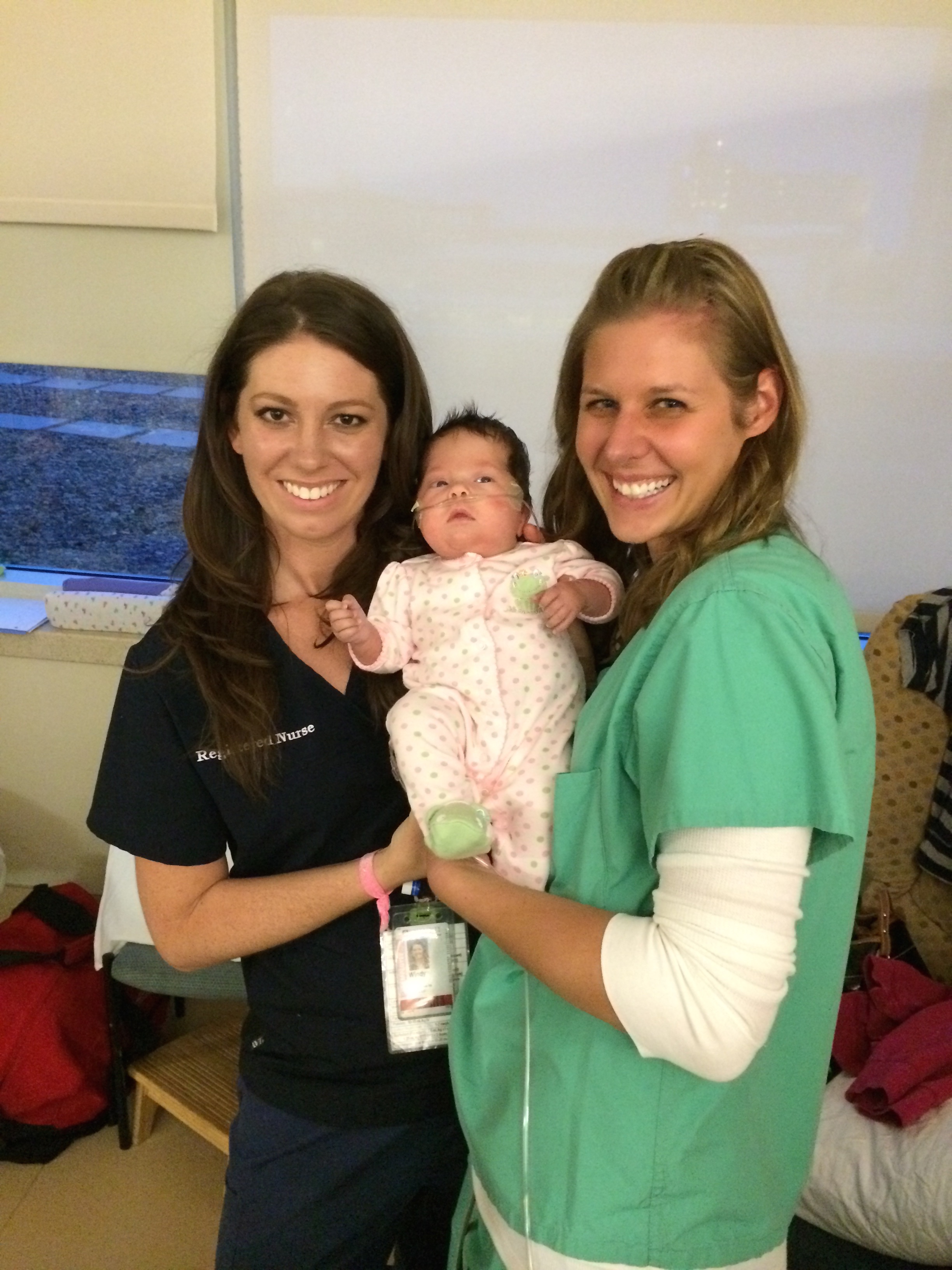
Windy and Rachel on their last night shift with London before she leaves the NICU.

When I was much younger I watched the show Rescue 911. Hosted by William Shatner, the show reenacted real-life emergencies and spliced in interviews from people who were present when the aforementioned emergencies occurred. At the end of the reenactments, the rescuers who saved the individual/s in need of help, were reunited with the people they saved.

The reenactments are so bad they are painful to watch. It was easy to find some old episodes of the show on YouTube. There is even a story about a baby being born “nearly three months early” while on a flight. He weighed in at 4 lbs, 6 oz. (I have to interject here, if the baby was really almost three months early, that’s a huge kid for that gestational age). Here’s the link to the story about the premature birth on the flight. As you might guess, the reenactment is hilariously bad.

What got me thinking about Rescue 911 was seeing some of London’s nurses the other week. I got home and two of her primaries were visiting Kate and London, eating pizza Kate made, and sipping wine. I got a chance to visit with the nurses a little bit before they left and during that time I thought of the reunions at the end of Rescue 911. I always enjoyed these scenes, loving the idea of being able to see and possibly become friends with the people responsible for saving my life or, in this case, my daughter’s life. And now, that was happening right there in my kitchen.

I would never wish what Kate and I went through with London upon anyone. But if it is to happen, this is the happiest ending one could possibly hope for. We were incredibly blessed to have such caring NICU nurses. And now those nurses have become friends. I hope that as long as we are in Denver and as long as they are working nearby, the reunions continue because, for us, they are heroines.

If You’re Just Now Getting Here

I probably should have done this sooner, but if you’re just now finding this blog via a tweet, Facebook share, or web search, then you should know that it all started with a series of posts detailing London’s birth. These posts are the foundation of this blog and, for their author, the hardest to write and the hardest to reread.

Feel free to scroll down through the archives, but if you’re looking for square one, and for getting a better feeling of how this family got its start, follow the links below. A quick word about the original posts, there are thirteen of them, but they aren’t very long posts so reading all parts is not a big ask.

London’s Birth Part I. 

Part II.

Part III.

Part IV.

Part V.

Part VI.

Part VII.

Part VIII. 

Part IX.

Part X.

Part XI.

Part XII.

Part XIII.

The NICU Is A Fortress

IMG_3504

One of my favorites. Her 2-month birthday. “To infinity and beyond.”

As badly as I wanted London to leave the NICU I was also terrified of some of the things she would lose when we walked out of that hospital. 24/7 caretakers. A team of RNs, NPs, and MDs just feet away. The opportunity to talk to one of them whenever we wanted to and to ask the dumbest questions of.

As a parent, you do grow accustomed to having your baby in the hospital 24/7. It is comforting to know that your child has the best babysitters in the world.

While London was still in the hospital I wrote:

Right now I feel like taking her home will be bittersweet. I’ll be beside myself, in a good way, when we walk into our house holding London, but it’ll also be frightening to leave our NICU family.

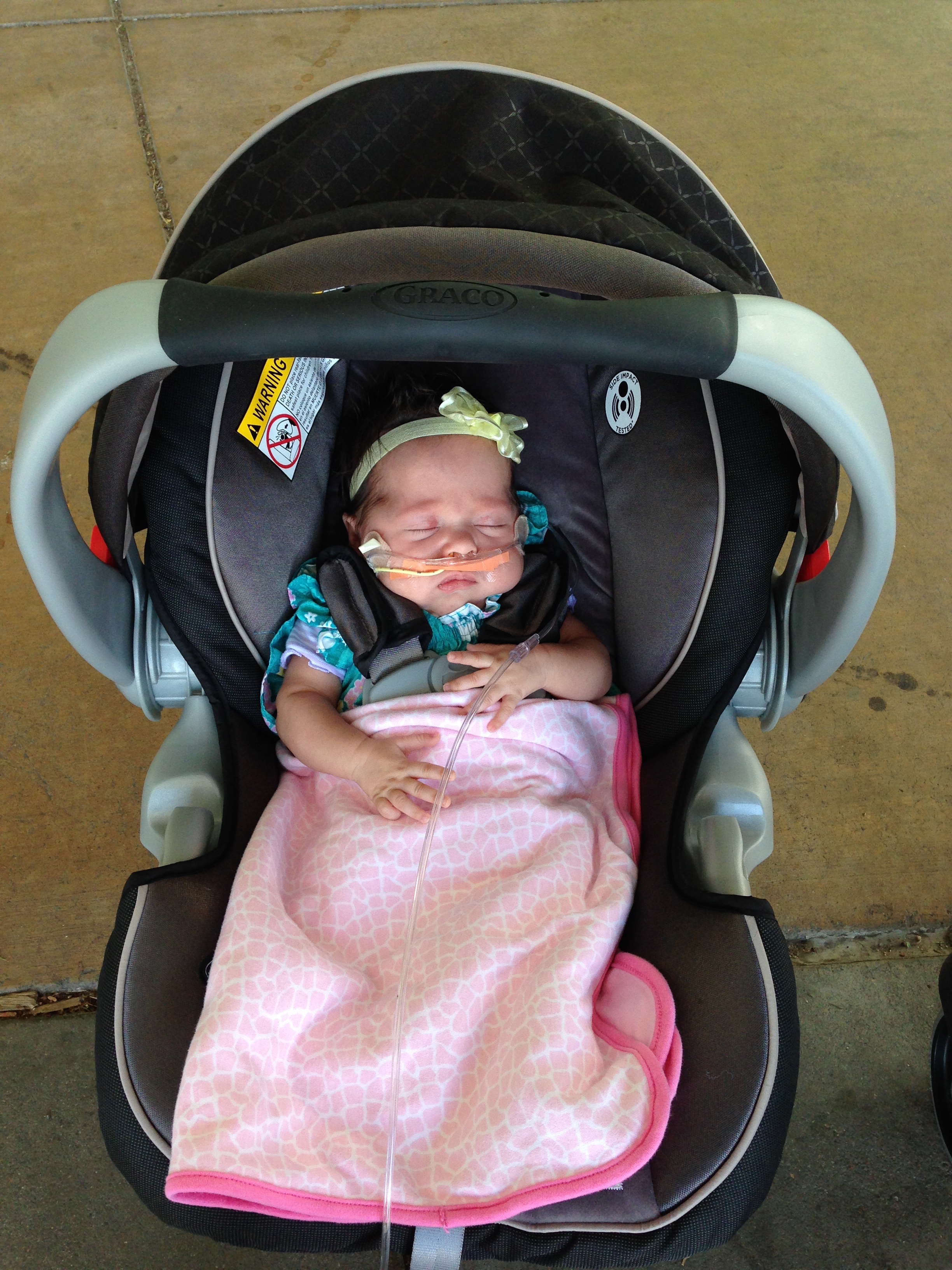
Back then, the approaching discharge date meant exposing an already fragile baby to the terrors of this world like driving home with her! Or contact with the public, those creepy baby oglers who think they have the right to walk up and touch your child just because she is the cutest thing they have ever seen. Can’t stand these people! We would be responsible for a baby, yes, but also all the leashes that come with her: NG tube connected to a feeding pump, an oxygen cord, and a pulse ox connected to her foot. Monitoring all that could be overwhelming on top of normal baby duties.

But a baby has to leave the NICU eventually. We had our gambles and triumphs there in that pod, but the good stuff was to be found in life beyond those hospital walls. It is hard to think of leaving the NICU as anything but a tradeoff. An adventure was before us, filled with successes and failures, loss and gain, losses and victories. But behind us was London’s NICU pod, which, for her parents, became the safest place in the world.

The Museum of London

IMG_3038

I have a sneaky suspicion that throughout her life London will be the recipient of a few gifts with a British theme to them. If we were going to easily tire of this, we wouldn’t have named our daughter London. Those gifts started arriving right away, one of them directly from London itself. A friend of ours was in the UK when London was born and brought back a gift from the Museum of London. When I saw the bag the gift came in I knew exactly where I was going to place it…on one of the walls of London’s pod. There it stayed for 109 days. As the weeks and months passed, there were more signs on the walls in London’s pod. Of course we have them all now at home, but I took pictures of all of them before we cleaned out London’s NICU pod. Here they are…

IMG_3054

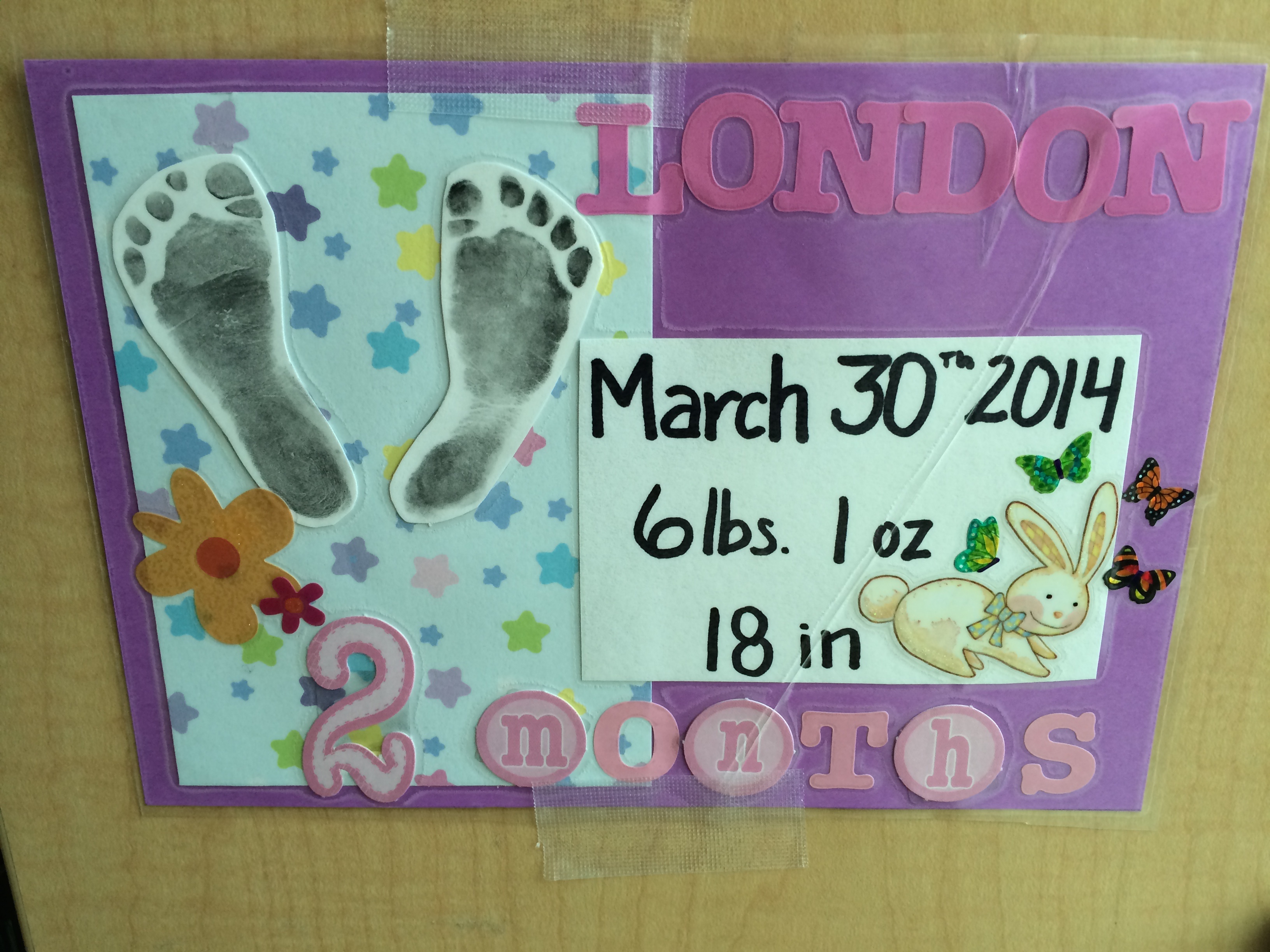
London’s first footprints with her birthweight. There’s no perspective here, but those feet are the size of my thumb. Oh, and all these signs were made by the nurses. That is something I never expected about our NICU stay, to have on-demand artists to create signs commemorating London’s growth and month birthdays and even holidays.

IMG_3055

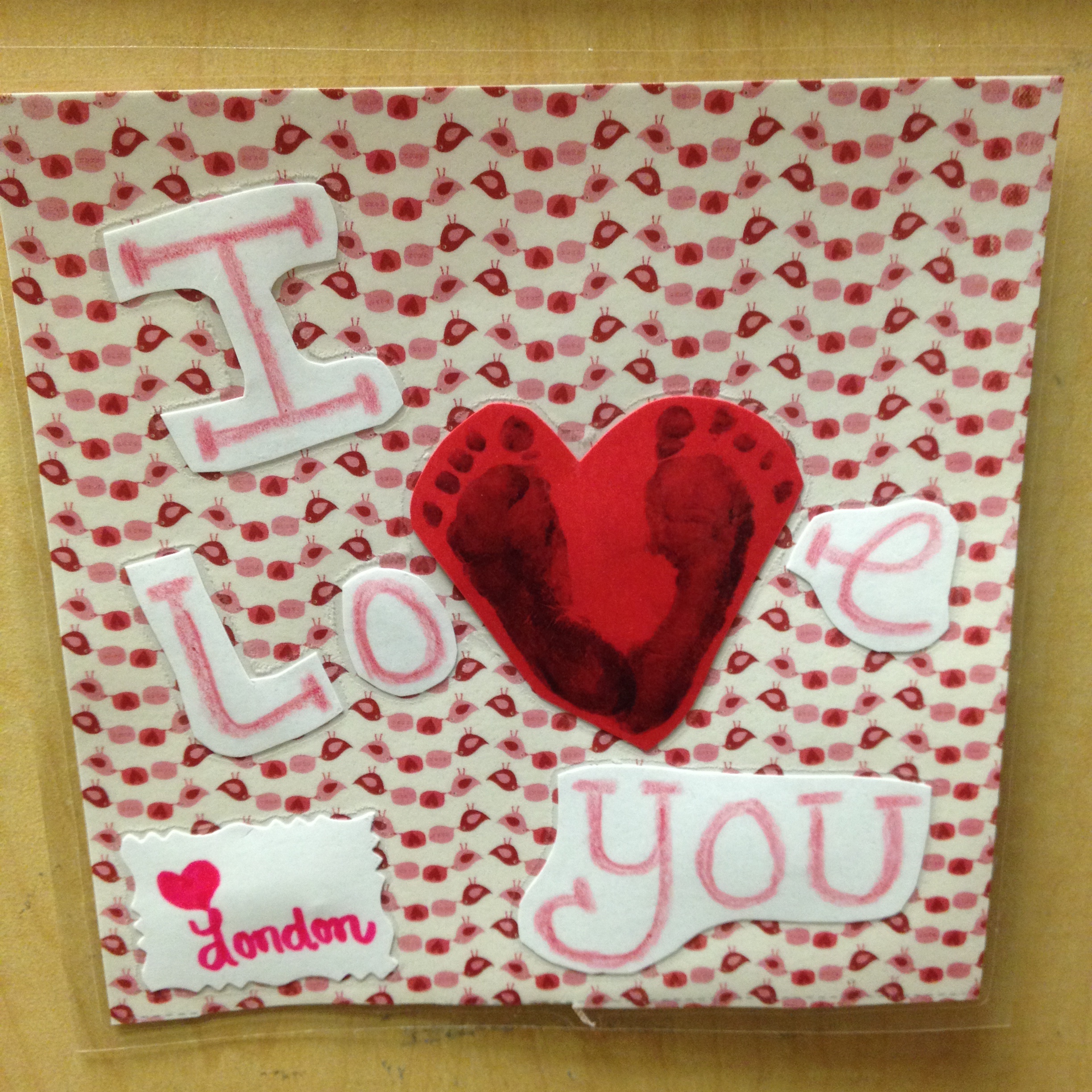
London’s first holiday was Valentine’s Day. We brought cards in for her. I bought a card for mom from London. Just looking at the card from London made mom cry. Forget about reading it.

IMG_3210

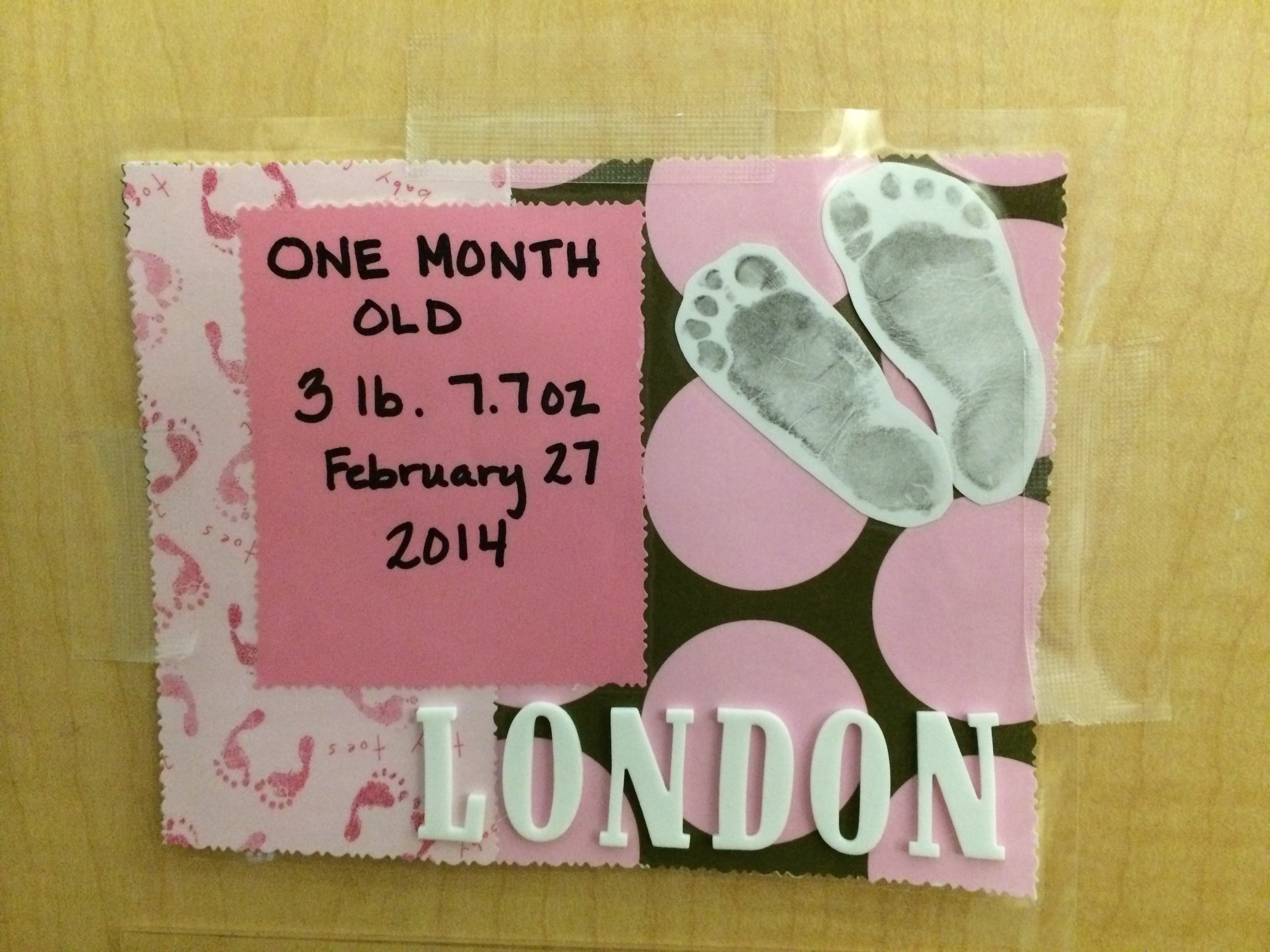
Born on January 30th, we just had to select a day at the end of February to be London’s one-month birthday. We took handprints and footprints that day and a family picture. London’s hands that day were about the size of my thumb.

IMG_3311


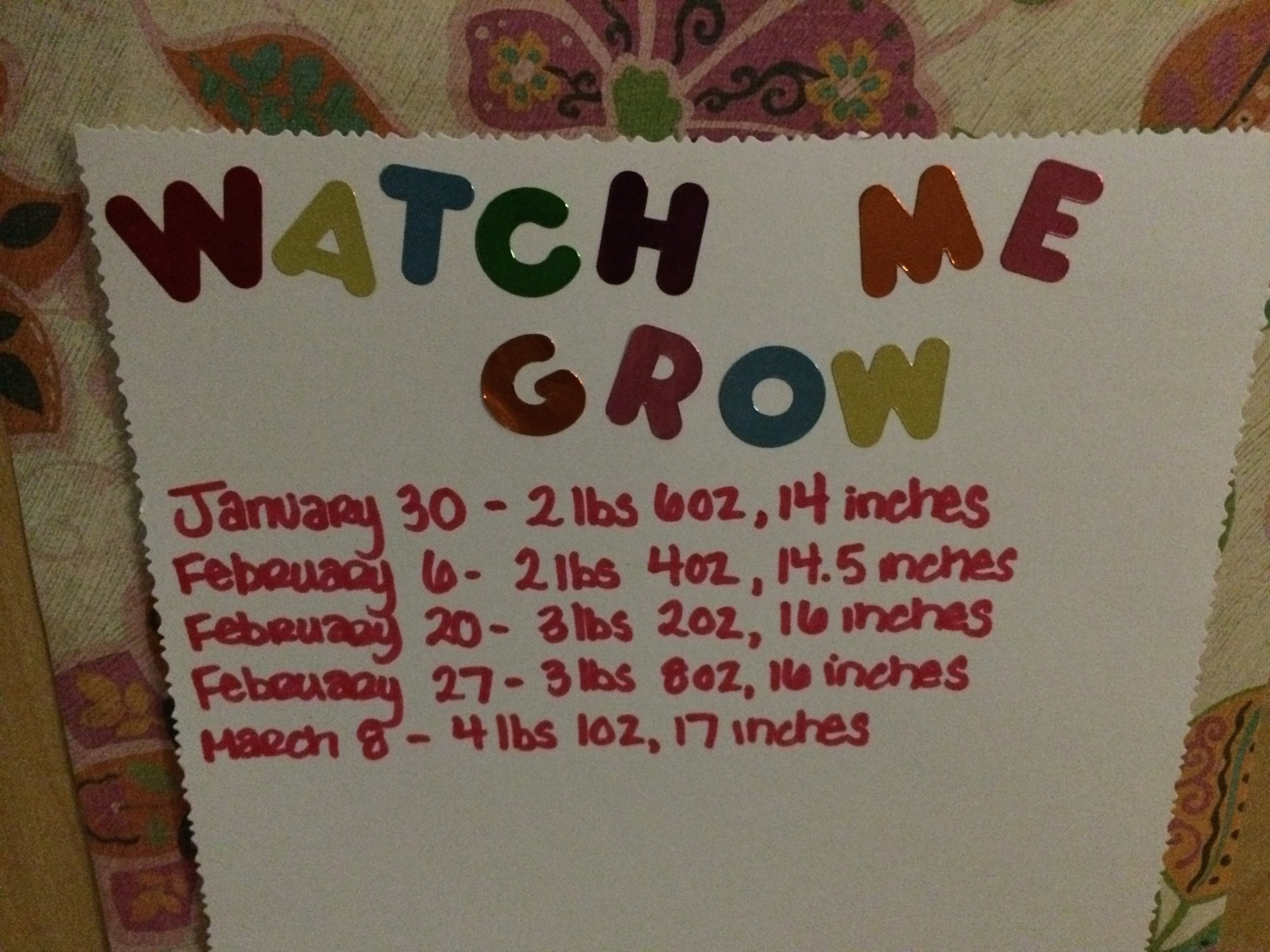
By March 8, London was 6 lbs 1oz shy of my birthweight.

IMG_3516

IMG_3936

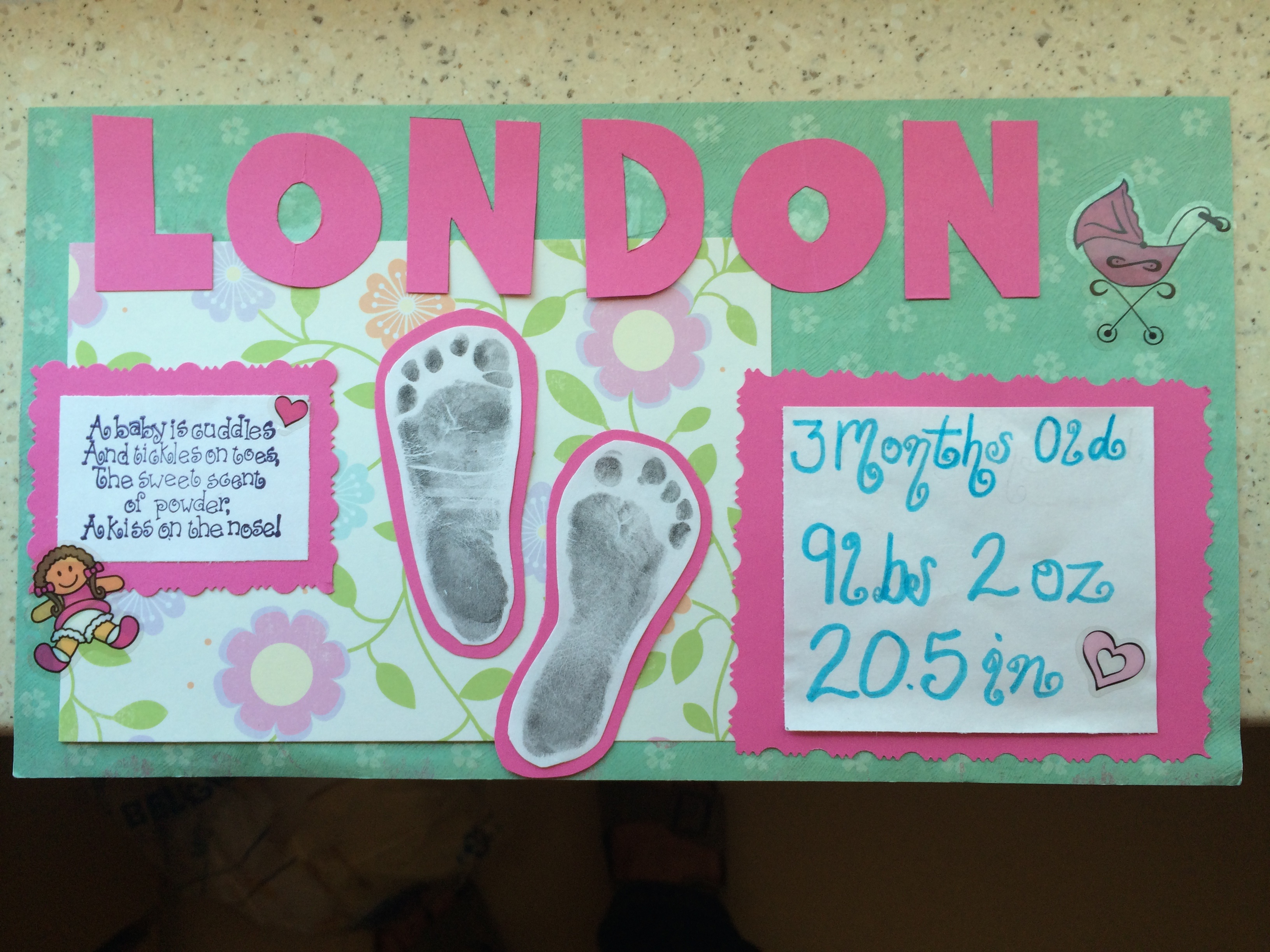
These footprints, although small, looked like Bigfoot had made them when you saw them side by side with London’s birth footprints. Unbelievable. Also, had London gone full term, we were told her birthweight would have been around 9 lbs 2 oz, the weight on her three-month birthday.

_BKP2734

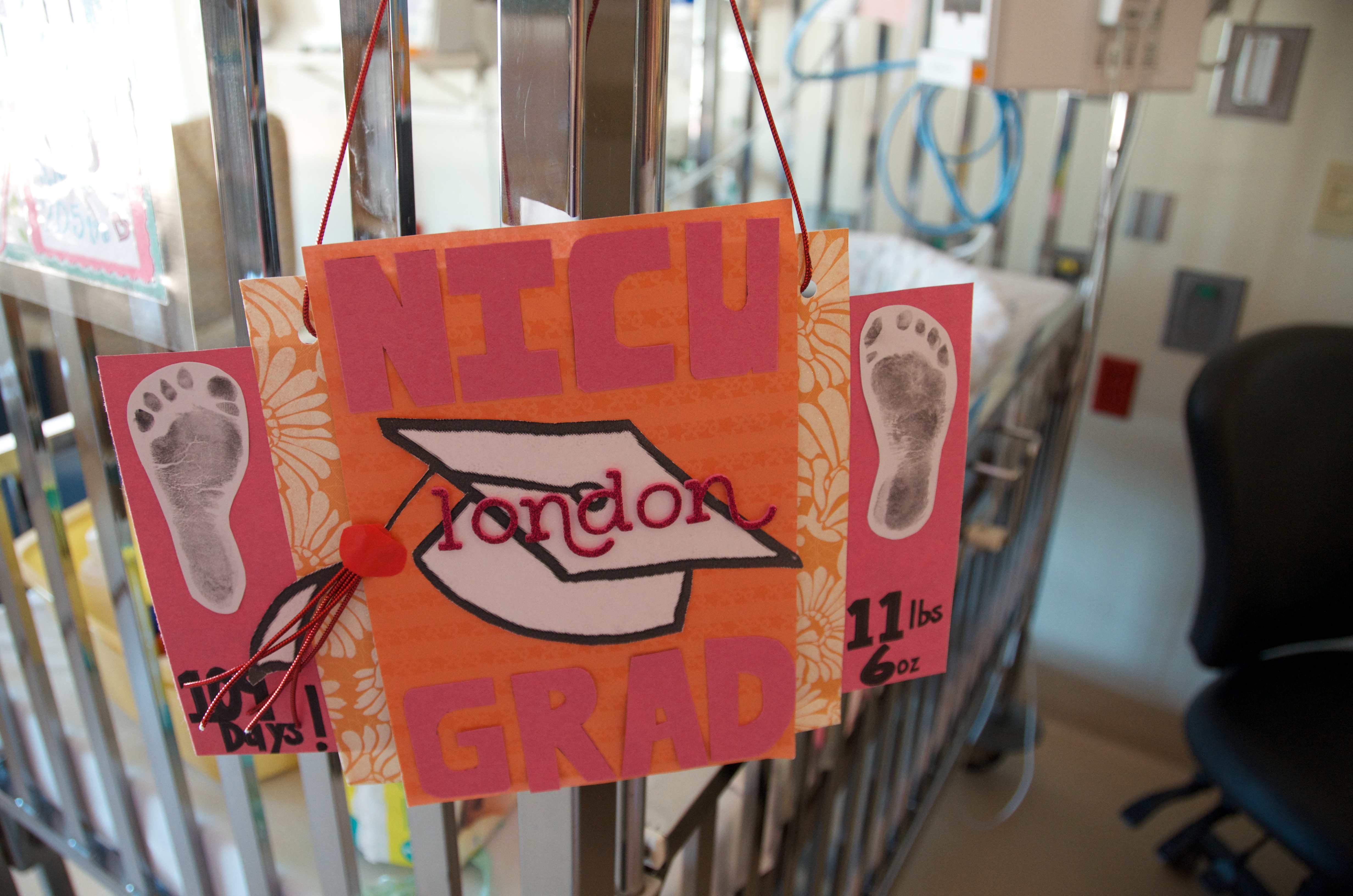
Lastly, one more sign made just in time for London’s discharge day from the NICU. She gained 9 lbs in the NICU and grew 6 inches. By her fourth month there, London could have eaten some of her NICU neighbors for dinner. She was the Queen Bee, unrelenting in her cuteness and exponential growth chart.

Summa cum laude. 

Little London’s Nurses

When I first met London’s primary NICU nurses I did not know just how special they would become to Kate and I. In hindsight, that I would come to think of them as extended family in a way was inevitable. NICU parents have to get away from the unit for their own health, but for many other reasons as well. Life goes on. Jobs don’t wait. Other responsibilities don’t disappear just because you find yourself in this incredibly hard situation. So, when it comes time to leave the hospital, you leave your preemie first and foremost in the hands of your NICU nurse. Of course, there is other support, other nurses on the floor, nurse practitioners, residents, fellows, and attendings, but the one who is on the front lines, the first responder, is the primary nurse for your child.

London had four primaries. From the start they were the most comforting, knowledgable, and loving people. They were her first, and they will always be her best, babysitters. They taught Kate and I most of what we know about raising a preemie. They explained every twist and turn of London’s treatments. I could go on and on and write a long list of the many things they did for London and for Kate and I, but why should I when I can just write this: they ushered me into parenthood with such grace that when it was time to leave the NICU with London it was hardest to say goodbye to them.

As I continue to write about the experience of having a preemie, I will write more about London’s nurses. But for now, I will end this short post with this thought that I had long before London was discharged:  London’s primaries are people who, no matter how well we stay in touch for years to come, I will treasure for the rest of my life because I will never forget the way London was introduced to this world and thus, I will never forget the people standing by her bed during that tumultuous beginning.


London’s Birth: Part XI, Changing a diaper on a two-pound baby

*This is another post in an ongoing series. Scroll all the way down or click to part I to get to the beginning.

While in the waiting room a doctor came in to talk with us about London’s condition. She sounded positive, being clear to us about what our expectations should be. We had to stay there for a while until Kate’s room was ready. When it was time, I helped push her bed over to the new room with nurse Amy, from earlier in the evening. We were on the fourth floor, facing south over the main entrance to the hospital. Kate was a little disappointed we didn’t have a mountain view. If you looked off to the right you could see the mountains bending southward, but it wasn’t very majestic like it would have been with an unobstructed view west.

I was able to go be with London once more before Kate was ready to head over there. That’s when I met nurse Megan and the new employee she was training, Laura. They were immediately helpful and gave me so much information I couldn’t keep track of it all. They pointed to line after line telling me what it was and using acronyms that I quickly forgot. “This is where she is getting her TPN.” “This is the PICC line.”

London was in her isolette, which was ridiculously hot and humid inside. Megan started to tell me about these things called “cares.” They are at certain times of the day, every four hours to be exact, and that is when we would take London’s temperature, change her diaper, listen to her, poke and prod and make sure she is doing well. Megan and Laura were just about to start and asked me if I wanted to jump in and take her temperature and change her diaper. Megan emphasized that if I was not ready, she could do it this time. This surprised me, but I did not take her up on that offer, I said, “I can do it. Just coach me through it.”

They showed me the one button on the isolette I was allowed to touch. It activated a heat shield so when I opened the little openings for my arms to go into the isolette it did not cool off in there. They gave me a thermometer and told me that I will take her temp in her armpit. They showed me how by placing the thermometer and holding her arm against the side of her chest. I put my hands in the isolette and immediately noticed the jungle like feel to the air in there. I had not touched London yet. I was so afraid. I felt like a simple touch of her arm would snap it. Because I felt that way I was much too gentle with her and failed to get a good temp reading. I didn’t have the thermometer truly in her armpit. The nurses corrected me and told me I could be a little firmer with her. They were right. London was so small and looked extremely fragile, but I could apply enough pressure to get the job done correctly without causing her any harm.

I had changed diapers before, but never on a two-pound baby in an isolette with really low arm openings for someone who is 6’9” and with intimidating wires and tubes everywhere. At this stage, London’s skin was so delicate that I could only touch and release with my hand or finger. I could not rub her skin because of the risk of it breaking and sloughing off. Yeah, that was easy to remember. Do not rub your daughter’s skin off. Check.

My hands are not monstrously big, but they fit my frame, so one of them could completely cover London’s body. During the diaper change I was using giant tools for a micro job, but because of the nurse’s help I changed London’s diaper. The nurse said, “Once you learn to change a diaper on a preemie like this, every diaper will seem easy.” I knew she had a point. This was harder and slower going than any diaper change I had ever done or thought I would ever have to do. Megan wrapped up the rest of London’s cares. I walked back to Kate’s room, thankful that when I returned to London’s side I would be with her mom and we would all be together for the first time.

London’s Birth: Part X, Into the NICU

*This is another post in an ongoing series. Scroll all the way down or click to part I to get to the beginning.

Right outside the double doors the charge nurse introduced herself. She guided me through a winding path of at least sterile-looking hospital hallways. Now was as good a time as any, “Can I get a new mask?”

“Of course,” she said, stopping at a counter and getting me one and several tissues. I pulled my mask away and took a peek at the inside, not a pretty sight.

I followed the charge nurse to a pod. Each baby in the NICU we were walking into stays in a pod, not a room necessarily, but more like a cubicle with walls nearly to the ceiling. We walked the length of the NICU, took a left and there was London, skinny, vented, cleaned, and holding on. The doctors kept telling me she was receiving surfactant, which is a mixture of fat and proteins made in the lungs, but preemies are often born before their lungs can produce enough surfactant. The mixture coats the alveoli, or air sacs in the lungs, and this prevents the alveoli from sticking together when the baby exhales. A nurse said London’s lungs were like a hardened sponge right now, not ready for life outside the womb.

I stood there for five to ten minutes, all the while an occasional nurse and doctor would tell me about what they are doing or what they plan on doing. I did not retain that much. I was just locked to my daughter and I was in sort of an emotionless state, unable to fully register the last six hours. I was thinking enough to take my phone out and snap a picture of her. I was hesitant to get close. I had the same feeling I had earlier in the OR, stepping up to the bedside and taking a picture of London meant I was getting closer to her. I was letting my guard down. I was starting to realize that five and a half months ago we embraced the idea of creating a life we ultimately had no control over. The unknown and deeply frightening future belonging to my daughter was coming into sharp focus. I took two quick pictures. London with a full head of hair turned to her left, eyes fused shut, gaping mouth with the endotracheal tube snaking out of it, monitors on her chest, blood pressure cuff and pulse ox on right arm, umbilical chord clamped shut, plastic covering her lower body to keep it humid, and a nurse’s blue-gloved hand holding her legs down. I said a quick prayer when I took the picture, please God, do not let this be the only picture I get to take of her.

Sometime later, the team was prepping London to place a peripherally inserted central catheter or PICC line and an umbilical catheter. They told me it was a good time to go check on Kate because they would be working for a while. I thought that sounded great. I took a picture of London’s pod number, “Pod 3, 423,” not knowing if I would be able to find my way back or if I would need that information later on. I started stepping away from the pod and realized I had no clue where Kate was now. Someone took me to a room, which looked like it was used to just house patients in limbo who might be fresh out of surgery and do not have a room to go to. There were four hospital beds and four curtains, but none of them were drawn. Kate was the only patient there. She looked great to me because she was still here, conscious, and strong, but she looked amazingly tired, which is to be expected. I know I looked like hell. We chatted about London and where she was placed in the NICU, what they were doing to her, her weight and height. 2 lbs, 6oz and 14.75 inches long.

London’s Birth: Part IX, What’s her name?

*This is another post in an ongoing series. Scroll all the way down or click to part I to get to the beginning.

Throughout the operation there were tears slowly dripping from my eyes and my nose was a leaky faucet. I was aware that my snot had flowed through my mask and even in that moment I was mildly annoyed with the thought of having to ask for another mask. I would ask later, when the time seemed right. Until then, I tried to minimize the flow of tears and snot.

It may sound like my eyes were wandering once my daughter was out of Kate, but they weren’t. I glanced for split seconds here and there, but my eyes were essentially locked on the little human being in front of me. Vented now, the doctors seemed a little more relaxed with her and ready to move. They told me where we were going. It went in one ear and out the other. I would follow them anywhere. They started to roll my daughter a bit, making for the double doors I had come through to enter the OR. They halted for a second, one NP turning to me and asking, “What’s her name?”

I had not yet imagined when I would announce to those present in any room the name of my daughter, but if I had, it would never have crossed my mind that this would be how I would introduce her to the world. “Her name is London,” I announced. It sounded weird giving a name to her at this stage because when your child is born this small and fragile, they almost seem like a science experiment. I had started to become aware of a disturbing, but natural protection mechanism that sets in when you see your preemie like this. I wanted to protect myself from her in a way. I didn’t want to become so attached to her just in case I lost her in the next hour, but giving a name to her instantly made it harder to keep my distance.

London and the team working on her started moving out, rolling right by Kate’s face and slowing down a bit so she might possibly get a glimpse of London’s face. I saw Kate strain her head to try to see her baby before we went through the doors. I stopped and gave Kate a huge kiss, an exchange of tears cheek to cheek, and a word about how London is vented. I also checked that I should keep on walking with London and the team. Kate nodded yes and I was off through the double doors with an “I love you” and one last glance at the amazing team sewing up my wife.

London’s Birth: Part VIII, 18 People

*This is another post in an ongoing series. Scroll all the way down or click to part I to get to the beginning.

I confirmed with Kate that I was to go be with the baby now. We kissed. I told her she was doing great and walked to the foot of Kate’s bed where the doctors had placed my daughter’s very small bed.

In front of me was an impossibly small baby girl. To call her a baby is not quite accurate. She looked more like a very, very small, skinny human being. There was no fat on her and she had none of the cuddly attributes that full-term babies have. There were seven doctors and residents attending to her, looking for signs of breathing, mostly. They seemed to poke and prod here and there with their hands and a few tools.

Immediately to my left, Kate was on the operating table, with her incision still wide open. I didn’t stare long, but I felt comfortable looking at the incision and the tissue and organs that were being rearranged so they could settle back into place. I turned my head ninety degrees right and continued to watch the doctors revive my daughter. I saw them prepping a blade to start the intubation when another doctor informed me that was exactly what they were being forced to do. She said this was very common. She was tall, had blond hair, and I remember a minute after my baby girl arrived on her miniature bed, she referred to her as a him. I clarified, “It’s a girl, right?” She looked again, “Oh, I’m so sorry.”

My daughter was successfully intubated a moment later. Her head and neck seemed impossibly flexible for the doctors to place the blade and insert the endotracheal tube. I looked left to Kate again. A nurse walked right in front of me carrying a metal dish with a big red blob in it that had what looked like puncture wounds. It was the deflated, tragic looking placenta that had prematurely detached from the uterine wall, aka placental abruption.

The OR was highly organized chaos to my uninitiated eyes. I took a moment, counting all the people in the room saving my wife and daughter. Eighteen. It was the beginning of a deep, new appreciation for the professionals around me. I was learning in the quickest and most explicit way possible that the quickest way to my heart was to save the two people dearest to me. It was early to have this revelation because I didn’t know if everything was going to turn out fine, but I still felt like I would love and cherish these people for the rest of my life because of their effort here.

London’s Birth: Part VII, 27 Minutes Later

These posts are in reverse chronological order. Read earlier posts first. They can be found by scrolling all the way down or clicking the links provided here: Part I, Part II, Part III, Part IV, Part V, and Part VI.

The only time I have ever seen a C-section setup in an OR was on ER. Well, in that respect, the set of ER got it right. Kate’s neck and head were peeking out from a curtain draped across the top of her shoulders. There was a nurse standing to the right of Kate’s head. There was a chair positioned to the left of Kate for me to sit in. I walked over and sat in it. I gave her a kiss. We exchanged “I love yous” and I sat down.

At this point, we didn’t have to discuss whether or not I would watch the baby come out or whether I would go be with the baby once she was out. Just a few days ago at home over dinner we had talked about what we would do in the case of a C-section. I said I would sit by Kate and would want to be present for everything. We agreed that I would go be with the baby once she was out of Kate, if Kate was clearly doing okay. I also expressed interest in seeing the baby being pulled out. In hindsight, it is incredible that we had this discussion already.

When seated next to Kate, I couldn’t even see the doctors working on her lower body. Kate said all she felt was pressure. I could see Kate’s head and shoulders shifting up and down and left to right on the bed as the doctors peeled away the layers, pushed things to the side, and cleared a path to the uterus.

The urgency of the C-section and the speed at which it all happened was astounding. I was not next to Kate long before the nurse next to her spoke up, “They are about to pull her out. Do you want to look?”

“Yes,” I said. The nurse would tell me when to stand up and look. “Okay.”

“Alright, stand now if you want to see,” she said.

I hesitated just for a second or two, perhaps not quite ready to see what I was about to see, scared to see what I was about to see, or just trying to register the moment. I’m sitting by my wife behind a curtain and on the other side is the rest of my wife’s body with a significant opening in it from which they are pulling out this human being we made, our daughter, who will be in my thoughts for the rest of my life no matter what happens in the next few minutes, hours, or days.

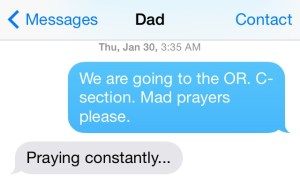
I rose from my chair and saw two doctors lifting my daughter up out of Kate. My daughter’s foot, the last part of her touching Kate, was just slipping the protective casing that had collapsed around her. Nothing could have prepared me for that view. It was beyond beautiful and it literally took my breath away. My legs gave out a bit and I had to sit down quickly. I was crying and Kate was looking at me expectantly. “She is the most beautiful thing I’ve ever seen,” I reported. We smiled through our tears. It was 4:02am, twenty-seven minutes since I had texted my dad, saying we were going to the OR.

London’s Birth: Part VI, At the Doors of the OR

Parts ONE, TWO, THREE, FOUR, and FIVE of this series should be read first.

The walk to the operating room was extraordinarily difficult. Dwelling on a worst-case scenario was unavoidable at times. Kate occasionally cried while she was being pushed toward the OR. The doctor told us that they would do their best to use local anesthesia so Kate could stay awake and so that they wouldn’t have to intubate her. I was told that I couldn’t come into the OR until the team had determined what type of anesthesia Kate would need.

At the huge double doors to the OR I had to say goodbye to Kate. No other goodbye I’ve had in my life had been that hard. How long was I saying goodbye for? I didn’t know for sure. Five minutes? I hope so. Five hours? I hope not. Five days because they had to intubate her and then there were complications? I don’t know how I would have gotten through it. But there was also the question in the back of my mind, for forever? The team pushed her through the doors and I was alone in this barren anteroom with two chairs and a couple of carts with masks, gloves, and other sterile clothing.

I did not expect to be alone at this point. I thought someone might stay with me. I sat down on one of the two chairs. At this point I continued praying, which I had not stopped doing for a while. It felt more like begging at this point or, more accurately, making demands of God. I sat with my head in my hands.

In a few minutes the doctors were attempting to place the epidural. Kate was screaming like she was being cut open. The trauma of having an emergency C-Section at 26 weeks coupled with the pain of the needle is enough to make any woman scream. I didn’t know what sounds to expect from the OR at this point, but that was as much as I could handle. Still seated, I think I may have been rocking back and forth at this point, still with my head in my hands.

The doors to the OR were to my right. A few doctors went through them once they got gowned up. Some of them wore clear shields that covered their whole face. One knows exactly what these are for. They’ll protect the doctors’ faces from splatters from cutting my wife open, moving aside some organs, and pulling a little human being out.

A doctor came through a different set of doors to my left. As she gowned up and scrubbed in she spoke with a healthy dose of authority, giving me a one-minute crash course on 26-weekers. “They have an 85% survival rate,” she said. That is higher than I thought it would be, I thought. “A common complication is with the eyes. It’s called ROP. It can be fixed with laser surgery,” she continued. And with that she walked through the doors. She was just very matter of fact and did not give me a parting “goodbye” or “see you in there.” But I completely understood. She was going into the OR to save the two most precious people in my life. If I could have sped her up somehow I would have. Godspeed, Lady.

A few more minutes passed and a different doctor came out of the OR with good news. “Kate is on a local anesthetic and doing great. You can come in now.”

London’s Birth: Part V, “We gotta get that baby out.”

This is a post in a series about my daughter’s birth. Read parts one, two, three, and four first.

Around 3:20am our doctor came into the room and made the call. The baby needed to come out now. Her heart rate was dropping too much and too frequently to safely leave her in Kate any longer. We were terrified, but I kept telling Kate silly things like, “It’s gonna be okay,” or, “We’re gonna get through this.” Kate was crying a lot, but also trying to compose herself. I remember her really losing it when a nurse and I were had to work Kate’s bra off in order to prep for the OR.

My scrubs were delivered to our room. They looked like a flight suit. I put them on backwards at first. A nurse pointed it out, but she said it didn’t matter. It mattered to me, so I turned the one-piece around, but didn’t quite zip it up yet.

You can easily argue that nothing in the future is certain. That is why so many of us worry. Especially during traumatic moments, we start to consider all the wildest and scariest scenarios. Kate and I had arrived at that point. “You know what to do if anything happens,” Kate said. “You know about my life insurance. You would have to contact my employer.”

IMG_3726 - Version 2

“Yes, I know,” I said. “But I’m not going to have to deal with that.” In response, Kate probably said, I know, but I can’t remember. I was at her side and just crying with her and telling her over and over, it’s going to be okay, she’s going to be okay.

Before I tucked myself into my scrubs and isolated my phone in my jeans pocket, I sent out text messages to both sets of parents and then we were off to the OR. It was 3:35am.

London’s Birth: Part IV, 2:30am Phone call

Just arriving? Read parts ONE, TWO, & THREE in this series before moving on.

The nurses placed monitors on Kate’s belly to watch the baby, but every time Kate had a contraction the baby’s heart rate dropped dramatically or the monitor was no longer picking the heartbeat up. Every time this happened the nurse had to come in and adjust the monitor to find the baby’s heartbeat. This happened so frequently it was pointless for a nurse to leave the room.

Absolutely ignorant of how the rest of the evening was going to unravel, Kate and I attempted to rest. I laid down on a couch, almost two feet shorter than me, but comfortable, and closed my eyes, but it was fruitless. The baby’s heart monitor would beep every couple of minutes; there were nurses in and out, and a few doctors here and there. After I while, I sat up. The doctor was in and out more often talking about the baby’s heartbeat. I don’t remember at all what time it was, but at some point in the evening, before we attempted to rest, we called Kate’s mom. We put her on speakerphone with the phone resting on Kate’s chest. Kate was getting IVs put in at the moment, one in each arm. The nurses were giving fluid, obviously, in hopes that there could be some fluid retention in Kate’s uterus, to build up a buffer for the baby. And in another arm she was starting to get some other drugs that I would learn a lot more about later on.

My mother-in-law went into a mom/nurse practitioner hybrid mode, which I can’t blame her for. She wanted to know all the technicalities. I just wanted Kate to tell her the basics and get off the phone because Kate should be resting. Eventually they hung up and I texted for a while with my mother-in-law. I tried to imply that Kate was really tired and shouldn’t be staying up and talking on the phone at the moment. The message was well received.

I had moved to the side of Kate’s bed as things continued to get a little more serious. I knew I had to call my parents. I hated knowing a call was necessary. By dialing them I was losing the last bit of me that thought everything was going to calm down soon. It meant I was giving into the seriousness of the situation because I was willing to introduce into my parents’ lives a horrible and scary scenario that would make them cry and worry like they haven’t done in years. My mom is old school. She doesn’t even sleep with her cell phone on usually. If it’s on, it’s in another room of the house. I went with my dad’s cell and after a few rings he picked up. I tried to imply right away that we were all still okay. Without saying it, I meant that we were all alive. I also tried to give him a few seconds to wake up and tune in his ears due to the difficulty of receiving a call at 2:30 in the morning. I just cut right to the chase and said, “Kate might be going into labor. Her water broke. We don’t know exactly what is going to happen, but this is what happened so far…”

I remember hearing my mom wake up in the background. She realized my dad was on the phone and not just talking to himself. My dad took a moment and recapped for my mom what I had told him. I heard it in my mom’s voice right away, shock, worry, and sadness. I disliked that I brought that upon them, but I had arrived at the point that not telling them was out of the question. We weren’t on the phone long, but I said I would keep them posted via text message about any changes on our end. We said our tearful goodbyes and hung up.