Handle With Care

Yesterday I wrote about holding London for the first time. Today I thought it appropriate to share a video of picking London up directly from her isolette. The video shows me doing this for the first time. The day of the first hold, I was seated in the chair already when the nurses placed London on my chest. Although that was complicated, it is a far more perilous task to pick London up out of the isolette and then move backwards with her to the chair and sit down. The most worrisome aspect of all this is the kink that can form in the oxygen tube when we move London. If that tube is not supported properly once she is on our chests it can once again kink.

When London was vented, it took about five or six minutes to move her and get her situated on us so that both London and parent were comfortable. I trimmed this video to just the first two minutes. At the beginning, you’ll be able to hear a lot of chatter about my height. This happened a lot in the NICU, but as our time there continued all the staff grew accustomed to my height, at least to the extent that they didn’t feel the need to tell me I was tall. If the video appears as huge on your screen as it does on mine, so big that you cannot see the whole video on your screen, press play (middle of frame), and then just click the full screen icon in the lower right corner of the video and you’ll be golden.

Welcome to the Pumphouse

Never in my wildest dreams did I think I was going to spend so much time with lactation nurses. We discussed the intricacies of hand expressing (whilst using hand motions), breast milk volumes, engorgement, and just how much breast milk one could fit in a chest freezer. I had no clue that my wife’s breast milk would still come in even though London was born at 26 weeks. I did not know there was such a job as a lactation nurse. But, like so many other things about London’s birth and care, I learned soon enough.

Breast milk, I was told, quite often comes in as soon as the placenta detaches from the uterine wall, no matter the gestational age. And, I soon found out, there is not just one lactation nurse in the NICU, there is a whole damn team, and I spoke at great length about breast milk and breasts with each one of them.
IMG_3159

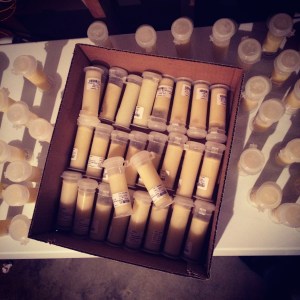
From the early days, when I thought this was a lot of breast milk.

The day of London’s birth, a lactation nurse stopped by Kate’s room to ask if she was going to pump breast milk. I had not even thought about that. The trauma of the last 16 hours was still settling in and thinking about and planning for the future had not yet crossed my mind. I think Kate was sort of at this point too, but we both were satisfied to know that there was a good chance Kate’s milk would come in. Let us begin then. Lactation brought in a breast pump that looked like a medieval torture device. They were calling it the “Symphony.” They hooked Kate up and the Symphony ran for 18 minutes and at the end you could just barely make out two milliliters of colostrum. A few hours later Kate produced 2.6mls and then later that night 3.8mls. The next day, January 31, was Kate’s first 24 hours of pumping. She produced 32.6mls that day, or 1.1 ounce. Lactation handed us a log, in which we kept track of when Kate pumped, for how long she pumped, and total volume.

A few days later, once we were home, lactation gave us a DVD to watch. Apparently, the DVD would help Kate get more milk by hand expressing and it would provide tips to alleviate the pain of engorgement. We were to watch it and return it in a timely fashion. On the night we received the DVD we popped it into my laptop to watch it before going to bed. We watched approximately one minute before Kate was laughing so hard it was painful, no really, it was very painful to laugh for Kate. She had had a C-section a few days ago. Kate was clearly in too much pain. If we continued watching we would only laugh harder, so I slammed the laptop shut. I had tears running down my cheeks I had been laughing so hard. I don’t know who is responsible for making lactation videos like this, but perhaps, now this is just a suggestion, do not make the first breasts on the video also the largest breasts known to mankind. In fact, moving forward, I would advise the filmmakers to not feature these breasts in any lactation video, ever. They were comically large, needing 3-4 hands to handle them. They were cringe inducing. They gave us an attack of the giggles like nothing had before. Actually, it is dangerous to watch this lactation video. You might literally bust your gut laughing if you have just had a C-section. Or, like me, you might become scared of laughing to death.

We decided that only I should watch the hand expression video. It was too dangerous for Kate to watch again. I would get myself in a very serious mindset and then watch it, hoping to tell Kate what I learned. It took a couple weeks to finally watch the video though. Lactation had twice asked for it back, the first time Kate and I told them the truth, we had tried watching it once already but couldn’t stop laughing. I am not sure lactation found this amusing. The second time they asked for the DVD I knew I had to buckle down and watch. So, one of those days at the NICU I brought my laptop and the DVD with me. While Kate was holding London, I backed my chair up to one wall of the pod, put on my headphones, and watched the lactation video. I kept my cool, not even bursting out in tears or shrieks of disgust. Not once, I tell you.

I shared with Kate what I had learned. She was impressed. Not like Kate’s breast milk volumes needed help. I mean, by now I was spending part of everyday rearranging containers of breast milk in the chest freezer, the chest freezer we needed to buy solely to store breast milk. But Kate’s volumes did increase and she was feeling better too. We joked that I knew more about hand expressing breast milk than she did so I should try to make a little money from it. I could print some business cards and walk around the NICU offering my services to anyone who needed them. I even had a business name, “Hand Expressions by Bryce.” Simple and to the point.

By day 57, or March 28, Kate was producing 1,863mls a day, or 63 ounces of breast milk. To put that in perspective, London took a total of 800mls yesterday  (July 23) and that is the most she has ever eaten in one day. In fact, it took London a long time to drink as much milk in one day as Kate got from one 20 minute pump. After a while I could no longer rearrange the breast milk in the chest freezer. It was full. It took us a while to accept that we were going to need a second chest freezer for milk, but I finally broke down and snagged the second one at Costco, one I had been eyeing for a couple of weeks.
IMG_3564

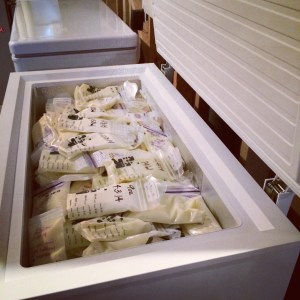
In foreground, first chest freezer maxed out with breast milk. In background, second chest freezer at the ready.

For a few months we rented a Symphony, which retails for $1500-2500, and kept it upstairs in our room where Kate did most of her pumping. We started to call it the Pumphouse. If we were home, Kate had to sneak off to the Pumphouse every three to four hours to spend some quality time with the Symphony. It was very tough keeping that schedule through the night, but Kate did an excellent job. I woke with her every time throughout the night and assisted in the bottling of the milk, the cleaning of the breast pump parts, the labeling, and then I would deliver the milk to the chest freezer in the basement. While Kate was hooked up to the Symphony we would queue up Netflix. We blew through the second season of House of Cards in thirty minute blasts. We moved on to movies, watching thirty minutes at a time of those too.

Toward the end of April, Kate was tapering off with the pumping. She had not dried up. No, no, no. We had filled over half of that second chest freezer. It was just getting to be too much for Kate to work full time and pump. But by then, the lactation nurses understood why Kate was putting an end to the pumping. Kate had a reputation around the NICU as a “super producer.” One day, a lactation nurse stopped by just to tell us that there might be another mom in the NICU who is producing more milk than Kate. It was impressive for all of us to hear. Good for her.

Much later, when it was time for us to bring London home, we had London’s staff write on one page of the journal we had been keeping about her NICU stay. One of our favorites from the lactation team wrote, “London, Just want you to know what a rock star your Mom was with pumping for you! She could have fed 3 babies in the NICU!! You are a lucky little girl to have the parents you do!”

I too believe Kate was a rock star with pumping. Heck, next week London is six-months-old and I can still dig around in our chest freezer for milk from March. Speaking of milk , it’s 11:30, time to feed her again. To the chest freezer I go.

London’s Email Updates

I sent the first of many emails updating family and friends about our situation at 2:43am on January 30th, one hour and nineteen minutes before London was born. It reads:

Hey Dear Friends,

Weve spent the night at the hospital because our little girl is coming early, really early. Kate felt some pain last night around 10 and we thought it necessitated a trip to the hospital. We are very thankful we came here because Kate’s water broke about an hour after we arrived. Kate is stable and the baby is doing okay for now, but Kate won’t be leaving the hospital until the baby is born. We don’t know exactly when that will be. It could be a day, weeks, or over a month.

We all need your prayers, happy thoughts, and whatever positive vibes you can send our way.

Love,

Bryce

Of course I had to send out another email very soon after that:

Update. The doctors needed to go forward with a c-section. Kate is doing great in recovery. Our daughter, London Grace Perica is also doing well. She was born at 4:02 this morning, 2 lbs 6 oz, 14.75 inches long. She’s stable. Very crucial period right now and I am so thankful for all your prayers and support.

Love,

The Perica Family

From that point on, email was the way to keep everyone in the loop regarding the many ups and downs of London’s NICU stay, but especially during those fragile first weeks. We received so many responses from these two small emails that it has taken me hours to scroll through them and the brief exchanges I had with some of you who asked specific questions about London’s health and how exactly you could support us through this time. The email conversations with some of you never stopped for the entire time we were in the NICU. Sitting down to write weekly updates about London’s progress or sometimes lack of progress was therapeutic for me. Writing the emails allowed me to calm down some after an especially frustrating or scary day. I wrote them next to London’s side, or during dinner at home, and sometimes they were the very last thing I did at night, tapping out emails on my iPhone in the dark with Kate sleeping beside me. It was a form of meditation. It is something that I would recommend to parents in a similar situation. Whether you are just emailing your parents or a huge group of friends, sending updates may trick you into thinking you are spreading the burden around. It may have had that effect on me.

Inevitably, I grew tired of sending out email updates about London in the NICU because all three of us just wanted the hell out. Writing the last update on May 22, three days after London came home was the best email I have ever sent. I have shared it below. Thank you for responding to emails throughout London’s stay and for reading further on this blog about her time in the NICU and raising her there and at home.

May 22, 2014, 11:34pm

Friends,

On Monday, after 109 days in the NICU, Kate and I walked out of the hospital with London. We were helped out to our car by one of our primary nurses, Megan, who was there the morning London was born and admitted to the NICU. By Monday, we had shed enough tears with Megan (and London’s 3 other primary nurses) throughout London’s NICU stay that there were only smiles on our faces as we loaded London into the car, hugged Megan goodbye, and drove home very carefully.

London has come home with an NG tube since she was not taking 100% of her milk through bottles. Kate and I both placed NG tubes in London before she was discharged. London has the tendency to yank them out so we need to know how to insert a new one. When necessary, we use a pump to give her the rest of her milk. She is on oxygen, as are most preemies in Colorado when they come home. At this point, it’s also necessary to hook her up to a monitor at night. Baby came home from the hospital with a lot of hardware, but we’ve got it all figured out.

London had a follow-up head ultrasound before discharge. We received the results on Monday before we left. The bleed in her brain has been completely reabsorbed. However, her ventricles are still enlarged. At this stage the doctors would like to see them a bit smaller, but they aren’t concerned enough at this point to do anything clinically. They will monitor her closely in follow-up appointments. At this point, we wait it out a little bit and hope the ventricles decrease in size. This was not 100% positive news, so it was a little unsettling to receive it the day we left, but it does not really change London’s outlook at this point. Other news we received before London was discharged…She had one more eye exam before going home. Her ROP continues to improve.

Though we are sure to face quite a few more challenges with London’s health and development, we are of the mindset that the biggest and scariest obstacle, the NICU stay, is behind us. Thus, I am finally ending this long email chain. Thank you so much for all the meaningful and loving replies and for your interest in London’s progress while she was in the NICU. Thank you for the prayers. It was always humbling to know how many people were lifting us up. I could say thank you for so many more things, but it would be a long, boring list, which would fall short of expressing our gratitude for you and the profound joy that has come to us in our little girl and finally getting her home.

Our Love,

bryce, kate, & london grace

Little London’s Nurses

When I first met London’s primary NICU nurses I did not know just how special they would become to Kate and I. In hindsight, that I would come to think of them as extended family in a way was inevitable. NICU parents have to get away from the unit for their own health, but for many other reasons as well. Life goes on. Jobs don’t wait. Other responsibilities don’t disappear just because you find yourself in this incredibly hard situation. So, when it comes time to leave the hospital, you leave your preemie first and foremost in the hands of your NICU nurse. Of course, there is other support, other nurses on the floor, nurse practitioners, residents, fellows, and attendings, but the one who is on the front lines, the first responder, is the primary nurse for your child.

London had four primaries. From the start they were the most comforting, knowledgable, and loving people. They were her first, and they will always be her best, babysitters. They taught Kate and I most of what we know about raising a preemie. They explained every twist and turn of London’s treatments. I could go on and on and write a long list of the many things they did for London and for Kate and I, but why should I when I can just write this: they ushered me into parenthood with such grace that when it was time to leave the NICU with London it was hardest to say goodbye to them.

As I continue to write about the experience of having a preemie, I will write more about London’s nurses. But for now, I will end this short post with this thought that I had long before London was discharged:  London’s primaries are people who, no matter how well we stay in touch for years to come, I will treasure for the rest of my life because I will never forget the way London was introduced to this world and thus, I will never forget the people standing by her bed during that tumultuous beginning.


Life Goes On, But Something Was Lost

“I love you, my child. My Child. Still can’t believe it all. Wishing you were still safe inside me and that I could feel you. I miss you, little girl. Be strong.”

– From a letter Kate wrote to London on January 31, 2014. London was one day old.


I start today’s post with this quote because in a few sentences Kate conveys the sense of loss mother’s have when they have their baby so early. Sense of loss is somewhat misleading (London was stable in the NICU), but Kate knew and I knew that the safest place for London and also where she would still be developing the best was lost. That was not the only thing lost though. A full-term pregnancy was now just a dream.

Kate was just starting to look pregnant when London arrived. Our closet was full of maternity clothes waiting for months 7, 8, and 9. In fact, the day we got home from the hospital I helped Kate up the stairs and followed her into our room. Shortly thereafter, I heard Kate in our closet and walked in to see what was going on. Kate stood staring at a rack of maternity clothes with tears running down her face. I listened to Kate and held her. Seeing Kate so sad about not getting to wear these clothes even made me cry.

As a father, I do not know the sense of worry and loss a mother has when, without any warning, the human being growing inside of her is out over three months early and exposed to a world she wasn’t supposed to see until spring. But now, having a wife who has gone through that, I have a decent understanding of what that is like.

The sense of loss manifests itself in a variety of ways. One of the strongest, at least in the first week after London was born, but one that also fades over time, is how painful it is to see pregnant women who are full-term or damn near close. To be honest, both Kate and I hated seeing very pregnant women for a while. We were comforted to know this is completely normal. In the two days after London was born, we received a slew of emails, calls, texts, and cards from people who wanted to let us know that they were praying for us and for London. A few of those contacts had preemies themselves. And in one particular email, a mom wrote, “you will hate seeing very pregnant women.” She nailed it. We both did. One of the first days out of the hospital we went to Baby’s R Us to stock up on some breast pump supplies. There were couples everywhere and it seemed like every single woman was about to pop. It was extraordinarily tough. I ran out of dagger eyes to give.

Being bothered by the sight of very pregnant women was the product of our envy during those early days. I remember I would see a couple who is clearly having a baby very soon and think, damn, they’ve got it so easy. They really have no idea. Look how they’re wandering the aisles at Baby’s R Us without a care in the world. Of course, our attitudes have since changed and I no longer think that those soon-to-be parents had it so easy. Having a baby is a lot of work, no matter the gestational age at birth. However, if having a full-term, healthy baby was exactly the same as having a preemie, I would be lying to you and severely devaluing our experience, the experience of thousands more, and the NICU and everyone who has ever worked in one.

I am so sensitive at times to other people’s feelings that it took me a long time to realize that even though this is our first time around with a baby, I know it has been more difficult than if London had been born full-term. Sharing that in the months since London was born and even now, I feel sort of like a jerk because it boils down to me saying, “Well, we have had it quite a bit harder than you.” I know that can sound like I am devaluing the difficulty of having a full-term baby, but that is not my intention. I am just trying to speak truth from our experience and that of the other parents in the NICU right now, who also know that with the littlest life they were blessed with comes the most terrifying and stressful days of their lives and the knowledge that although life goes on, something has been lost.

Hospital on the Horizon

Before London, I never really liked being in a hospital for any reason. Even if I was there for a flu shot or to pick Kate up from work. I only saw hospitals through a narrow, ignorant lens. I thought they were places where sick people go to stay for a while and at the end of their stay those lucky enough to leave are still sick or don’t know why they are sick. Those without the luck, arrive at a hospital and stay there until their death. This is a morbid way to think about a place designed to get you better, but I had this view for a couple reasons.

When your spouse works in a hospital they tend to convey some sad stories to you about things they have seen at the hospital. The stories could be worse depending on what unit they work in. For example, stories from the outpatient wing probably aren’t going to be as horrific as some from oncology. Well, I used to hear some pretty sad stories and they were very difficult to hear. I did not hear enough of the good stories because I always found myself thinking, how could you work at a place like that? How depressing. So when I would go into a hospital I would maybe just choose to see the very sick and that made hospitals nearly impossible to be in.

And then I got very sick in 2007…The short story about that experience is this. I had a bunch of weird things happening to me, headaches, Bells Palsy, partial, but temporary hearing loss in one ear, and iritis were among the most troubling issues. I had a CT, an MRI, X-rays, blood draws of all sorts, and I spoke with a lot of doctors and specialists. I never received a diagnosis. I got better, but I could not attribute that to treatment I received at a hospital, except for the steroids for the Bells Palsy and later for the iritis. I probably had a virus of some sort that was working its way through my body. Doctors never knew when it would be over. They couldn’t tell me what it was. And all those tests…negative. I had a big scare and I felt like it was just dumb luck that I got better, when really my body finally overcame whatever serious bug was screwing everything up.

My opinion of hospitals changed very quickly in January. The morbid thoughts were, for the most part gone. Of course I worried for the health of my wife and daughter, but for the first time the hospital was no longer a place where you go to die. It was a place of healing, of miracles. It was where you went to live. Even the sight of the building became a comfort to me. This particular hospital is huge and easy to see from many parts of Denver and so, when I wasn’t at the hospital with London, I could often look to the horizon and see her home and know that she was surrounded by the most professional and loving staff I could have ever dreamed of. This was our family’s fortress now. Not all rooms in it have a happy story to tell. Hope is sometimes scarce in this place, but I knew of an OR tucked away on the fourth floor where not just lives were saved, but dreams, hopes, and a future were salvaged because of a hospital. I will never think of them the same way.

Letter to London On My 31st Birthday, Her Day 4

Dear London,

You will remain for the rest of my life, the best birthday gift I have received. I did not expect to become a dad at 30. I thought I had a few more months, a little more time to prepare for your arrival. IMG_2967

On this birthday, your mom and I checked out of the hospital. It was extraordinarily tough leaving there without you, but getting home did make us smile. We can’t wait to bring you here. Aunt Kendra cleaned up the entire house. There was a giant balloon that said, “Baby Girl!” (a note from the present day: the baby girl balloon was still aloft, but slightly deflated, three months later when we finally disposed of it) and there were two smaller balloons that read, “Happy Birthday!” and “Welcome Home.”

Kendra left a birthday cake in the fridge for us too. It was about as good as a homecoming could have been without you there.

Your  mom and I were very tired so we fell right asleep for a nap before Nana and Papa arrived. Their arrival woke us up. I brought them upstairs aIMG_2968nd we all talked about you for a while in our room before we went downstairs for dinner. During our meal, I retold the story of your birth and what it was like seeing you for the first time.
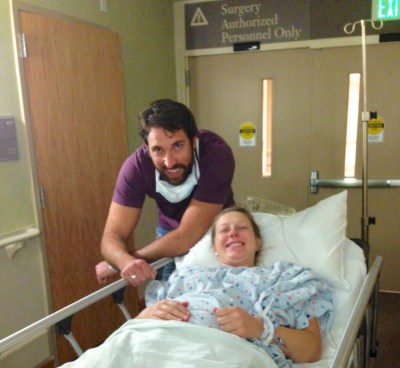
After dinner, we took Nana and Papa to meet you. They instantly fell in love with you. Nana called you a miracle and of course they both shed tears. After a while we prayed over you, like we have been doing every night since you first arrived.

We eventually went home. What I want you to know about home on my birthday and, until the day you come home, is that it is just a shell where we eat and sleep. It is incomplete without you. Our hearts are always besides yours at the NICU. Here at home, we fall asleep trying to fill the void with videos and pictures of you. And then we dream of you. Sometimes we cannot sleep because of the worry at our core for you. As soon as we wake, you are our only concern. Our home’s potential is latent. We bought it just weeks ago with you in mind and it is only you who will make it what we so badly want it to be.

Goodnight London.

London’s Birth: Part XIII, That time I cried in the shower

*This is the LAST post in an ongoing series. That’s good, because had I gone on a bit further I would have exceeded my knowledge of Roman numerals. Scroll all the way down or click to part I to get to the beginning.

Kate was able to sleep for an hour and a half after we got back to the room. I stayed awake and waited for Kate’s sister, Kendra, to arrive. She was driving down from Laramie. I know she got some sleep the night before, but it was minimal and she was not willing to wait another three hours for her parents to get to Laramie on their way to Denver. She would be showing up around 12:30. That is when London had another care time. I was back taking some pictures of London at 12:34pm. I took the first video of London. It’s a 15-second clip of London lying there, chest moving up and down incredibly fast as the vent pumps air into her. Her sternum and ribs are clearly visible. She is so skinny. Her eyes are still fused shut at this point. Her arms are out to tIMG_3101 - Version 2he side, they both have lines in them.

After London’s cares I went back to Kate’s room and Kendra had arrived. Kate was filling Kendra in with the details of the birth because when Kendra arrived she didn’t know that London had been born. I had been waiting to go home to get us clothes and everything else we might have brought to the hospital in three months when we were planning on having London. Now that Kendra was at the hospital, I could do that.

I told Kate my plan and she gave me a list of things to bring back. We were saying our goodbyes when she added, sort of jokingly, “Are you going to go home and break down in the shower?” I smirked, but as soon as she said it I knew that probably was where I was going to break down.

Once home, I grabbed some food. It was after 1pm and throughout the night all I had eaten was a small bag of salt and vinegar chips and a Monster energy drink. I was not as famished as you might guess though; I had more pressing issues than needing to eat over the last 15 hours.

I packed up a couple of bags for the next night and day. I looked in the mirror. I badly needed a shower and sleep. My eyes were bright red and a little puffy. Sleep had to wait, but at least I could try making myself presentable. Into the shower I stepped, and there I cried.

If you’ve ever been around someone who has just lost someone very close to them in a tragic, sudden way, you know how they cry. It is a heart-wrenching sob, which racks the body. This was the kind of cry I had in the shower. It lasted five seconds but then I composed myself and took several deep breaths because I had not lost someone. For me, Kate, and London, life was intact.

Prior to this moment, I had just wept, but finally getting to be alone and having the time to come to grips with the last fifteen hours launched me into a private expression of fear, sadness, gratefulness, and joy. Fear because there were times during the night I thought I would lose my wife and then at other times I thought I was going to lose my daughter. Sadness because I was mourning not having a full-term, healthy baby, one who did not face an arduous months-long stay in the NICU, where there are no promises. Gratefulness for the professionals who saved the most precious people in my life. Gratefulness for modern medicine. Gratefulness for health insurance. And joy, because after all that happened the night before, I was still a husband to an amazingly strong, smart, and beautiful woman and now I was a dad to a baby girl who I felt like I knew so much about so soon after her birth because of the way I had seen her fight for her life. All this had been building up and now emotions were overflowing.

I finished getting ready, grabbed the bags, and went to the hospital. Took elevator D to the fourth floor, Neonatal Intensive Care Unit. Settled into a chair next to London. Accustomed myself with my new home. Closed my eyes. Took a deep breath and exhaled. Opened my eyes and started an entirely new phase of life in the NICU.

London’s Birth: Part XII, Mom meets Daughter

*This is another post in an ongoing series. Scroll all the way down or click to part I to get to the beginning.

We had to wait to go see London until Kate’s nurse came in and checked up on her. We had heard it was a male nurse and we were initially uncomfortable with that, but we were somewhat relieved once he came in and introduced himself and started to talk about what things he would look for. He was a dad himself. Very short hair, pretty much bald, and of average height with a warm demeanor. He was going to apply pressure to Kate’s stomach to feel for the top of the uterus. He would also check for blood coming out of Kate, which so soon after the C-section was completely normal. He would also handle the catheter and switch out the bag if full. He did all that and I thought he did an exceptional job. The uncomfortable feeling was gone and we were just minutes away from getting to go see London together for the first time.

The nurse and I helped Kate into the wheelchair. It was a very slow process, but the nurse seemed impressed by Kate’s progress, having been stitched up just four hours earlier. Once Kate was ready to roll, we were off.

I knew Kate would be happy to see London for the first time, but I was a bit nervous, hoping she wouldn’t break down. There was absolutely nothing I could say to Kate to prepare her for the sight of her daughter.

As we arrived at London’s isolette, Kate reached out to delicately put her finger in London’s hand and she whispered her very first words to London, “Hi, baby girl.” That was all she got out before we both were tearing up and looking on London with wonder and fear, a combination of feelings that is right at home in the NICU.

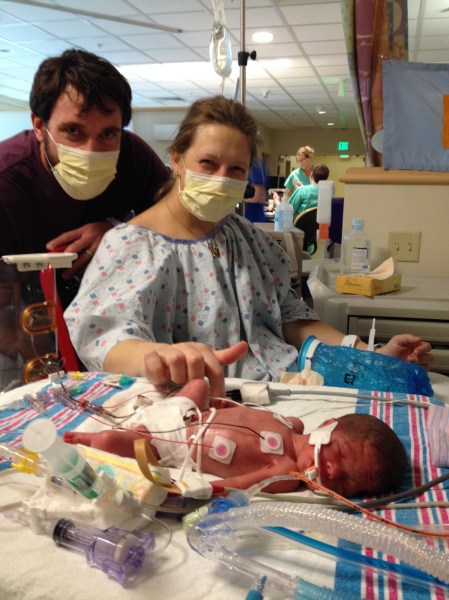
After some time, we were composed enough for a picture, our first family portrait. I handed my iPhone over to Megan and she captured the moment. It was 8:58 in the morning. London is sprawled out in the foreground. The top of her isolette is popped open. ThereIMG_2912 are tubes of varying widths coming out of her and wandering all over her tiny little bed. The white sticker on her right cheek is visible (it’s holding her endotracheal tube in place). Kate is right behind London, with her right index finger in London’s right hand. Kate is still in a hospital gown and has a blue bag on her lap in case she loses her breakfast. I am crouched behind Kate with my left arm resting on the back of the wheelchair. We both have masks on, but you can tell we are beaming behind them. Kate’s eyes are squinty, a tell that she has a huge smile on her face. In the background, over Kate’s left shoulder, you can see some nurses, who were strangers then, but who are nearly family now.
We weren’t with London that long before we had to get Kate back and comfortable in bed. We still hadn’t slept at all. Resting at this point was very important for Kate’s recovery. Shortly after we left London’s side, we shared that family portrait with family and then on Instagram and Facebook. And now, here.

London’s Birth: Part XI, Changing a diaper on a two-pound baby

*This is another post in an ongoing series. Scroll all the way down or click to part I to get to the beginning.

While in the waiting room a doctor came in to talk with us about London’s condition. She sounded positive, being clear to us about what our expectations should be. We had to stay there for a while until Kate’s room was ready. When it was time, I helped push her bed over to the new room with nurse Amy, from earlier in the evening. We were on the fourth floor, facing south over the main entrance to the hospital. Kate was a little disappointed we didn’t have a mountain view. If you looked off to the right you could see the mountains bending southward, but it wasn’t very majestic like it would have been with an unobstructed view west.

I was able to go be with London once more before Kate was ready to head over there. That’s when I met nurse Megan and the new employee she was training, Laura. They were immediately helpful and gave me so much information I couldn’t keep track of it all. They pointed to line after line telling me what it was and using acronyms that I quickly forgot. “This is where she is getting her TPN.” “This is the PICC line.”

London was in her isolette, which was ridiculously hot and humid inside. Megan started to tell me about these things called “cares.” They are at certain times of the day, every four hours to be exact, and that is when we would take London’s temperature, change her diaper, listen to her, poke and prod and make sure she is doing well. Megan and Laura were just about to start and asked me if I wanted to jump in and take her temperature and change her diaper. Megan emphasized that if I was not ready, she could do it this time. This surprised me, but I did not take her up on that offer, I said, “I can do it. Just coach me through it.”

They showed me the one button on the isolette I was allowed to touch. It activated a heat shield so when I opened the little openings for my arms to go into the isolette it did not cool off in there. They gave me a thermometer and told me that I will take her temp in her armpit. They showed me how by placing the thermometer and holding her arm against the side of her chest. I put my hands in the isolette and immediately noticed the jungle like feel to the air in there. I had not touched London yet. I was so afraid. I felt like a simple touch of her arm would snap it. Because I felt that way I was much too gentle with her and failed to get a good temp reading. I didn’t have the thermometer truly in her armpit. The nurses corrected me and told me I could be a little firmer with her. They were right. London was so small and looked extremely fragile, but I could apply enough pressure to get the job done correctly without causing her any harm.

I had changed diapers before, but never on a two-pound baby in an isolette with really low arm openings for someone who is 6’9” and with intimidating wires and tubes everywhere. At this stage, London’s skin was so delicate that I could only touch and release with my hand or finger. I could not rub her skin because of the risk of it breaking and sloughing off. Yeah, that was easy to remember. Do not rub your daughter’s skin off. Check.

My hands are not monstrously big, but they fit my frame, so one of them could completely cover London’s body. During the diaper change I was using giant tools for a micro job, but because of the nurse’s help I changed London’s diaper. The nurse said, “Once you learn to change a diaper on a preemie like this, every diaper will seem easy.” I knew she had a point. This was harder and slower going than any diaper change I had ever done or thought I would ever have to do. Megan wrapped up the rest of London’s cares. I walked back to Kate’s room, thankful that when I returned to London’s side I would be with her mom and we would all be together for the first time.

London’s Birth: Part X, Into the NICU

*This is another post in an ongoing series. Scroll all the way down or click to part I to get to the beginning.

Right outside the double doors the charge nurse introduced herself. She guided me through a winding path of at least sterile-looking hospital hallways. Now was as good a time as any, “Can I get a new mask?”

“Of course,” she said, stopping at a counter and getting me one and several tissues. I pulled my mask away and took a peek at the inside, not a pretty sight.

I followed the charge nurse to a pod. Each baby in the NICU we were walking into stays in a pod, not a room necessarily, but more like a cubicle with walls nearly to the ceiling. We walked the length of the NICU, took a left and there was London, skinny, vented, cleaned, and holding on. The doctors kept telling me she was receiving surfactant, which is a mixture of fat and proteins made in the lungs, but preemies are often born before their lungs can produce enough surfactant. The mixture coats the alveoli, or air sacs in the lungs, and this prevents the alveoli from sticking together when the baby exhales. A nurse said London’s lungs were like a hardened sponge right now, not ready for life outside the womb.

I stood there for five to ten minutes, all the while an occasional nurse and doctor would tell me about what they are doing or what they plan on doing. I did not retain that much. I was just locked to my daughter and I was in sort of an emotionless state, unable to fully register the last six hours. I was thinking enough to take my phone out and snap a picture of her. I was hesitant to get close. I had the same feeling I had earlier in the OR, stepping up to the bedside and taking a picture of London meant I was getting closer to her. I was letting my guard down. I was starting to realize that five and a half months ago we embraced the idea of creating a life we ultimately had no control over. The unknown and deeply frightening future belonging to my daughter was coming into sharp focus. I took two quick pictures. London with a full head of hair turned to her left, eyes fused shut, gaping mouth with the endotracheal tube snaking out of it, monitors on her chest, blood pressure cuff and pulse ox on right arm, umbilical chord clamped shut, plastic covering her lower body to keep it humid, and a nurse’s blue-gloved hand holding her legs down. I said a quick prayer when I took the picture, please God, do not let this be the only picture I get to take of her.

Sometime later, the team was prepping London to place a peripherally inserted central catheter or PICC line and an umbilical catheter. They told me it was a good time to go check on Kate because they would be working for a while. I thought that sounded great. I took a picture of London’s pod number, “Pod 3, 423,” not knowing if I would be able to find my way back or if I would need that information later on. I started stepping away from the pod and realized I had no clue where Kate was now. Someone took me to a room, which looked like it was used to just house patients in limbo who might be fresh out of surgery and do not have a room to go to. There were four hospital beds and four curtains, but none of them were drawn. Kate was the only patient there. She looked great to me because she was still here, conscious, and strong, but she looked amazingly tired, which is to be expected. I know I looked like hell. We chatted about London and where she was placed in the NICU, what they were doing to her, her weight and height. 2 lbs, 6oz and 14.75 inches long.

London’s Birth: Part IX, What’s her name?

*This is another post in an ongoing series. Scroll all the way down or click to part I to get to the beginning.

Throughout the operation there were tears slowly dripping from my eyes and my nose was a leaky faucet. I was aware that my snot had flowed through my mask and even in that moment I was mildly annoyed with the thought of having to ask for another mask. I would ask later, when the time seemed right. Until then, I tried to minimize the flow of tears and snot.

It may sound like my eyes were wandering once my daughter was out of Kate, but they weren’t. I glanced for split seconds here and there, but my eyes were essentially locked on the little human being in front of me. Vented now, the doctors seemed a little more relaxed with her and ready to move. They told me where we were going. It went in one ear and out the other. I would follow them anywhere. They started to roll my daughter a bit, making for the double doors I had come through to enter the OR. They halted for a second, one NP turning to me and asking, “What’s her name?”

I had not yet imagined when I would announce to those present in any room the name of my daughter, but if I had, it would never have crossed my mind that this would be how I would introduce her to the world. “Her name is London,” I announced. It sounded weird giving a name to her at this stage because when your child is born this small and fragile, they almost seem like a science experiment. I had started to become aware of a disturbing, but natural protection mechanism that sets in when you see your preemie like this. I wanted to protect myself from her in a way. I didn’t want to become so attached to her just in case I lost her in the next hour, but giving a name to her instantly made it harder to keep my distance.

London and the team working on her started moving out, rolling right by Kate’s face and slowing down a bit so she might possibly get a glimpse of London’s face. I saw Kate strain her head to try to see her baby before we went through the doors. I stopped and gave Kate a huge kiss, an exchange of tears cheek to cheek, and a word about how London is vented. I also checked that I should keep on walking with London and the team. Kate nodded yes and I was off through the double doors with an “I love you” and one last glance at the amazing team sewing up my wife.

London’s Birth: Part VIII, 18 People

*This is another post in an ongoing series. Scroll all the way down or click to part I to get to the beginning.

I confirmed with Kate that I was to go be with the baby now. We kissed. I told her she was doing great and walked to the foot of Kate’s bed where the doctors had placed my daughter’s very small bed.

In front of me was an impossibly small baby girl. To call her a baby is not quite accurate. She looked more like a very, very small, skinny human being. There was no fat on her and she had none of the cuddly attributes that full-term babies have. There were seven doctors and residents attending to her, looking for signs of breathing, mostly. They seemed to poke and prod here and there with their hands and a few tools.

Immediately to my left, Kate was on the operating table, with her incision still wide open. I didn’t stare long, but I felt comfortable looking at the incision and the tissue and organs that were being rearranged so they could settle back into place. I turned my head ninety degrees right and continued to watch the doctors revive my daughter. I saw them prepping a blade to start the intubation when another doctor informed me that was exactly what they were being forced to do. She said this was very common. She was tall, had blond hair, and I remember a minute after my baby girl arrived on her miniature bed, she referred to her as a him. I clarified, “It’s a girl, right?” She looked again, “Oh, I’m so sorry.”

My daughter was successfully intubated a moment later. Her head and neck seemed impossibly flexible for the doctors to place the blade and insert the endotracheal tube. I looked left to Kate again. A nurse walked right in front of me carrying a metal dish with a big red blob in it that had what looked like puncture wounds. It was the deflated, tragic looking placenta that had prematurely detached from the uterine wall, aka placental abruption.

The OR was highly organized chaos to my uninitiated eyes. I took a moment, counting all the people in the room saving my wife and daughter. Eighteen. It was the beginning of a deep, new appreciation for the professionals around me. I was learning in the quickest and most explicit way possible that the quickest way to my heart was to save the two people dearest to me. It was early to have this revelation because I didn’t know if everything was going to turn out fine, but I still felt like I would love and cherish these people for the rest of my life because of their effort here.

London’s Birth: Part VII, 27 Minutes Later

These posts are in reverse chronological order. Read earlier posts first. They can be found by scrolling all the way down or clicking the links provided here: Part I, Part II, Part III, Part IV, Part V, and Part VI.

The only time I have ever seen a C-section setup in an OR was on ER. Well, in that respect, the set of ER got it right. Kate’s neck and head were peeking out from a curtain draped across the top of her shoulders. There was a nurse standing to the right of Kate’s head. There was a chair positioned to the left of Kate for me to sit in. I walked over and sat in it. I gave her a kiss. We exchanged “I love yous” and I sat down.

At this point, we didn’t have to discuss whether or not I would watch the baby come out or whether I would go be with the baby once she was out. Just a few days ago at home over dinner we had talked about what we would do in the case of a C-section. I said I would sit by Kate and would want to be present for everything. We agreed that I would go be with the baby once she was out of Kate, if Kate was clearly doing okay. I also expressed interest in seeing the baby being pulled out. In hindsight, it is incredible that we had this discussion already.

When seated next to Kate, I couldn’t even see the doctors working on her lower body. Kate said all she felt was pressure. I could see Kate’s head and shoulders shifting up and down and left to right on the bed as the doctors peeled away the layers, pushed things to the side, and cleared a path to the uterus.

The urgency of the C-section and the speed at which it all happened was astounding. I was not next to Kate long before the nurse next to her spoke up, “They are about to pull her out. Do you want to look?”

“Yes,” I said. The nurse would tell me when to stand up and look. “Okay.”

“Alright, stand now if you want to see,” she said.

I hesitated just for a second or two, perhaps not quite ready to see what I was about to see, scared to see what I was about to see, or just trying to register the moment. I’m sitting by my wife behind a curtain and on the other side is the rest of my wife’s body with a significant opening in it from which they are pulling out this human being we made, our daughter, who will be in my thoughts for the rest of my life no matter what happens in the next few minutes, hours, or days.

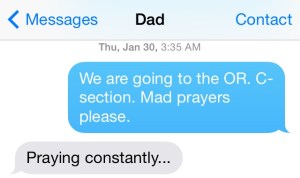
I rose from my chair and saw two doctors lifting my daughter up out of Kate. My daughter’s foot, the last part of her touching Kate, was just slipping the protective casing that had collapsed around her. Nothing could have prepared me for that view. It was beyond beautiful and it literally took my breath away. My legs gave out a bit and I had to sit down quickly. I was crying and Kate was looking at me expectantly. “She is the most beautiful thing I’ve ever seen,” I reported. We smiled through our tears. It was 4:02am, twenty-seven minutes since I had texted my dad, saying we were going to the OR.

London’s Birth: Part VI, At the Doors of the OR

Parts ONE, TWO, THREE, FOUR, and FIVE of this series should be read first.

The walk to the operating room was extraordinarily difficult. Dwelling on a worst-case scenario was unavoidable at times. Kate occasionally cried while she was being pushed toward the OR. The doctor told us that they would do their best to use local anesthesia so Kate could stay awake and so that they wouldn’t have to intubate her. I was told that I couldn’t come into the OR until the team had determined what type of anesthesia Kate would need.

At the huge double doors to the OR I had to say goodbye to Kate. No other goodbye I’ve had in my life had been that hard. How long was I saying goodbye for? I didn’t know for sure. Five minutes? I hope so. Five hours? I hope not. Five days because they had to intubate her and then there were complications? I don’t know how I would have gotten through it. But there was also the question in the back of my mind, for forever? The team pushed her through the doors and I was alone in this barren anteroom with two chairs and a couple of carts with masks, gloves, and other sterile clothing.

I did not expect to be alone at this point. I thought someone might stay with me. I sat down on one of the two chairs. At this point I continued praying, which I had not stopped doing for a while. It felt more like begging at this point or, more accurately, making demands of God. I sat with my head in my hands.

In a few minutes the doctors were attempting to place the epidural. Kate was screaming like she was being cut open. The trauma of having an emergency C-Section at 26 weeks coupled with the pain of the needle is enough to make any woman scream. I didn’t know what sounds to expect from the OR at this point, but that was as much as I could handle. Still seated, I think I may have been rocking back and forth at this point, still with my head in my hands.

The doors to the OR were to my right. A few doctors went through them once they got gowned up. Some of them wore clear shields that covered their whole face. One knows exactly what these are for. They’ll protect the doctors’ faces from splatters from cutting my wife open, moving aside some organs, and pulling a little human being out.

A doctor came through a different set of doors to my left. As she gowned up and scrubbed in she spoke with a healthy dose of authority, giving me a one-minute crash course on 26-weekers. “They have an 85% survival rate,” she said. That is higher than I thought it would be, I thought. “A common complication is with the eyes. It’s called ROP. It can be fixed with laser surgery,” she continued. And with that she walked through the doors. She was just very matter of fact and did not give me a parting “goodbye” or “see you in there.” But I completely understood. She was going into the OR to save the two most precious people in my life. If I could have sped her up somehow I would have. Godspeed, Lady.

A few more minutes passed and a different doctor came out of the OR with good news. “Kate is on a local anesthetic and doing great. You can come in now.”

London’s Birth: Part V, “We gotta get that baby out.”

This is a post in a series about my daughter’s birth. Read parts one, two, three, and four first.

Around 3:20am our doctor came into the room and made the call. The baby needed to come out now. Her heart rate was dropping too much and too frequently to safely leave her in Kate any longer. We were terrified, but I kept telling Kate silly things like, “It’s gonna be okay,” or, “We’re gonna get through this.” Kate was crying a lot, but also trying to compose herself. I remember her really losing it when a nurse and I were had to work Kate’s bra off in order to prep for the OR.

My scrubs were delivered to our room. They looked like a flight suit. I put them on backwards at first. A nurse pointed it out, but she said it didn’t matter. It mattered to me, so I turned the one-piece around, but didn’t quite zip it up yet.

You can easily argue that nothing in the future is certain. That is why so many of us worry. Especially during traumatic moments, we start to consider all the wildest and scariest scenarios. Kate and I had arrived at that point. “You know what to do if anything happens,” Kate said. “You know about my life insurance. You would have to contact my employer.”

IMG_3726 - Version 2

“Yes, I know,” I said. “But I’m not going to have to deal with that.” In response, Kate probably said, I know, but I can’t remember. I was at her side and just crying with her and telling her over and over, it’s going to be okay, she’s going to be okay.

Before I tucked myself into my scrubs and isolated my phone in my jeans pocket, I sent out text messages to both sets of parents and then we were off to the OR. It was 3:35am.

London’s Birth: Part IV, 2:30am Phone call

Just arriving? Read parts ONE, TWO, & THREE in this series before moving on.

The nurses placed monitors on Kate’s belly to watch the baby, but every time Kate had a contraction the baby’s heart rate dropped dramatically or the monitor was no longer picking the heartbeat up. Every time this happened the nurse had to come in and adjust the monitor to find the baby’s heartbeat. This happened so frequently it was pointless for a nurse to leave the room.

Absolutely ignorant of how the rest of the evening was going to unravel, Kate and I attempted to rest. I laid down on a couch, almost two feet shorter than me, but comfortable, and closed my eyes, but it was fruitless. The baby’s heart monitor would beep every couple of minutes; there were nurses in and out, and a few doctors here and there. After I while, I sat up. The doctor was in and out more often talking about the baby’s heartbeat. I don’t remember at all what time it was, but at some point in the evening, before we attempted to rest, we called Kate’s mom. We put her on speakerphone with the phone resting on Kate’s chest. Kate was getting IVs put in at the moment, one in each arm. The nurses were giving fluid, obviously, in hopes that there could be some fluid retention in Kate’s uterus, to build up a buffer for the baby. And in another arm she was starting to get some other drugs that I would learn a lot more about later on.

My mother-in-law went into a mom/nurse practitioner hybrid mode, which I can’t blame her for. She wanted to know all the technicalities. I just wanted Kate to tell her the basics and get off the phone because Kate should be resting. Eventually they hung up and I texted for a while with my mother-in-law. I tried to imply that Kate was really tired and shouldn’t be staying up and talking on the phone at the moment. The message was well received.

I had moved to the side of Kate’s bed as things continued to get a little more serious. I knew I had to call my parents. I hated knowing a call was necessary. By dialing them I was losing the last bit of me that thought everything was going to calm down soon. It meant I was giving into the seriousness of the situation because I was willing to introduce into my parents’ lives a horrible and scary scenario that would make them cry and worry like they haven’t done in years. My mom is old school. She doesn’t even sleep with her cell phone on usually. If it’s on, it’s in another room of the house. I went with my dad’s cell and after a few rings he picked up. I tried to imply right away that we were all still okay. Without saying it, I meant that we were all alive. I also tried to give him a few seconds to wake up and tune in his ears due to the difficulty of receiving a call at 2:30 in the morning. I just cut right to the chase and said, “Kate might be going into labor. Her water broke. We don’t know exactly what is going to happen, but this is what happened so far…”

I remember hearing my mom wake up in the background. She realized my dad was on the phone and not just talking to himself. My dad took a moment and recapped for my mom what I had told him. I heard it in my mom’s voice right away, shock, worry, and sadness. I disliked that I brought that upon them, but I had arrived at the point that not telling them was out of the question. We weren’t on the phone long, but I said I would keep them posted via text message about any changes on our end. We said our tearful goodbyes and hung up.

London’s Birth: Part III, Approaching Midnight

*If you’re just now getting here, read part I and part II of London’s Birth before continuing on.*

In came several nurses and the lead nurse started asking what happened. Well, it was pretty clear. All one had to look at was the bed Kate was on. The nurse got on the phone and the tone she used was one I hadn’t yet heard that night. She was speaking to a doctor, I presume, and she said that the patient in her room PROMed.  At the time, I didn’t know what that meant, but I was in a crash course and someone soon told me it meant premature rupture of membranes.

A team of residents came in and started to examine Kate. I was seated perpendicular to the bed so I could see Kate and sort of see what the doctors were doing. I don’t know how long the examination lasted, but in that time there were a lot of exchanges between Kate and I. We were both scared by now. We were shaking from the adrenaline. The residents needed Kate to scoot down the bed to have a better look at her. Kate was exhausted and scooting down the bed was tough and frightening for her. What made it worse, was that with each attempt at scooting she moved further and further into the pool of amniotic fluid and blood. She was not quite inconsolable, but I had never seen her like this. I held her hand. I broke it off. I then sat back and took a breath. Then I would stand over her and kiss her forehead, her cheek, her lips, and remind her that I love her and that, “Everything’s going to be okay,” which started to feel like more and more of a lie with each passing minute. And then I would start all of that over again.

At this stage, everyone knew the situation was serious and we were going to be here a while. They moved us to a birthing room. It was huge compared to the first room. A nice view, a giant tub in the bathroom, and intimidating lights in the ceiling angled right at Kate. I should clarify, the lights weren’t on, just a detail of the room that stood out.

This room had a plushier bed for Kate. She seemed almost comfortable, given the situation. I was encouraged to rest once they told us that they are just going to monitor the baby’s heartbeat and let the baby’s condition determine what they do tonight. At this stage, I had been paying attention to certain things but not really digesting what all of this meant. I remember at one point the nurse, a new one, her name was Amy, told us that we were here for good until the baby was born. Here being the hospital. Amazingly, this was the only time during the night I felt angry and it was a fleeting moment. I was angry about just the inconvenience of it all, thinking Kate would be bedridden for the rest of her pregnancy. Three more months like this…three more months like this! Kate would be miserable. I would live at home by myself. I would be miserable too. We would both be so lonely. In hindsight, I am embarrassed to share these feelings because they are selfish and they are devoid of the knowledge I would gain in the coming hours, that this baby was coming out and she was never going to be kept in there for any longer than she wanted.

London’s Birth: Part II, The Next 30 Minutes

Continuing with the timeline of London’s birth, I pick up from where I left off in this post. Read it here. It covered the first 30 minutes or so of our very long night.

The first nurse that took care of us was of moderate height, blond hair, and had a caring approach to our situation. I don’t remember her name, but in comparison to us, she seemed extraordinarily calm and that kept me feeling optimistic about our chances of just calming this down and getting out of here.

Kate described her contractions in a way that clued in the nurse that Kate was in the medical field. The nurse put some monitors on Kate and hooked them up to a cardiotocograph, or electronic fetal monitor (EFM) to record contractions and the fetal heartbeat. She assured us that the doctor was on her way and that it would not be too long. She asked us if we wanted anything. “Water, please,” we both said.

Our water arrived in a few minutes and then we were just left alone in a relatively drab room. There was a TV over my right shoulder that Kate could watch. At one point I turned the volume up for a bit of a distraction. Leno was on, one of his last shows.

Kate later told me that she got up to use the bathroom at one point and while she was in there, standing in front of the mirror, she said she just knew that she was having this baby tonight.

The contractions were still coming every 5-10 minutes. They were still very painful. At one point I looked up and saw that wince on Kate’s face that I first saw just an hour ago from the couch at home, but this one was accompanied with the gush of fluid that came out of Kate. It sounded like popping a water balloon that is just sitting on a table with some pressure on it. I knew exactly what it was and so did Kate, but I waited for a half-second for her to say, “Oh my gosh, my water just broke.” There was a new, heightened expression of panic on her face. I had stood up. I was scared by the amount of blood. I did not think there was supposed to be that much blood. But I didn’t know anything. Kate was pressing the call button on the bed. We waited fractions of a second for a response and then we both had the same idea. Go get a nurse, Bryce!

I ran over to the door. I’m sure the nurse knew by my look that we needed urgent help, but I said it anyways, “I need a nurse, now!”

London’s Birth: Part I, January 29, 2014, 10:00pm

It started with a wince. I was sitting on one couch. Kate was on the other. She looked like she was in pain.

“I just had a really painful contraction,” she told me.

I didn’t really think anything of it at the time. “Alright, well let’s not worry too much. Just get ready for bed and try to relax.”

Kate went upstairs and I gathered our dishes from the coffee table and started to wash them. Over the running water I heard Kate yell for me, but her sound was different. It was mixed in with her crying and once I put that together I dropped the scrubber and the dish I was cleaning. I hit the water off and bolted upstairs. Kate was waiting for me at the top.

She said she just had two more contractions and she was panicking. I guided her to the bed. We talked about our options. There were really just two. One, we just go ahead like it’s a normal night and we settle into bed and try to fall asleep, hoping the pain will just subside. And two, we call the hospital and see what they recommend. We noncommittally went with option two, still thinking we were overreacting. I grabbed some paperwork off the dresser and looked at a short list of reasons why we should call the hospital, painful contractions was there. “I think this is a good idea,” I said.

Kate called and explained what was going on. Up to four painful contractions in the last fifteen minutes. “Yep, you better come in just to be safe,” the lady on the other end of the line said.

I changed into jeans. I grabbed a book, Stoner by John Williams, and put on my heavy coat and we were out the door. It was 10pm.

On the way, Kate requested that I take the corners slowly. I did, but it was tough. Kate was clearly still in pain and I didn’t know how fast I had to be driving. We live ten minutes from the hospital. In that time Kate had another sharp, painful contraction.

I dropped her off at the main entrance. At that point, I was nervous to even let her walk a little bit by herself, but we agreed that she should start making her way to the fourth floor, where labor and delivery was located. I sped off to one of the visitor lots, parked in the first spot I saw, and sprinted into the hospital. Kate had barely made it to the reception desk on the fourth floor by the time I caught up with her.

We stated our situation and the receptionist told us to take a seat in the waiting room and someone would be with us in a minute. We shuffled over to a dark, square room tucked away in the corner of the 4th floor reception area. We sat down on a well-used sofa. CNN was on the one small television shoved high into a corner of the room. We were only alone for a couple minutes, but it felt like ten because already my mind was racing, trying to flip through scenarios, but it was so early in the night my imagination wasn’t going too wild. The way I saw this unfolding was that we were going to be called back to a room and the doctor was going to give us some magical drug that would stop the painful contractions and we might be out of there by midnight. Not bad. We wouldn’t lose much sleep. Kate would even be able to work in the morning. Maybe, at worst, she would have to come in a few hours late the next day.