Dread and Disappearing

If you know me, you know that I love movies and, to complement that love of movies, I listen to and also love The Big Picture, the esteemed podcast from The Ringer with hosts Sean Fennessey and Amanda Dobbins. I do not miss an episode and, on occasion, I even listen to them discuss a movie that I have not seen. In fact, that frequently happens because getting to the theater is hard. I really have to carve out time, arrange for someone to watch the kids, and then, hope that what I want to see has not left theaters during the weeks it took me to secure said viewing time.

I was listening to such an episode (one in which the hosts discuss a movie I haven’t seen) in October, when Sean interviewed the writer and director of If I Had Legs I’d Kick You, Mary Bronstein. To help out, here’s the one sentence synopsis from IMDB, “While trying to manage her own life and career, a woman on the verge of a breakdown must cope with her daughter’s illness, an absent husband, a missing person, and an unusual relationship with her therapist.” The connection I feel to this movie (I still haven’t seen it!) and its writer/director is that Bronstein’s daughter had a serious illness and Bronstein played caregiver for a long, hard time. Okay, let’s go to the interview.

Right out of the blocks, Sean asks, “Do you remember the exact day you began writing it?”

Bronstein gives a long, eloquent answer, but one thing she says hits me so hard, some truth that I had felt before I listened to this pod, but a truth that was really good to hear someone else utter, especially an artist. Bronstein answers that she had a “sense of existential dread that I couldn’t put my finger on and, at first, I thought it was because the situation I was in, like, will she get better? What will happen? Then I realized it wasn’t that at all. It was the feeling that I felt like I was disappearing, because everything, every part of my being was put into taking care of her and making sure that she was gonna get better and we could get back to New York and get back to normal. But then I realized, oh wait, she is gonna get better and we are going to go back to New York and our home and it is going to go back to…normal. But like what then? What then? Because I’ve been in this state now for so long…in this caretaking role for so long it’s been my whole life, what then? What’s gonna happen?…In a very literal sense I felt myself disappearing, my being, my self, and I started writing…in that state.”

That’s the quote. And if you’ve been a caretaker for someone before, especially of a child with some disease, disorder, or illness, you know that regardless of the severity of that disease, it can be all consuming and it can completely suffocate the will you have to do anything else with your time, if you’re lucky enough to have any time leftover.

Although I didn’t realize it then, my time as a caretaker started nearly 12 years ago when my daughter was born at 26 weeks. She had, at times, a very rough NICU stay that lasted 109 days. After discharge, we were back at the hospital several times a week for appointments. That lasted months. Years later, we still had a lot of appointments, assessments, and scares. Then after teachers expressed concern, more assessments, a diagnosis of Autism Spectrum Disorder, Level 1, and new, ASD-focused, home therapy for years. Then another diagnosis, this time of ADHD, a common dance partner of ASD. Then individualized education program (IEP) meetings. Then 504 (not quite as accommodating as an IEP) meetings. Then more worry. Then back to an IEP.

All that time, much of my interests were pushed aside, as happens to any present parent, and I let worry for my daughter and her future absolutely break down hope I had for myself, belief that I would get to do anything else. I felt myself disappearing. There were fits and starts with writing, but I have gone years without it. Actually, the only thing that I have consistently practiced for the last 12 years, outside of managing the house and taking care of the kids, is running. That’s the one thing I have held fast to. I guess that’s why it became an obsession of mine, which if you don’t know, we haven’t spent much time together in the last decade. But trust me, if you stick around here for any length now, you’ll know.

Anyway, back to myself disappearing, dissolving into worry and insignificance. I started to hear a voice, my voice, and it has been urging me to make sure this part of me, the one that has always loved the written word, both reading and writing it, to make sure that part does not die like all the other parts. To save that part, that’s the end game, if you will. What will come of it? I am not sure, nor do I want to dwell on that either. I know it’s a big part of me and one worth saving, one that makes me a better person in my other roles of husband, dad, and son. But you’re still gonna get running posts and don’t forget movies. I love movies.

To Suzi


IMG_3586

Suzi, just last Christmas, with my family.

A couple of weeks ago, the family gathered for a reunion, one that my Grandma Suzi played a role in planning, but one that she did not make it to. She passed away in June after an amazing 91 years on Earth. Naturally, part of the reunion weekend turned into a memorial for her, during which any family member was free to speak about Suzi. I chose to write something that day based on a conversation I had with Suzi the month before she died. This is what I said:

In May, after I went for a run in Fort Collins, I was sitting with Suzi in her kitchen. She asked me how far I ran. I told her. Then she said something that struck me as profound, but to her it was a simple recollection. She said, “I remember running. I loved that feeling.”

In that moment after she said that I tried to picture a time when I could no longer run. It made me sad, reflecting on the fragility of our bodies, and on the days that have already passed by, specifically the days I chose not to run. 

Upon further reflection, I started to think of other blessings in my life that have an expiration date, like being able to pick up my son and hold him with one arm. Or being at home with my kids. Or being able to outsmart my kids or being able to outrun them. At some point, if I live long enough, I will speak about many of the things I love now in the past tense. So I must do them now. We must do them now while we still can. 

That’s what Suzi taught me in her last weeks of life. Suzi did everything she could do until the very last moments she could do them. And she even did some things well past the point that she could actually do them…like driving. 

Stubborn to the very end, but Suzi just wanted to live life. She spoke about running in the past tense, but more often than not when speaking about the things she loved she spoke in the present tense. May we all be that lucky, that wise, and this loved. 

I’ll Be Back

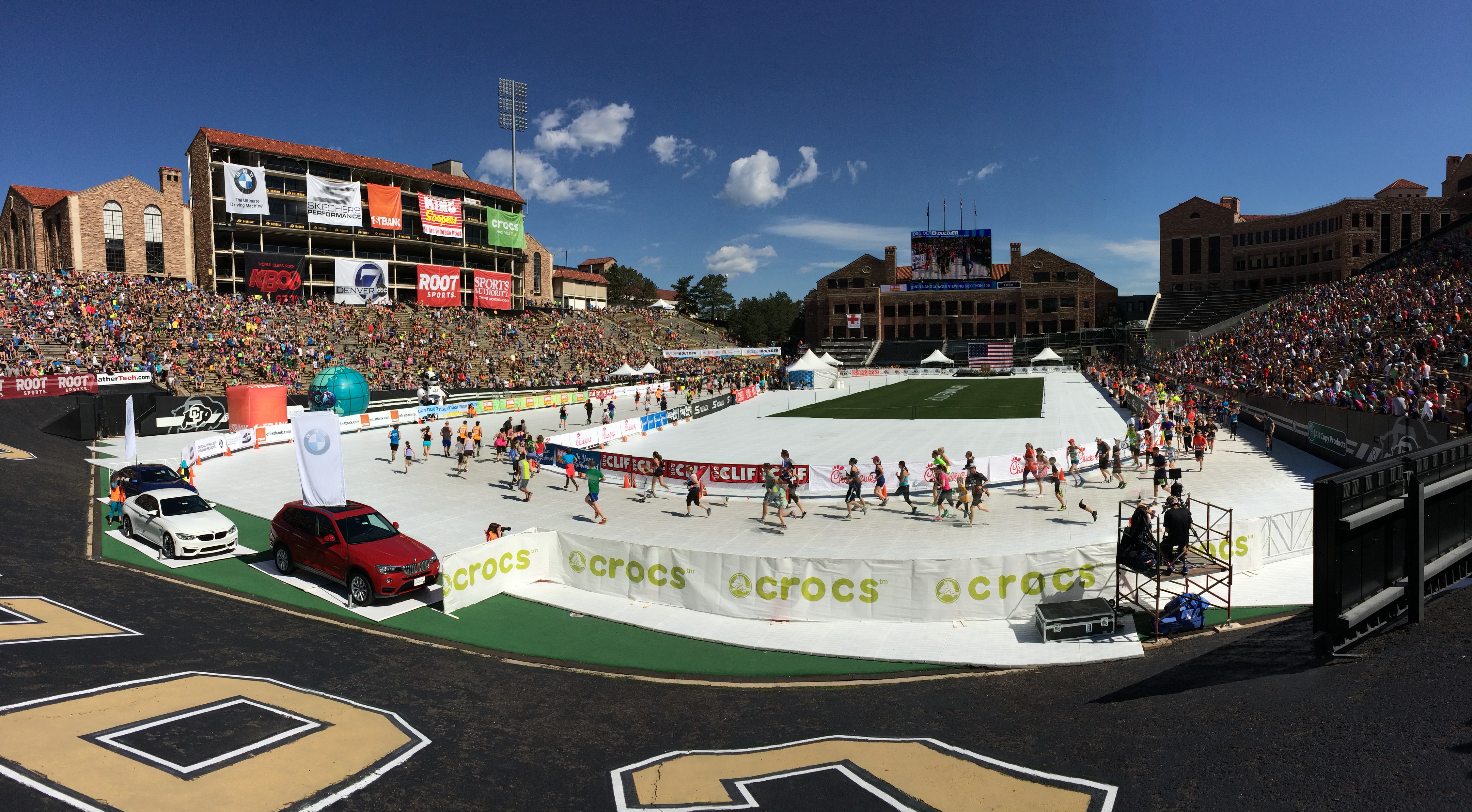
Since I threw it out there that I was going for a sub-40 10k time in this year’s IMG_9019BolderBoulder, it is with some disappointment and a lot of frustration that I now have to report there was no sub-40 time from me on Monday.

I am still thinking about all that went wrong early Monday morning and I have come up with a number of reasons (or excuses, if you like) that could have negatively effected my performance.

1. I had too much to drink before the race. I had to get up at 4:45 to make it to the start of the race that morning. I think all that time tricked me into thinking I could have a large coffee, 2 bananas, a big spoon of peanut butter, and a little water before my race. Although I was done eating and drinking by 6:10, 45 minutes before my wave started, this was way too much to consume before a race. I haven’t normally had that much to eat and drink before a race so I don’t know why I did something different on the day of the BolderBoulder. It’s a rookie mistake and I’m embarrassed by it. In previous running races–all 4 of them–I’ve had at most one banana, a little peanut butter, and maybe 10-12 ounces of water.

2. I took the first mile out too fast. 6:07 on my GPS watch. 6:11 on official results. Both are too fast for me, but it’s very hard at the start of a race to not let the energy get the best of you. You feel good. You are racing with the biggest group of fast runners you have seen. You stupidly think that you can maintain said pace because you still feel good. Of course I felt good. It was the first, damn mile. If I was running the race again right now I would slow down to a 6:30 for that first mile and try to maintain that through the first four miles, then try to pick it up for the last 2.2. In a 6-mile race a couple weeks ago my first mile was 6:36, then 6:37, and 6:34. I was hurting in mile 4 and 5, but still kept it under 7 minutes and then in mile 6 I had enough energy left for a 6:24. Mile 6 in Monday’s race was 8:02.67. Doh! I straight up walked 50 yards of that. It was gross.

3. I underestimated the Bolder Boulder course. There isn’t much of an incline in the first four miles, but it’s just enough to break you down if you underestimate it. I didn’t think it would prove to be that sapping to my legs, but it was. It’s certainly not an ideal course to set your PR on. That said, I haven’t been running long, so I set a PR (42:29), but was nowhere near my goal time.

4. I should have gone out for easy runs on Saturday and Sunday. This was the first time that I’ve tapered off a serious running regimen so instead of taking one day off my feet, I took two. I thought two might be necessary because I am a little more muscular than your avid runner. In hindsight, I think a 20-minute easy run on Saturday and a 10-minute easy run on Sunday would have been ideal.

5. My training program needs more interval work in it. I have already found good alternative programs to use for a sub-40 minute 10k. The regimens  are all about 10-14 weeks long and one of them has at least two, sometimes three rest or active rest days, which I certainly need.

6. Although my left foot did not bother me on Monday, something may be wrong with it. Since it was giving me substantial pain during the last two weeks of training, I did cut back on my interval training by turning fast 400s into fast sprints the length of a soccer field. That may have taken a slight edge off my fitness level, but I would not give this too much weight. That is why this is reason six, not one.

As far as the Bolder Boulder goes, I will compete next year and I have made some goals for that race. 1. Beat this year’s time. 2. Don’t vomit. 3. Don’t require medical attention. 4. Don’t take it out so fast. 5. Don’t drink a tumbler of coffee an hour before you run.

I will be happier and I will feel better after next year’s race if I obey these commands.

Drinking on Monday Starts at 8…am

For the last ten weeks I have been training for the Bolder Boulder.

This running thing is pretty new to me. I competed in my first 10k on Thanksgiving day last year. Since then, I’ve tried two 5k races and another 10k.

Before those races, I ran in one 5k at the Milwaukee Zoo in 2008. That race doesn’t really count. Between 2008 and the turkey trot in 2015, running was not a hobby. I still hit the pavement every once in a while, but it was merely for cardio.

IMG_8998

The start of the A Wave at the Bolder Boulder. Just looking at this gets my heart racing.

Part of the reason I have kept on competing since the turkey trot is because the racing conditions were so horrible then. It was 32 and raining and the trail was 2-6 inch thick mud. My time was awful. The last three miles of the race were run in 7:50, 9:53, and 7:24. Can you tell which mile I fell twice on, nearly impaling my hand on a very narrow tree stump?

I think it was soon after that race I decided I needed another shot at a 10k and I instantly thought of the Bolder Boulder. For much of my life I’ve lived within a 45 minute drive of Boulder and have never thought about entering the race.

The race is five days out and today I realized I haven’t trained this hard for a competition since training for my last swim meet as a collegiate swimmer in 2005. I am actually tapering off of what was, for me at least, a tough training schedule. I’ve even shunned a daily beer or beers for all of May, which has been almost as hard for me to do as the running. I think I have had two drinks since the start of May. That Oskar Blues beer after I finish my race at Folsom Field is going to taste so good.

For many of my training runs I had to literally push my training partner. For London, it has been an easy training schedule. She gets a cushy ride in the Mountain Buggy, sips away at her water cup, throws it from the stroller when she decides it’s cramping her style, and kicks off her shoes whenever desired. Her stroller ain’t light and neither is she, weighing in at 35 pounds, but I was thankful to be pushing just one kid over the last ten weeks.

On Monday morning, London will just be having her breakfast when my wave (AA) goes off at 6:56. I get so anxious just thinking about it. I’m not sure what I will think of the crowd. I am hoping to just lock onto a group running my pace and zone out for four, maybe even five miles before I think about the rest of the ground to be covered.

My goal is to come home on Monday with one extra t-shirt, one that says Sub 40 Club on it. With luck, it’ll fit me.

Cleared to Run

For years I had been ignoring a substantial pain in my right knee, thinking it was something that required surgery. Finally, in September, I stopped procrastinating and made a doctor’s appointment. The doctor was quite confident I was dealing with patellar tendonitis. He signed me up for physical therapy, prescribed nitroglycerin patches, and sent me on my way.

Six PT sessions, including two dry needling appointments later, I am pretty confident that the doctor was right. I have a slew of exercises and stretches which have kept the pain to a minimum. Ideally, when you really want to heal the patellar tendon, you eliminate running or jumping exercises first and then do the physical therapy exercises. I have opted for a different route, simultaneously doing the PT and beginning to train for my first 10k on Thanksgiving day. So far, so good. My knee hurts almost every time I start a run, but a mile or two in it does not bother me at all. Couple the exercises with the knee strap I wear, and my right knee feels excellent the whole latter half of the run.

DSCN0026_1296

Swimming days at UW. 2005.

My interest in running first grew when I was swimming for Wyoming. In the fall and spring, the team would often run a 5k before getting into the pool and swimming one, as in another 5k, not a 1k. I wasn’t the fastest runner at practices. There would always be a couple guys ahead of me who were just built for longer distances, but I always enjoyed those runs, even though they were at 7200 ft in elevation. In the years since, I have loved running for exercise, but I haven’t ventured into competition that much. I ran in one 5k in Milwaukee a few years ago and that is it.

With a Thanksgiving 10k on the horizon, I really wanted to do some formal training. Not knowing where to start, I did some googling, naturally, and I found this (the intermediate 10k training program from Hal Higdon). Feeling like that was as good a place to start as anything else, I enlisted myself in a solo training program. Of course, it’s not entirely solo. On many of my runs I have had to push London in the Mountain Buggy. She enjoys it tremendously. I, on the other hand, sort of prefer the days I can run by myself. Although it rests on three wheels, the Mountain Buggy with London in it is no light load. The max distance I have pushed London is six miles. In the beginning, pushing London for 3 or 4 miles was very hard, but now, six weeks in, I can push her for a four mile run and quite easily run under eight minute miles. Progress.

Come race day, I’ll have two big breaks. One, I won’t have to push London around the course. And two, perhaps even more of a boost, the race takes place at about 1000 ft in elevation. There is some bad news though. There is a decent chance it will be cold enough to watch your spit freeze right after it hits the ground. At the start of last year’s race it was 12 degrees.

The Mountain Buggy

I never expected to receive a stroller as a surprise birthday gift. Nor did I expect to be happy when receiving a stroller as a surprise birthday gift. When both of those things happened, I knew I had fully arrived as a SAHD.

IMG_5714

With the latest edition to the stroller stable.

The picture here is just moments after I came in the door to find London locked in and ready for a stroll in this Mountain Buggy Terrain, the tallest, most beautiful jogging stroller I have ever pushed around. We had thought about making this stroller our everyday stroller for a while, but after using it for nearly three months I am glad we did not. To be clear, the Terrain is amazing. At its tallest, it’s actually too tall if I want to run with it. (I love having something that’s too tall). The stroller is rock solid on bumpy trails and there is more than enough adequate storage below the seat and in pockets on either side of the sun shade.

But the thing is a beast! When collapsed it barely fits in the back of our Toyota Highlander. It’s no light stroller. Lift with your legs, not with your back. Lugging it around for everyday tasks and errands would have been a hassle. I am still ever so grateful for our Uppababy and the Chicco umbrella stroller we now have.

Again, the tall strollers are consistently one of the most expensive models in the market. However, our Terrain was a spotless floor model so it was discounted nearly $200. Phew.

I’ll never forget the first time I took London for a run in the stroller. She started giggling as soon as I started off on the trail. She kept laughing so that in ten minutes she had worn herself out and was snoozing. So even on gravel, the Terrain provides a smooth enough ride for the occupant.

I had given the Uppababy some stroller love on this blog back in September. The Mountain Buggy is worthy of the same praise. If you’re tall and want a jogging stroller, look no further.