12 Classics in 2015 (2016 version): The Executioner’s Song

I set out to read 12 classics in 2015. Technically, I finished seven in 2015 before I, quite optimistically, took on The Executioner’s Song, the 1109 page Norman Mailer book about Gary Gilmore. The plan was to finish this book in 2015 and then sprinkle the remaining days of 2015 with four slim classics. I didn’t get there. I finished the last page of ES last Monday.

Having never read a book over 1,000 pages before, I was fooled by Dave Egger’s quote on the back of Mailer’s book. “…It’s the fastest 1,000 pages you will ever know.” Well, it is the fastest I’ve ever read a book of this length, but certainly not the shortest amount of time I have taken to cover 1,000 pages of prose.

What is obvious in my completion of this book is that it was good. I would not have continued past page 300 if it was poor. I knew nothing about Gilmore going into the book. I’m not sure I had ever heard of him. This, Eggers wrote in the introduction, is one of the best scenarios for reading ES. In fact, Eggers urges Gilmore-clueless people to stop reading the introduction at this point and skip to the boIMG_8500ok. That’s what I did and I am ever thankful for it, for if I knew Gilmore’s fate there would be no suspense to carry me through to the last page.
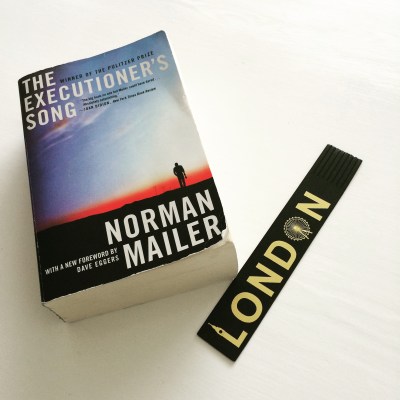
I can’t believe someone would undertake such a vast project to tell Gilmore’s story, but Mailer somehow did it and painted a thorough picture of all the primary actors in Gilmore’s life (and there were a lot), giving the reader a complex cast of characters, matched only by the complexity of Gilmore.

Knowing what we know about Gilmore, that he killed two people, you want to dismiss him as a sick, bad person. But it’s amazing the people he wins over from the time he is arrested to the time he is executed. People poised to make a lot of money off of Gilmore’s death decide in the end that they can’t do it. They respect, even love, Gilmore too much to do that to him. This was the most surprising part about the book. There was this side to Gilmore that was very intellectual, caring, and even nice. Although his temper could flare up in the briefest of exchanges.

I enjoyed The Executioner’s Song. The book was worthy of derailing my original plan of reading 12 classics in 2015, for by finishing this book alone I feel like I accomplished something significant. That said, I am quite relieved to know that I can move on to the books that have been stacking up while I made my way through The Executioner’s Song.
The Next Book For London

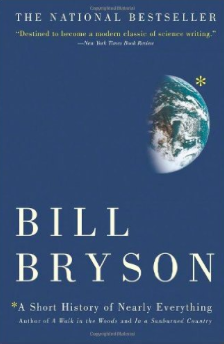
The next book I read to London has impossibly big shoes to fill. What can knock Screen Shot 2015-08-11 at 4.39.35 PM4,100 pages of Harry Potter off the top? Well, it isn’t Bill Bryson’s A Short History of Nearly Everything or ASHONE for short. That’s right, I went full nonfiction science writing for the next book. I needed a change of pace and I am quite sure London won’t notice, except for the expanded vocabulary in Bryson’s work compared to HP.

I love Bill Bryson’s writing. Somehow I had owned ASHONE for ten years and had never read it. London and I cracked open the book a couple of weeks ago, validating my purchase of this book in a Borders (remember them?) in Longmont, Colorado all those years ago. We are only a hundred pages in, but I’ve found that I am not enjoying this as much as his travel writing. There just aren’t as many opportunities in science writing for Bryson to add his signature humor. That said, it’s still an excellent book. Bryson makes the hardest of subjects accessible by writing about them in the common tongue.

One of my favorite passages early on in the book is from chapter two:

…it isn’t possible, in any practical terms, to draw the solar system to scale. Even if you added lots of fold-out pages to your textbooks or used a really long sheet of poster paper, you wouldn’t come close. On a diagram of the solar system to scale, with Earth reduced to about the diameter of a pea, Jupiter would be over a thousand feet away and Pluto would be a mile and a half distant (and about the size of a bacterium, so you wouldn’t be able to see it anyway). On the same scale, Proxima Centauri, our nearest star, would be almost ten thousand miles away. Even if you shrank down everything so that Jupiter was as small as the period at the end of this sentence, and Pluto was no bigger than a molecule, Pluto would still be over thirty-five feet away.

I absolutely love reading about how huge space is. And this is just our solar system.

I always think about God when I think of space, its scale, its never-ending mysteries, because for me, space has always been one of those things in which I see the presence and power of God. Pure awe.

I’m looking forward to the rest of this no-longer-dusty Bryson book.

4,100 Pages of Harry Potter

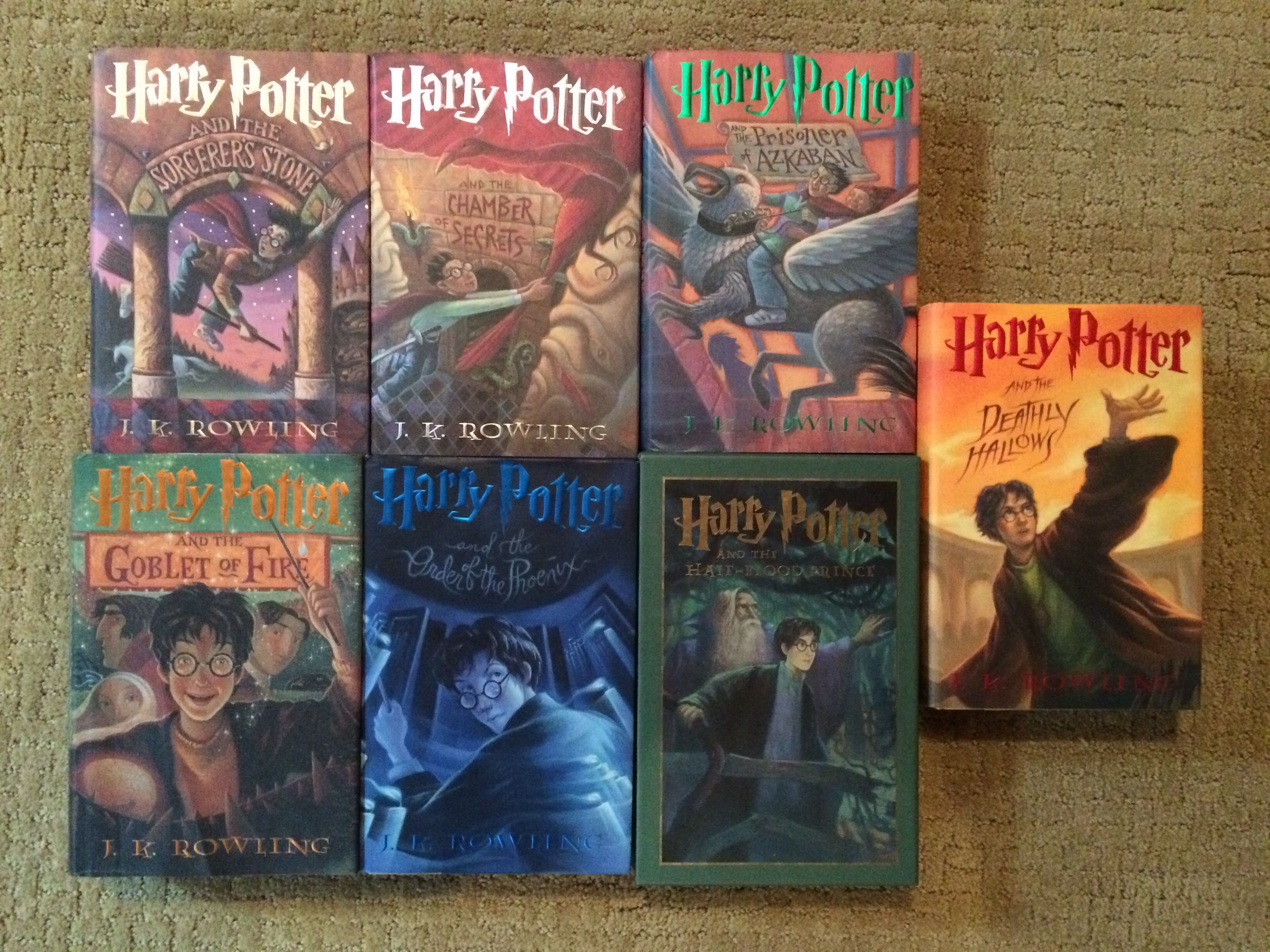
On July 16th, I read the last page of the Harry Potter books to London. It had taken me one year, two months, and four days to read that page and the previous 4,099 to her. Before May 12, 2014, I had never made an earnest attempt at even reading the first book. I had made more of an attempt at watching the movies, but had only made it through the first two and started and failed to finish the third movie on several occasions.

By the time I got to page 759 of Harry Potter and the Deathly Hallows, I felt I was finishing more than a book, but a saga of both literature and life. The obvious saga, that of Harry Potter’s journey from Four Privet Drive to the climactic duel with Lord Voldemort, and the less obvious saga, of London’s journey from her 102nd day in the NICU (the day I started the first book) to her fourteenth month at home, and her seventeenth month of life.

HP Books

Beautiful artwork on all the covers of these increasingly heavy books.

When I cracked open Harry Potter and the Sorcerer’s Stone it was an act of therapy. I did not know if I would finish all the books. I did not know if I would be able to read all of them to London. However, as time went by, it became clearer and clearer to me that I would finish the books, that London would hear every page of these books, and that just because we got out of the NICU did not mean the reading of the books ceased to be therapeutic.

In the beginning, it was easy to find time to read Harry Potter to London. I would place her on a pillow in my lap and could read for as long as I like really, assuming she was oxygenating well and in a comfortable position. When she left the NICU, I read several times a day to her, while she was on the floor making cooing noises, while she was falling asleep, and while she was taking a feeding from her NG tube. Later on, I only read to her as she fell asleep for naps. And a little later on from that, she stopped falling asleep if I was by her side reading Harry Potter. This coincided with her ability to pull to a standing position, so she would stand inside her crib and reach out for the pages of the book and get frustrated that she couldn’t grab them.

Eventually, I had to start reading Harry Potter to her when she was in the living room playing with toys. By this last stage, I knew that my voice comforted her. I could read a whole chapter and sometimes two while she played. I may have pushed the limit on July 16, when I read the last sixty pages to her in one sitting as she drained all the fun out of one toy to the next until she was clearly wondering why I had been reading to her for so long without any breaks.

On more than one occasion during the last several days of reading Harry Potter I choked up because it would dawn on me that I am almost done with the books, or I would remember in a flash how far London has come over these 4,100 pages, so incredibly far as you may know.

I take great joy in knowing that I will be able to read these books once again to London when she is older and able to follow the plot. Perhaps I won’t read every word aloud to her. She might take over. That is fine with me. I know I will always be reading with London.

*Special thanks to my wife’s family who let me borrow all of their pristine, hard cover, first edition Harry Potter books.

12 Classics in 2015: The Stranger

I enjoyed picking up another slim volume, knowing I would finish this next book in two or three sittings. The Stranger, by Albert Camus, is a study of the absurd arc of all lives. It focuses on one man, Meursault, who kills a man on the beach in the first part of the book. Meursault’s trial constitutes the second part of the book.

Meursault, to me, felt very little emotion other than his lust for Maria, his girlfriend and, possibly, future wife. And although I saw some justification of him shooting the man on the beach, Meursault seemed to hold none of the same justification. He seemed only to defend his atheistic beliefs, and nothing else. He is a sad figure, not because I am a believer and he is an atheist, but because he seems utterly defeated by the absurdity of life. He refuses to use religion or the legal system to comfort or free himself because he recognizes the futility in prolonging the truth: that we will be born, we will die, and then no longer matter. All of us.

Meursault is a Debbie Downer, but Camus channels his philosophy quite well through Meursault’s actions and words. Interestingly, Meursault becomes happiest when he gives up all hope of a life, long or short, and accepts that any path he goes down ends the same.

I certainly don’t see eye to eye with Camus on this. I recognize that life can indeed be absurd and it will yell at us again and again, “resistance is futile,” but resisting is one of the hardest and most rewarding parts of life. It amplifies everything, the valleys, the peaks, the springs, and the winters of our lives. I believe it makes for a richer life, which looks better to me than Meursault’s fate of a jail cell and decapitation.

12 Classics in 2015: The Jungle

The Jungle is widely known as the book that turned the public’s gaze upon the meat industry. Months after the novel’s publication, the Food and Drug Act went into effect. The public was disturbed to find out that their chances of eating rotten and diseased food were quite good, as the condition of the slaughterhouses was revolting and what oversight existed at the time was a farce.

This was a positive reaction from the public, but Upton Sinclair did not mean to turn the people’s fervor toward the meat industry alone. Sinclair’s primary protestations regarded the labor conditions and complete lack of workers’ rights. Indeed, that is what struck me about the book. Sure, the descriptions of the making of sausage with scraps of meat and innards from the floor and the drains, and the tubercular cows passing right by the “screener”, are disturbing. But the human suffering detailed in the book is far more painful to endure. It lasts from shortly after the first chapter to the very last (357th) page.

The book’s main character is Jurgis Rudkus. You get the impression that the lion’s share of his life is lived out on these pages. What life Jurgis does have plays out like a train wreck. You see everything coming before he does. Blow after blow Jurgis is dealt with no means to protect himself or to save his family from abject poverty. My heart ached for Jurgis and every member of his family and for all those wasting away in Packingtown, the meat-packing area of Chicago.

I am thankful that workers’ rights are a thing now. No one spoke of them in The Jungle until the very last pages of the book, which is a screed in support of Socialism, one of Sinclair’s great causes.

The struggle of the working class is still very real. More than once I thought of fast-food workers, who are campaigning for greater pay because of the poverty they are forced into by trying to support a family on the current minimum wage, and I recognized that they are a group of people who would be at the heart of The Jungle if it were written today. Sinclair would be pleased to know that these workers don’t have to work 7-5:30 Monday thru Saturday just to keep their job, but many still work those hours because one job is not enough. A second is needed to scrape by.

The Jungle is a serious book with an intensely dark and sad narrative, but also a book with a surprising appeal to the reader to read just one more page. I found it enticing, even though with every new page Jurgis encountered his next setback or you could make out the train wreck on the horizon a little better. Out of the six classic books I have read this year, The Jungle has surprised me the most with its novel subject matter and its desperate plea for help from the immigrant masses who are still growing, tending, picking, and packing our food.