The next book I read to London has impossibly big shoes to fill. What can knock 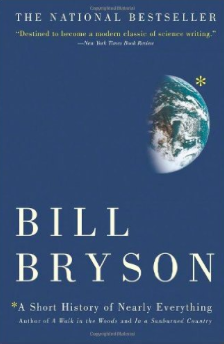 4,100 pages of Harry Potter off the top? Well, it isn’t Bill Bryson’s A Short History of Nearly Everything or ASHONE for short. That’s right, I went full nonfiction science writing for the next book. I needed a change of pace and I am quite sure London won’t notice, except for the expanded vocabulary in Bryson’s work compared to HP.
I love Bill Bryson’s writing. Somehow I had owned ASHONE for ten years and had never read it. London and I cracked open the book a couple of weeks ago, validating my purchase of this book in a Borders (remember them?) in Longmont, Colorado all those years ago. We are only a hundred pages in, but I’ve found that I am not enjoying this as much as his travel writing. There just aren’t as many opportunities in science writing for Bryson to add his signature humor. That said, it’s still an excellent book. Bryson makes the hardest of subjects accessible by writing about them in the common tongue.
One of my favorite passages early on in the book is from chapter two:
…it isn’t possible, in any practical terms, to draw the solar system to scale. Even if you added lots of fold-out pages to your textbooks or used a really long sheet of poster paper, you wouldn’t come close. On a diagram of the solar system to scale, with Earth reduced to about the diameter of a pea, Jupiter would be over a thousand feet away and Pluto would be a mile and a half distant (and about the size of a bacterium, so you wouldn’t be able to see it anyway). On the same scale, Proxima Centauri, our nearest star, would be almost ten thousand miles away. Even if you shrank down everything so that Jupiter was as small as the period at the end of this sentence, and Pluto was no bigger than a molecule, Pluto would still be over thirty-five feet away.
I absolutely love reading about how huge space is. And this is just our solar system.
I always think about God when I think of space, its scale, its never-ending mysteries, because for me, space has always been one of those things in which I see the presence and power of God. Pure awe.
I’m looking forward to the rest of this no-longer-dusty Bryson book.

 the FoCo dad