Do It Afraid

“Sometimes fear does not subside and one must choose to do it afraid.” – Elisabeth Elliot, poet.

That is how I feel about writing these days, months, and years since I have not put pen to paper and fingers to keys. I have waited for the fear to subside. As you can tell, it has been a long wait and it would have been longer. But for what? I do not know.

Even stupider, I have waited for ideas to come to me without first sitting down at the desk.

And worst of all, I thought I would eventually convince myself, by taking a long break from writing, that I am indeed not bad at it. That most definitely did not happen. I think I have tired of the waiting. Tired of telling myself, writing, well, that is something I will do when life calms down. I think I have known for a while now that it will not.

Furthermore, my voice will not come to me if I do not share it. So, I will share it, but as Elliot reminds me, I must choose to share it afraid. For now, I have to lie to myself to get my butt in chair. (Thank you, Anne Lamott). You have something worth sharing. People will connect to the story of you and your family. I can build a following if I do this. I do not suck at writing. I will get better, even become good at this. Doing this will improve other areas of your life. These are some of the lies I tell myself. And to some degree, I recognize that some of them are not lies at this point. I guess the evolution that has taken place in my head is that it is better to convince myself of these lies than to go on believing much worse ones that I have spent a decade or longer believing, such as:

  • You are not unique.
  • You are alone.
  • This experience of being a stay at home dad, raising an autistic daughter and a neurotypical son is not unique enough to share.
  • I am not good at writing.
  • This will never make me a dime.
  • After spending 12 years as a dad and caregiver, no one will ever hire me again.
  • I am old and washed up.
  • If my own sister once told me this blog is ridiculous, then I should not try anymore.
  • I should not share because that one cousin called into question my whole education (a BA in English and an MA in International Studies) and approach to life all because I dared to support the COVID-19 vaccines. I should be fearful of pissing off people like him.

Yes, these are all things I have convinced myself of over the years as my writing became rarer, as blank journals stacked up, as keys stopped clacking. But no more. I will believe the first set of lies that, even if they do not come true, at least I will be a better person for having lived like they are truths.

The fear bit, well, I do believe the more I do this the more it will dissolve away. But I must be prepared for it to always be there and to always put pen to paper alongside a well of dread.
Write Every Day

Do I have a piece of advice for new parents? Heck no! I am flying by the seat of my pants, making things up as I go along, convincing myself I am doing it the right way until I find out I am doing things completely wrong. I haven’t subscribed to a parenting magazine and I don’t listen to parenting podcasts. Maybe I should do one of those things. I know I would learn something, but then there is always the time.

Do I have the time? No. Sometimes. I don’t know. I probably do have the time, but remembering every little thing I am supposed to do during that time–when she is sleeping or at preschool–is very, very difficult. Many of the tasks seem overwhelming or too time-consuming, like if I take time to peruse through a parenting magazine for an hour and London simultaneously takes a short nap, all I can say about my day is that I read a parenting magazine. Forgive me, but I want more out of my precious free time. By now I have probably given you the impression that I have no interest in learning about parenting or becoming a better parent. That is just not the case.

What got me on this topic of advice was a question a friend asked me months ago. It was not a blanket appeal for advice for new parents. The question was broader than that. What have I found to be helpful? What was a waste? What would I do differently? It was a multi-parter, but without the requirement of answering each part. I have got a simple answer for one part.

Screen Shot 2017-09-29 at 1.36.30 PMWhat have I found to be helpful?

Write a few words about every day you have with your child. When you are in the thick of it, you can think to yourself, I have no time or energy for this. This is often true. It’s okay if you get a few days behind and have to write an entry for a few days back. But there is another excuse, I’ll never forget this. Oh, how wrong you are. There is so much happening each and every day that there is no way to remember each and every day. Your kid can say something hilarious one moment and then the next you are rushing to get out the door and by the time you get back home you know that something great happened that morning but you can’t recall what it was that happened.

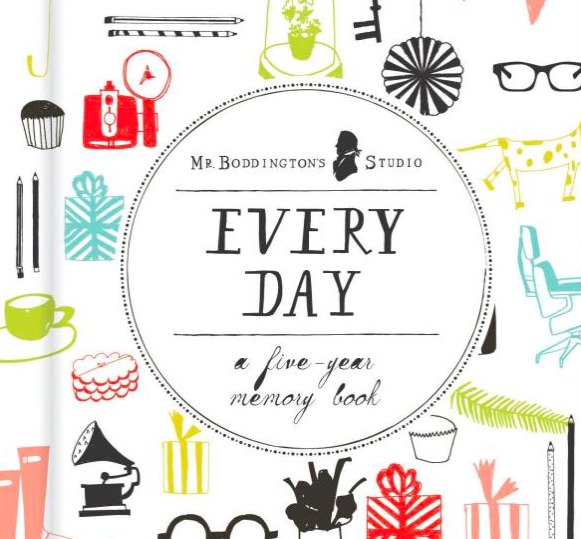
So, my advice, if you want to call it that, is to buy a one line a day journal that covers five years. I have written about these journals before. I just bought this one for my baby boy…arriving any day now. Name suggestions anyone?

For the days of firsts, you will likely have photos and videos of crawling, walking, talking,  and maybe even sitting on the pot. But if you don’t write it down, you will forget your kid’s reaction to his first popsicle, the name of a friend made at music class, or that day your kid takes a glorious three-hour nap (September 10, 2016).

Do not fret if you don’t write something every day. I do write something every day, but it took me a while to get into that habit. There are too many blank days in London’s first year and a half of this journal, but better to get into this habit later than never. Now, I am on a streak of 2+ years and her journal has become one of the most-prized possessions in my entire house.

If the house goes down in flames, I am getting my family out and then going back for this journal and, if I have the time, a backup of the hard drive on this computer (photos!). Everything else can be replaced.

But do not forget the journal. Even the sharpest of minds cannot bottle up all the precious days of infancy and toddlerhood.

I Needed A Subject

As a creative, there is nothing quite as painful as being told what you’re putting out there is not very unique. When I was told this, it basically boiled down to, and I’m paraphrasing here, “People have gone through much worse…There are lots of stay-at-home parents…What you are doing isn’t special.”

These words struck me in a part of my heart that the world had not calloused over, a part that my own cynicism had not hardened. Their aim was true, but the words were not. Nevertheless, they hurt at the moment and they still hurt. They made me second guess. But they’re not going to stop me. I hope other creatives don’t let the people who don’t understand their art destroy their drive to make it.

My drive was fully realized the moment London arrived in my life, as I expressed to a dear friend in an email on March 24, 2014, nearly two months after London was born:

For a long time I’ve questioned whether I will ever write for a career, as I’ve dreamed of most of my life. Besides getting rejected from MFA programs four years ago, I’ve also had my doubts that I had anything worth writing about. Clearer than ever, I have an answer to that now. I’m not sure what form that might take, but I have a story to tell from this whole experience. This also dawned on me within the first day or two after London’s birth. And in a way, it felt like God was saying, “This is it. This is what you’ll write about.” That has rattled me, probably because it is the truth. Pure, distilled truth.

Years later, I don’t know exactly what form that might take and I recognize the story is just starting. But I hear the still, small voice…This is it. This is what you’ll write about.

Just the Two of Us

London and I sat in the sun on a warm February day. We took chalk and colored our_BKP8247 respective patches of concrete and bricks. There was no breeze, a few clouds, and a welcoming burst of warm Colorado air in the waning winter.

I colored stripes. London seemed more interested in collecting all the chalk and moving it from one location to another and then she would peel off to grab another rock to drop down the drain cover.

There wasn’t anything particularly extraordinary about our activity that morning, at least, that is what I thought at the time. But later that day I found out Kate was pregnant. A blessing, indeed, but I almost immediately recalled the simple morning I had with London, the hundreds of simple mornings. The two of us drawing with chalk, taking a break with her, and sitting on the brick wall at the end of the alley. Just the two of us. The  two of us.

I at once felt overjoyed at the thought of my family growing and mourned the days of London and I coming to an end. She is my life’s greatest work. My family is my greatest joy. If I don’t write about them, then why write about anything else? More to come…

Published

What seems like two years ago, I submitted a short essay to the Denver Post. To my delight, I heard back from them. They wrote that my essay was being considered for online publication as a guest commentary. A couple months passed and I hadn’t heard anything from them so I emailed the Post again. They wrote back, saying that my essay was still in the queue and I would be notified if it was published. I maintained my optimism for about one more month and then, like all writers often do, I gave up all hope. I started wearing Crocs, drinking Folgers, and bought tighty whities in bulk at Costco.

Skip ahead to 2017 and I am half-heartedly looking for writing gigs when I do a quick self Google. I was curious if any of my writing was available on the web still. One of the top results was a Denver Post page titled, “Guest Commentary: Tiny hands change everything.” I clicked on the link. I confirmed that it was my work and noted the date. July 17, 2015. UPDATED April 24, 2016.

The photo with the commentary is of an adult hand, one finger of which is grasped by a tiny baby. This is not a photo of hands I know. I could have provided a better photo if they had told me I was going to be published.

Like this one…

IMG_2923

And then I read the words. Thoughtful, touching, but flawed. Like nearly everything I write, I only thought it was decent or, at best, good, at the time I wrote it. Now, almost two years later, it strikes me as insufficient, short, even a little cheesy. I would have been happier to link to it back in July of 2015. Linking to it now is anticlimactic. It feels like I am sharing a draft with you. Nonetheless, for it to appear on the Denver Post‘s website and for me to not share that on this blog does not feel right. Here is the article.

Have a great weekend.


Back from the Basement

I’m back from the dead, I mean, the basement. For four months we endured one of the slowest basement finish projects ever taken on by man. It must be said that the aforementioned man and his pals worked maybe three days a week and a workday consisted of showing up at 10am and leaving by 3:30. Things got to a point where I did not want the man and his pals to work on anything else in the basement because every time they fixed something they broke or maimed some other fixture in the basement. The short list of fixes would grow from 5 to 40 in a week. I happily gave the man the check labeled, “Full & Final Payment,” knowing I was going to finish the rest of this basement myself.

Since then, I have spent every minute I had away from London in the basement. Even when she was awake I occasionally brought her down to the basement, installed her in the high chair, and queued up Sesame Street. I’d even push it to see if I could get her to watch two episodes in a row. I got pretty damn close a few times all without coating her with drywall dust, paint, caulking, and spackle. Success.

I had told the man that I could handle the painting of the walls,

IMG_8805

Kate enjoying an almost finished basement.

but somewhere along the way he thought that meant I was painting all the baseboard, trim, and doors. Rookie mistake on not clarifying that. However, after seeing how the man painted the ceiling, I felt quite confident I did not want him painting anything else in the basement. So, I took care of those things myself. The doors were easy, just time consuming if you want them to look good and show no roller or brush marks. The baseboard was a different story. I did not have the opportunity to paint it before it was flush with the hardwood floors downstairs. Painting already installed baseboard takes ten times as long as painting pieces of baseboard fresh from the hardware store. This is what really took up the majority of my work.

Other things we had to take care of ourselves: cleaning off the adhesive on the window frames left by this crazy,. strong, fireproof tape used to install insulation in the basement, installation of speakers in walls, caulking all trim/baseboard joints, filling nail holes, mounting doors, installing hardware, painting shelves, ceiling paint touchup, replacing a light switch, installing blinds, painting quarter-round trim, and finally, assembling Ikea furniture, which actually was given the final touch last night. All is not done. I have yet to paint a couple closet doors, paint the stairwell, install carpet on lower half of stairs, and paint an exposed I-beam. Kate and I agreed that when all that is done we will feel as though we finished a quarter of the basement ourselves.

Throughout this process I have been aware that we saved a substantial amount of money by using the people we used. We had expressed an interest in using the same people to finish the bathroom in the basement, but we will now be doing that ourselves. That will, undoubtedly, turn into a bigger project than it is in my mind and it will mean I may have to take another long break from writing, but this break may have been for the better too.

I’ve missed writing. Writing helps me destress. When I don’t have the opportunity to do it I have this horrible nagging sensation that if I were writing right now I would be writing some of my best stuff. Of course, this is not true, but it’s hard to ignore this voice, which always creeps into my life at the precise moment that sitting down for a couple hours to write something is an impossibility.

I promise no regular blogging at this point. I can’t even say for sure when I will write again. Like I wrote above, there are still significant projects to be completed before I can sit in front of a computer to write for even 30 minutes, but that time is closer now than it has been for months. I like that.

12 Classics in 2015 (2016 version): The Executioner’s Song

I set out to read 12 classics in 2015. Technically, I finished seven in 2015 before I, quite optimistically, took on The Executioner’s Song, the 1109 page Norman Mailer book about Gary Gilmore. The plan was to finish this book in 2015 and then sprinkle the remaining days of 2015 with four slim classics. I didn’t get there. I finished the last page of ES last Monday.

Having never read a book over 1,000 pages before, I was fooled by Dave Egger’s quote on the back of Mailer’s book. “…It’s the fastest 1,000 pages you will ever know.” Well, it is the fastest I’ve ever read a book of this length, but certainly not the shortest amount of time I have taken to cover 1,000 pages of prose.

What is obvious in my completion of this book is that it was good. I would not have continued past page 300 if it was poor. I knew nothing about Gilmore going into the book. I’m not sure I had ever heard of him. This, Eggers wrote in the introduction, is one of the best scenarios for reading ES. In fact, Eggers urges Gilmore-clueless people to stop reading the introduction at this point and skip to the boIMG_8500ok. That’s what I did and I am ever thankful for it, for if I knew Gilmore’s fate there would be no suspense to carry me through to the last page.

I can’t believe someone would undertake such a vast project to tell Gilmore’s story, but Mailer somehow did it and painted a thorough picture of all the primary actors in Gilmore’s life (and there were a lot), giving the reader a complex cast of characters, matched only by the complexity of Gilmore.

Knowing what we know about Gilmore, that he killed two people, you want to dismiss him as a sick, bad person. But it’s amazing the people he wins over from the time he is arrested to the time he is executed. People poised to make a lot of money off of Gilmore’s death decide in the end that they can’t do it. They respect, even love, Gilmore too much to do that to him. This was the most surprising part about the book. There was this side to Gilmore that was very intellectual, caring, and even nice. Although his temper could flare up in the briefest of exchanges.

I enjoyed The Executioner’s Song. The book was worthy of derailing my original plan of reading 12 classics in 2015, for by finishing this book alone I feel like I accomplished something significant. That said, I am quite relieved to know that I can move on to the books that have been stacking up while I made my way through The Executioner’s Song.

Emails and Poetry

I rely on my parents to send me inspirational emails every so often. Yesterday, on my 33rd birthday, I received such an email. My mom encouraged me to go to a blog she regularly reads, to read a specific poem, and to listen to a hymn.

The blog is Barnstorming.

The poem found in this post is “Sure On This Shining Night” by James Agee

Sure on this shining night
Of star made shadows round,
Kindness must watch for me
This side the ground. 
The late year lies down the north.
All is healed, all is health.
High summer holds the earth. 
Hearts all whole.
Sure on this shining night I weep for wonder wand’ring far alone
Of shadows on the stars.

The Next Book For London

The next book I read to London has impossibly big shoes to fill. What can knock Screen Shot 2015-08-11 at 4.39.35 PM4,100 pages of Harry Potter off the top? Well, it isn’t Bill Bryson’s A Short History of Nearly Everything or ASHONE for short. That’s right, I went full nonfiction science writing for the next book. I needed a change of pace and I am quite sure London won’t notice, except for the expanded vocabulary in Bryson’s work compared to HP.

I love Bill Bryson’s writing. Somehow I had owned ASHONE for ten years and had never read it. London and I cracked open the book a couple of weeks ago, validating my purchase of this book in a Borders (remember them?) in Longmont, Colorado all those years ago. We are only a hundred pages in, but I’ve found that I am not enjoying this as much as his travel writing. There just aren’t as many opportunities in science writing for Bryson to add his signature humor. That said, it’s still an excellent book. Bryson makes the hardest of subjects accessible by writing about them in the common tongue.

One of my favorite passages early on in the book is from chapter two:

…it isn’t possible, in any practical terms, to draw the solar system to scale. Even if you added lots of fold-out pages to your textbooks or used a really long sheet of poster paper, you wouldn’t come close. On a diagram of the solar system to scale, with Earth reduced to about the diameter of a pea, Jupiter would be over a thousand feet away and Pluto would be a mile and a half distant (and about the size of a bacterium, so you wouldn’t be able to see it anyway). On the same scale, Proxima Centauri, our nearest star, would be almost ten thousand miles away. Even if you shrank down everything so that Jupiter was as small as the period at the end of this sentence, and Pluto was no bigger than a molecule, Pluto would still be over thirty-five feet away.

I absolutely love reading about how huge space is. And this is just our solar system.

I always think about God when I think of space, its scale, its never-ending mysteries, because for me, space has always been one of those things in which I see the presence and power of God. Pure awe.

I’m looking forward to the rest of this no-longer-dusty Bryson book.

DVDs $1, Stories Are Free

This house and its occupants are prepping for a garage sale this week. London’s help is extremely limited to nonexistent. She takes a long time examining every little thing we hand her, so she won’t be determining what we are getting rid of and what we are saving. She is most helpful when she decides to take a long morning nap on a Sunday so we can dig through the basement for potential hot ticket items.

We found lots of things to sell yesterday and just as much to throw away or donate. I discovered I had three copies of Goodfellas. (Hey, if there’s one movie to own several copies of it’s that one.) I have a DVD player to sell, but I can’t seem to locate the power cord or the remote. I am finally going to sell my Star Wars Pepsi can collection from one movie, which was both the most anticipated movie of all time and the most disappointing movie of all time, The Phantom Menace. But this can collection? Pristine. Complete. It represents a lot of work. It represents a lot of soda drinking.

For some reason I still had the majority of my class notes from the University of Wyoming. I chucked them all, but kept a few stories to possibly share on here. I threw out two boxes of old New Yorkers, magazines I had been saving because there was at least one tantalizing article in each magazine. I had lofty visions of getting to all of them some day, but having so many magazines and books I want to read around the house can really stress me out. It almost leads to less reading because I see the stacks everywhere and just think, I’ll never make it, why start now?

So, to those stories. I’m going to close this post with one. Please note, these are not my words. It was an assignment in an undergrad writing class for which you had to use a minimum number of sources to build one story or essay using nothing but quotes, a literary collage. And, here it is…

What I recall isn’t pain but a sense of jarring reversal, as of all motion, sound, and light encountering their massive opposites. I felt grass and dirt against my cheek, and sorrow that Dad was shot, and confusion that I couldn’t reach him. (1)

As I saw the last blue line of my native land fade away like a cloud in the horizon, it seemed as if I had closed one volume of the world and its concerns, and had time for meditation before I opened another. (2)

I shut my eyes, the old morte settled its grip, and the next country gathered itself under my feet. (1)

The grey rain-curtain turned all to silver glass and was rolled back, and he beheld white shores and beyond them a far green country under a swift sunrise. (3)

I waded ashore with measureless relief. The bank was an even slope of waving knee-high grasses and I came up into them and turned to look back. It was a wide river, mistakable for a lake or even an ocean unless you’d been wading and knew its current. Somehow I’d crossed it and somehow was unsurprised at having done so. (1)

There came into view a man, or so it seemed. (4) He had a blue coat and a long brown beard; his eyes were blue and bright, and his face was red as a ripe apple, but creased into a hundred wrinkles of laughter. In his hands he carried on a large leaf as on a tray a small pile of white water-lilies. (4)

“This is what we all find when we reach this country. We’ve all been wrong! That’s the great joke. There’s no need to go on pretending one was right! After that we begin living.” (5)

The words uttered by the person without, affected me as somewhat singular, but what chiefly rendered them remarkable was the tone that accompanied them. It was wholly new. I cannot pretend to communicate the impression that was made upon me by these accents or to detect the degree in which force and sweetness were blended in them. They were articulated with a distinctness that was unexampled in my experience. But this was not all. (6)

“We do not want you to become lazy, but to imitate those who through faith and patience inherit what has been promised.” (7)

It (the words) imparted to me an emotion altogether involuntary and uncontrollable. When he uttered the words my heart overflowed with sympathy and my eyes with unbidden tears. (6)

He sat down on a rock and swung his feet in a stream–it was deep and swift; it would take him in a moment. I seized his arm. Please, I said. Soon, he replied, which makes better sense under the rules of that country than ours. Very soon! he added, clasping my hands; then unable to keep from laughing, he pushed off from the rock like a boy going for the first cold swim of spring; and the current got him. (1)

Is there a single person on whom I can press belief? No sir. All I can do is say, Here’s how it went. Here’s what I saw. I’ve been there and am going back. Make of it what you will. (1)


Sources:

(1) Enger, Leif. Peace Like a River. Atlantic Monthly: New York, 2001.

(2) Irving, Washington. The Legend of Sleepy Hollow and Other Stories. Penguin: New York, 1978.

(3) Tolkien, J.R.R. Return of the King. Houghton Mifflin: Boston, 1955.

(4) Tolkien, J.R.R. The Fellowship of the Ring. Houghton Mifflin: Boston, 1954.

(5) Lewis, C.S. The Great Divorce. Harper: San Francisco, 1946.

(6) Brown, Charles Brockden. Wieland. Oxford: New York, 1994.

(7) Hebrews 6:12. Bible.


Blogging Away Resistance

You may have noticed that for a while in the late spring and early summer I was writing a lot on here. Every weekday I would sit down and write something. I was going strong. I was practicing my craft and sharing whatever came to mind. Traffic to the blog steadily increased too.

And then nothing.

Two-week and three-week blocks would pass without me writing anything at all. And when I wrote, the posts weren’t so much related to raising London at all. There were a few book reviews and a little something about Jon Stewart’s last show.

Some of this absence is explained by some summer and spring trips. We are once again free to move about the country with no complications other than those standard hiccups that come with a baby (even though she wears 3T clothing, she’s still technically a baby).

The rest of the absence can be attributed to me thinking it is healthy to take a break from writing every so often and then just a dearth of ideas. The writing break I’ve always been a fan of. It is healthy, but this break has been unhealthily long due to this creeping feeling that I am just contributing to the noise, that is, the saturation of our world by parenting blogs.

I have been having an internal debate about what is worthy of writing about. There is a part of me that wants to write as much as I can on here. And there is also this part that just does not want to spew forth words just for the sake of it. There is a part of me that realizes the stupidity in having a blog about fatherhood. There are thousands of them out there. And there have been billions of fathers before I became a father. What do I have to contribute to fatherhood that has not already been contributed? Is there anything original for me to unearth, create, or ideate?

Well, for a while now the part of me that answers no to that question has been winning the debate. And I think that is the resistance Steven Pressfield writes about in his amazing work, The War of Art.

Coming up with words to share on this blog is moderately difficult for me. But giving into resistance and batting away those words while admonishing myself for ever thinking they were worth putting out there is very, very easy to do. This is the “War of Art,” and it is so unbelievably hard to be in when you think of yourself as a creative, whether you are drawing, writing, painting, sculpting, photographing, or whatever it is that you create.

I have not written these words anywhere else. Sitting down with my computer now and explaining my absence was as much for me as it was for the followers of this blog. I hope it means I return to regular blogging, but even as I write this I fear the next time the fuel gauge reads empty. That thought alone is almost enough to put a halt to the journey right this minute, but I am not there yet.

Pressfield writes that resistance will bury you. Okay, maybe I was a little buried there for a while, but for now, for now I am above ground.

12 Classics in 2015: The Stranger

I enjoyed picking up another slim volume, knowing I would finish this next book in two or three sittings. The Stranger, by Albert Camus, is a study of the absurd arc of all lives. It focuses on one man, Meursault, who kills a man on the beach in the first part of the book. Meursault’s trial constitutes the second part of the book.

Meursault, to me, felt very little emotion other than his lust for Maria, his girlfriend and, possibly, future wife. And although I saw some justification of him shooting the man on the beach, Meursault seemed to hold none of the same justification. He seemed only to defend his atheistic beliefs, and nothing else. He is a sad figure, not because I am a believer and he is an atheist, but because he seems utterly defeated by the absurdity of life. He refuses to use religion or the legal system to comfort or free himself because he recognizes the futility in prolonging the truth: that we will be born, we will die, and then no longer matter. All of us.

Meursault is a Debbie Downer, but Camus channels his philosophy quite well through Meursault’s actions and words. Interestingly, Meursault becomes happiest when he gives up all hope of a life, long or short, and accepts that any path he goes down ends the same.

I certainly don’t see eye to eye with Camus on this. I recognize that life can indeed be absurd and it will yell at us again and again, “resistance is futile,” but resisting is one of the hardest and most rewarding parts of life. It amplifies everything, the valleys, the peaks, the springs, and the winters of our lives. I believe it makes for a richer life, which looks better to me than Meursault’s fate of a jail cell and decapitation.

12 Classics in 2015: The Jungle

The Jungle is widely known as the book that turned the public’s gaze upon the meat industry. Months after the novel’s publication, the Food and Drug Act went into effect. The public was disturbed to find out that their chances of eating rotten and diseased food were quite good, as the condition of the slaughterhouses was revolting and what oversight existed at the time was a farce.

This was a positive reaction from the public, but Upton Sinclair did not mean to turn the people’s fervor toward the meat industry alone. Sinclair’s primary protestations regarded the labor conditions and complete lack of workers’ rights. Indeed, that is what struck me about the book. Sure, the descriptions of the making of sausage with scraps of meat and innards from the floor and the drains, and the tubercular cows passing right by the “screener”, are disturbing. But the human suffering detailed in the book is far more painful to endure. It lasts from shortly after the first chapter to the very last (357th) page.

The book’s main character is Jurgis Rudkus. You get the impression that the lion’s share of his life is lived out on these pages. What life Jurgis does have plays out like a train wreck. You see everything coming before he does. Blow after blow Jurgis is dealt with no means to protect himself or to save his family from abject poverty. My heart ached for Jurgis and every member of his family and for all those wasting away in Packingtown, the meat-packing area of Chicago.

I am thankful that workers’ rights are a thing now. No one spoke of them in The Jungle until the very last pages of the book, which is a screed in support of Socialism, one of Sinclair’s great causes.

The struggle of the working class is still very real. More than once I thought of fast-food workers, who are campaigning for greater pay because of the poverty they are forced into by trying to support a family on the current minimum wage, and I recognized that they are a group of people who would be at the heart of The Jungle if it were written today. Sinclair would be pleased to know that these workers don’t have to work 7-5:30 Monday thru Saturday just to keep their job, but many still work those hours because one job is not enough. A second is needed to scrape by.

The Jungle is a serious book with an intensely dark and sad narrative, but also a book with a surprising appeal to the reader to read just one more page. I found it enticing, even though with every new page Jurgis encountered his next setback or you could make out the train wreck on the horizon a little better. Out of the six classic books I have read this year, The Jungle has surprised me the most with its novel subject matter and its desperate plea for help from the immigrant masses who are still growing, tending, picking, and packing our food.

12 Classics in 2015: The Old Man and the Sea

Reading 12 classics in 2015 would be a lot easier if you could knock out each one of them during a flight, like I did this short book on the way home from DC. In order to read some of the longer books I have selected for this task, such as Moby Dick, Midnight’s Children, and The Executioner’s Song, I needed to select some very short works.

_BKP1117

2013. Cayucos, CA.

The Old Man and the Sea is a delightfully simple plot that I will not rehash here. A warning though, it being such a short book most of the plot will be revealed by merely writing a few paragraphs about it.

While I read this book I thought about chasing goals, the way we chase them, and the people we leave in our wake while we chase those goals. Once the old man, Santiago, commits to catching the giant marlin he has hooked, there is no turning back. However, along the way, on nearly every other page, the old man thinks of the young boy, his apprentice Manolin, who had fished with him in the past and regrets his decision to not take the young boy out with him this day.

Pride and the necessity to make a living pushes the old man out to sea, the catch seeming impossible for hours and then days, but finally the marlin weakens and starts circling the boat. At this point, the old man’s energy and hand strength is somewhat revived. He pulls the marlin in against all odds and lines up the eighteen feet of marlin next to his boat. What a prize! Bask now in the glory of your catch because it will be rotted, decayed, or poisoned by the time you expect to reap the bounty.

Indeed, by the time the old man gets to shore, he has eighteen feet of skeletal remains alongside his boat and the old man himself is nearly dead. Would the ending have been different if the young boy had been allowed to fish with the old man on this journey? I think we are led to think that way. The victory for the old man is that he made it home at all and he can now take Manolin out fishing once again. Together, perhaps, they will catch a big marlin, but the biggest catch of all was lost. Be it pride, stubbornness, or just a foolhardy decision to go for the big prize, the old man did it. Better to try and fail than to not try at all. For if the old man had cut his line after the marlin towed him out to sea for a day, the decision would have eaten at him for the rest of his life.

I revere Hemingway’s writing. It’s the stuff I will aspire to for as long as I write. I will never get there, but it is fun to imagine. I will also never get to the point where I will shoot myself in the head with a shotgun. Exquisite writing and shotgun-assisted suicide I leave to you, Ernest.

Sidebar Additions

Hi People.

There may not be time for me to write a more substantial blog than this today, but I just wanted to alert you to a few sidebar additions to the blog. There is now a Facebook like button. So, if you haven’t, get on that button. There’s also a link to my Instagram account and a preview of some of the most recent photos I have posted there. Lastly, there’s a button you can click to follow the blog via email.

Now, I must attend to packing for my trip. I still remember how. I think.

12 Classics in 2015: Midnight’s Children

For my fourth act, I read Salman Rushdie’s Midnight’s Children51yqNUCZu6L

When you study literature Rushdie’s works come up a lot in discussion. And yet, I made it through an English undergraduate program without ever being assigned one novel or short story by Salman Rushdie. In my graduate studies in International Relations, his name came up quite a bit too because of my focus on the Middle East. But no Rushdie reading assignment there either. Of course, when a professor would ever mention Rushdie in my undergraduate or graduate courses my classmates would nod their heads. I would too. We all knew who he was. But had we read his stuff? Maybe my peers had. I had not. So, I picked up Midnight’s Children, admired the cover, and dove in. It was March 30th.

And now it is May 12th. What exactly happened between the aforementioned dates, pardon me, between the covers of the book, I am not entirely sure. But I am not too worried about that because a major theme of the book is the unreliability of Saleem’s narrative. He reminds you again and again that this may not be the way things happened exactly, but it is how he is remembering them at this precise moment. Padma (Saleem’s future wife) reminds Saleem of his story’s inaccuracies as well whenever he has screwed up the date of a significant event, such as Gandhi’s assassination.

Saleem’s story starts long before his birth, with the telling of how his grandfather met his wife, but the story really picks up when Saleem is born at exactly midnight on August 15, 1947, the day India became an independent country. All the babies born in India during its first hour of existence end up acquiring special powers. One of them can time travel. Another is a powerful witch. Saleem, being born at the precise moment India was born, is the most powerful. He can read people’s minds. And he can feel the presence of all those born that fateful night, the young ones known as Midnight’s Children. He can read minds from afar and explore the memories of anyone he wishes.

Eventually, Saleem loses that gift, but acquires another, the ability to smell nearly everything, from love to the exact scent of every human he has ever come into contact with. Over 533 pages, his story unfolds like that of Forrest Gump. Saleem is intimately involved with his country’s dealings for much of the book. Finally, he catches up to his 31-year-old self who is telling the story, only to close the novel (spoiler alert) with the prediction of his own death on the day he turns 32.

Saleem’s journey is epic. There is no point in sharing the entirety of it here or ever, really. I would feel different, I think, if I had loved the book. But this book, which might be the heaviest lifting I will do throughout this New Year’s resolution of mine, was one of the most confusing books I have ever read. Perhaps, the most confusing book that I have ever finished. For most of the book, I consulted chapter summaries on Spark Notes. Of course, I read the chapter first and only then would I read Spark Notes. It was a rough start, having no idea what really happened after I finished the very first chapter. In my defense, it was late afternoon, I was sitting outside in the sun, and London was napping. But I had my coffee? It didn’t matter. In fact, coffee can’t really help you through this book. But Spark Notes did, so I actually felt a connection to the story from time to time.

The thing about Midnight’s Children is that it is damn respectable for the quality of the writing. The style is unbelievable. Rushdie’s vocabulary is astonishing and there are sentences that flow so well I read them a few times for the sheer delight in their finely-tuned form. The book won the Booker prize in 1981. And then, for the 40th anniversary of the Booker prize, it was voted Best of the Booker, the best novel to have won that prize in 40 years. That is one huge honor, which certainly played a role in my selection of this particular work of Rushdie’s. I have got to read such an acclaimed book.

I did. It did not live up to what I would expect for the Best of the Booker award, but the book will certainly stick with me for a while. And now, when a professor mentions Rushdie’s name I can nod my head without feeling like such a dolt.

Too Many Journals

I would think twice about giving new parents a journal. Chances are, they already have three…at minimum.

They don’t need but one place to write their thoughts down about the expecting, the arrival, and the aftermath of their first child. We were lucky and probably only got about five journals, enough to record every minute of IMG_6093every day for the first three years.

Among people who journal, my devotion to it is moderate and, still, I am considerably disappointed by my lack of devotion to it. After all, it’s what writers do.

I’ve got a bookshelf of empty journals and I bet quite a few people can say the same, long before they have kids. For me, the site of an empty journal, which has been on my bookshelf for a decade, can be a consistent reminder of failure. (Note to self: move all empty or one-tenth-completed journals to box in basement.) Perhaps it’s the same with the people you are giving that journal too. Perhaps it’s not. But before you go ahead and give them that new-parent journal you better do a journal inventory of their bookshelves (in all rooms) and then assess whether these parents need more blank pages in their house.

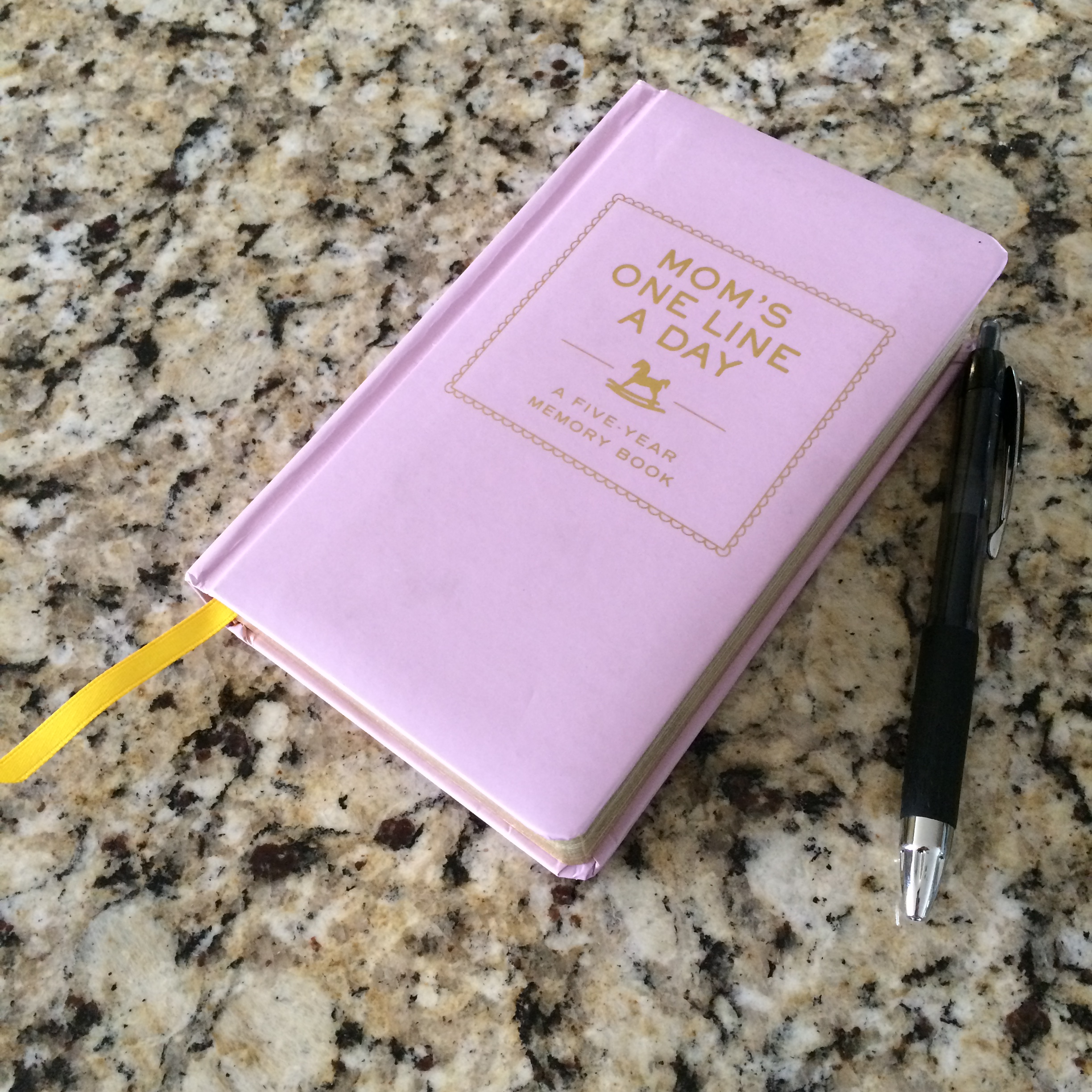
If you do that assessment and you decide to still get a journal, I have a recommendation. It’s called Mom’s One Line A Day. It’s my favorite journal with the crappiest title. It offers six narrow lines of writing space for each day for five years. On each page you can see what you were doing on the same date in a five-year span. Now that’s a crapload of journaling, don’t get me wrong, but at six lines a day, even if your handwriting is small, it fills up fast.

Even with that knowledge, I fail to write in it half the days, but since Kate and I have used this journal for over a year now we have a considerable record of London’s first 15 months (nearly).

More momentous are some days than others, but I have found it helpful even to write down the seemingly mundane. Example: April 21, 2015 – 2 naps still. Read HP (book 6) out loud to you and some of A Game of Thrones. Outside in backyard you watched as I planted some herbs.

And right above that entry, I can see that on April 21, 2014, I wrote: Dad started reading The Hobbit to you today. You can’t truly follow the story but you know my voice and somehow you can tell when I start reading each day because you smile every time. It’s truly amazing.

So, if you must, pull the trigger on the Mom’s One Line A Day journal. It’s just the right dose of urging the parents to write about this spectacular time in their lives.

One Year Ago Today

IMG_2988

Mom’s hands comfort London on February 4, 2014.

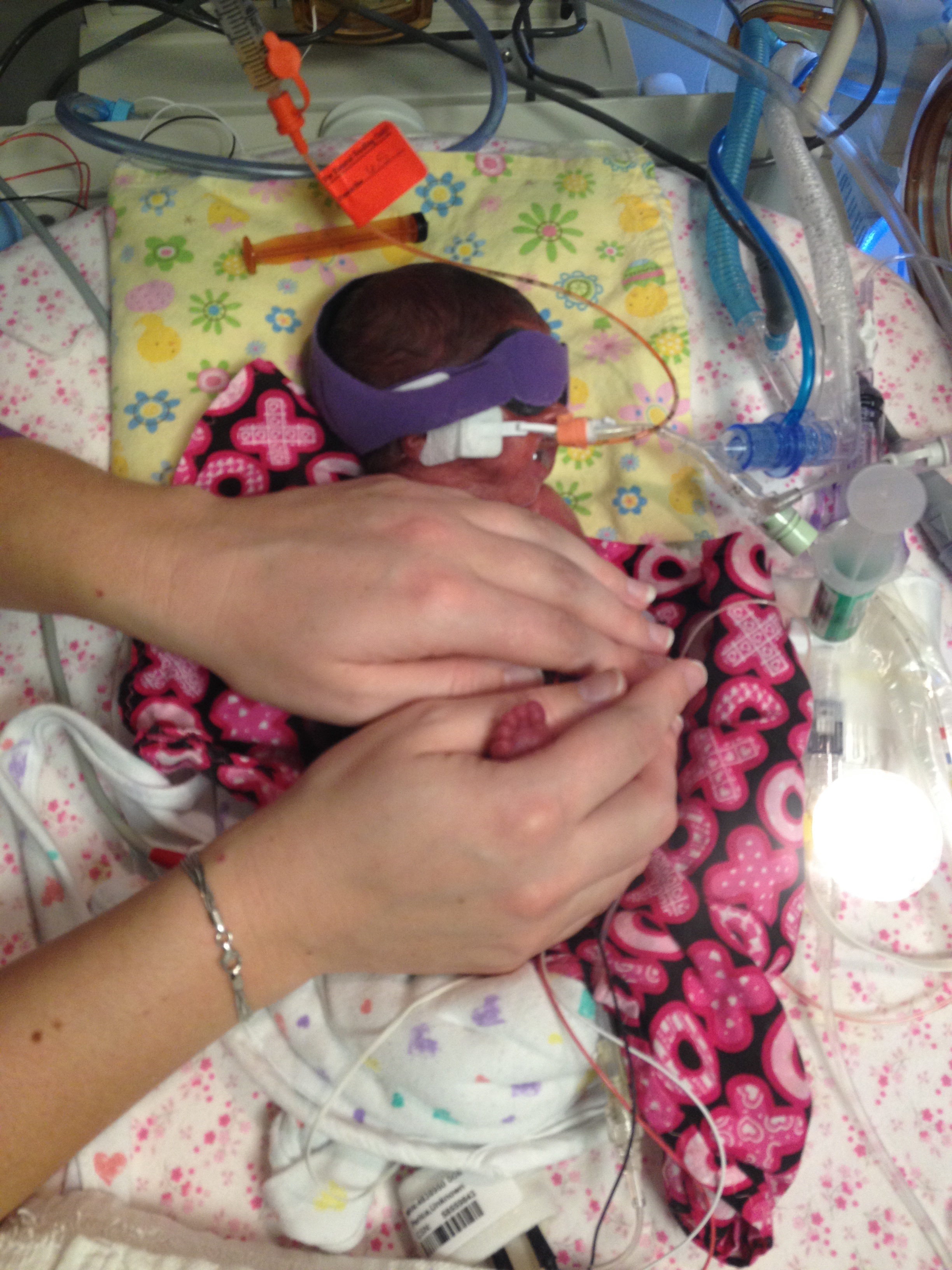
One of the most important things Kate and I did in the frantic, scary days following London’s birth was to write down what we did, even if it was watching some television to unplug for a minute. I am so thankful we have a journal from that time and from most of London’s NICU stay. Today I want to share with you what I wrote on February 5, 2014, London’s sixth day of life.

Wednesday.

Nana and Papa (my parents) told us that we could do whatever we wanted to this day and they would take care of dinner and grocery shopping and whatever else. We, of course, chose to sit next to you for the day. So we did. It was exhausting, the most tiring thing I’ve ever done, to sit next to you and constantly worry, watch the monitor, and pay attention to each and every beep.

You had a decent day. You had one more dose of drugs this night at 7, hoping to close that PDA of yours.

We had leftovers for dinner tonight. Nana and Papa came to the hospital to pray with us and to see you. They knew we were exhausted from being with you.

We watched Downton Abbey tonight, but Kate fell asleep. She is so exhausted from producing all that milk for you. I finished the episode with Nana and Papa and went to bed for the night. They stayed up though and watched another episode of Breaking Bad.

It’s silly what I wound up writing down some days, but even the mention of watching Downton helps me visualize that evening and what came before and what followed.

Maybe by chance you just found this blog and you have a baby in the NICU. If you haven’t already started a journal, I highly recommend getting one and starting today. It’s never too late. A lot of people might say, and you might think this yourself, that I will never forget such days as those immediately following the birth of my preemie. There is some truth to that, but there is only so much room in our heads and some bits of information slip away, unless you are one of those people who can remember every single day of their lives, every meal, every drive to work, etc. Chances are that this is not the case, so go get yourself a journal.